
Contents of this article
There are three aspects of risk management (setting a stop-loss) that you need to understand before placing a trade:
- The loss rate of your trading system.
- The average loss per trade.
- The return needed to recover your account after losses.
Loss rate
Your loss rate, whether estimated from backtesting or from your actual trading history, is an important number you need to know. No real trader wins every trade, and it is important to have realistic expectations about how often you will lose. If a trader entered and exited completely at random, they would have a failure rate of around 50%, like flipping a coin.
If you are working with a high-win-rate trading system, you may do better by paying attention to the next factor: the risk–reward ratio. It is not the number of winning trades that determines your profit, but the size of your gains relative to your losses.
The average loss you will experience is closely tied to your position sizing. If you know you will have losing trades, the next question is “How big will they be?” If you expect 40% of your trades to lose based on your system, and the average loss will be –5% when your stop-loss is triggered, you can decide on an appropriate position size.
What stop-loss percentage is reasonable?
If your position size is 10% of your trading capital and a losing trade is closed when price falls 5%, you will lose 0.5% of your total trading capital per trade; if your position size is 20% of your trading capital, that figure becomes 1%. Understanding the frequency and average size of your losses can help you manage them both psychologically and financially.
The return needed to recover from losses is the next important aspect to keep in mind. When a loss or a string of losses drives your trading account down to a level from which it cannot recover, then in theory you have lost. Long-term survival of the account matters more in trading than short-term profitability.

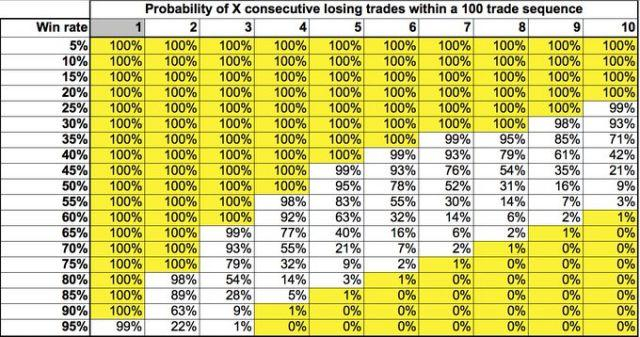
A trading system with a 60% win rate and 40% losing trades has a 1% chance of 10 consecutive losses in 100 trades. If you risk at most 1% of your trading capital per loss, your drawdown will be 10% and you will need about an 11% gain to get back to breakeven. If you risk at most 2% of your trading capital per loss, your drawdown will be 20% and you will need about a 25% gain to get back to breakeven. The worst case is when a trader needs a +100% return just to get back to their starting point after losing half their capital.
Manage your loss rate, your loss per trade and your account recovery rate to give yourself the chance to keep the profits you make in the market and to maintain a stable trading psychology.
Happy trading !
The “Stock Trading For A Living” Course
Green Chart designed this course to give students a solid foundation in fundamental analysis and stock valuation, and to show them how to integrate it effectively into their existing trading system, especially for traders who already use technical analysis. The programme includes five theory sessions and six months of hands-on trading practice in the real market with the lecturer.
See full course details here.