Contents of this article
- The Author, George Charles Selden
- Notable Ideas in the Book
- First, the Speculative Cycle
- Next, Reasoning Backward and Its Consequences
- Those with the Most Say in the Market Are Usually… Silent
- Failing to Judge the Market Objectively.
- Our Thoughts on the Book
- Technical Analysis Course – CMT Level 1
- “Stock Trading For A Living” Course
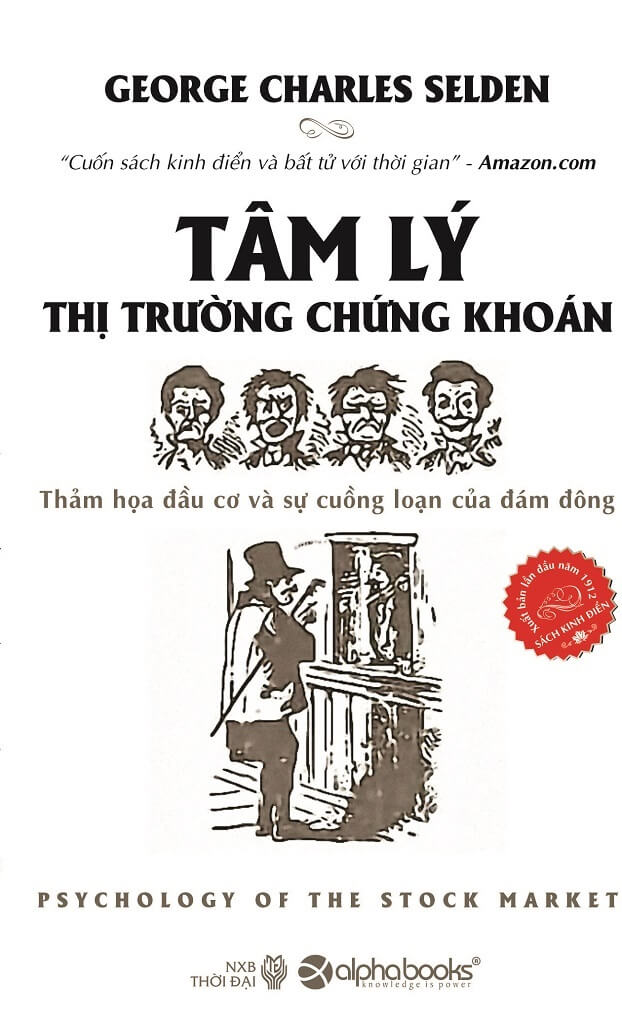
“The Psychology of the Stock Market” was published early, in 1912, yet more than 100 years later it has lost none of its value. The book not only gives readers valuable advice on trading stocks, it also changes how they see crowd psychology in the stock market. As the author observes, once you clearly understand crowd psychology in the market, you can start to discover many interesting things hidden deep within it. “The Psychology of the Stock Market” is one of the best books on the stock market that we value highly and want to recommend to you.

The Author, George Charles Selden

George Charles Selden was a man of many talents. He began as a graduate student and graduated from Columbia University, yet the work he went on to do had little to do with what he had trained in. He worked as a news reporter, as a statistician and as a contributor to the major publication The Wall Street Journal. Through these varied jobs and fields, he built up considerable experience and knowledge of financial markets in general and the stock market in particular. This was one of the reasons behind the writing of “The Psychology of the Stock Market”.
Notable Ideas in the Book
“The Psychology of the Stock Market” is divided into 8 parts:
- The speculative cycle
- Reasoning backward and its consequences
- “They”
- Confusing the present with the future – forecasting
- Confusing the particular with the general
- Panics and booms
- The psychology of the scale order trader
- The psychology of the individual investor
First, the Speculative Cycle
In the first part of “The Psychology of the Stock Market”, the author explains how the market moves and how investors behave. He also points out some of the mistakes retail investors often make, including their illusions about their own worth and about the pile of stocks they are holding.
In this part, the author also raises the most fundamental issue of the stock market, one many investors still do not fully grasp: the fixed supply of shares
Based on the law of supply and demand and the fixed number of shares, the author concludes that for every share bought, a share is sold. This is similar to trading in the foreign exchange market. The amount of money each country issues in a period and circulates in its economy is fixed to match that country’s basket of goods. Any need to issue more money must be weighed and studied carefully for its effects on the national economy. The market is always a tug of war between speculators and investors. Here the author also discusses market movements through the phases of inception, growth, boom and decline. This is a closed cycle, and by using the idea of the speculative cycle the author implies that it repeats itself.
Next, Reasoning Backward and Its Consequences
This part leaves many investors startled, because the author exposes many fatal weaknesses that lead to the disastrous failure of so many investors.
Those with the Most Say in the Market Are Usually… Silent
Excerpt:
“It is hard for an ordinary person to act against popular opinion. In the stock market this is even harder, because clearly, in the long run, stock prices must be determined by the general, prevailing opinion of the public. What we forget is that public opinion in a speculative market is measured in dollars, not in the size of the crowd. The opinion of one man who holds a million dollars’ worth of stock carries five times the weight of five hundred people who each own only a thousand shares. Money is the power of the market – the number of people taking part means nothing at all.”
Failing to Judge the Market Objectively.
Excerpt:
“We find that the ordinary man is always inclined to be optimistic about his own business and pessimistic about the business of others. And of course this rule holds just as true for a professional operator in the stock market. By the same logic, he usually assumes that others are making mistakes and is convinced that his own analysis of the market is right. He values only the opinions of a few people he regards as broadly successful; beyond them, the more he hears that the market will go up, the more he doubts his own wisdom in agreeing with that view.
This contrariness of the market, though easy to understand once its causes are dissected, breeds a rather odd kind of skepticism among professional operators – which is why they often distrust what is obvious and plain, and go against ordinary reasoning when approaching any market question.”
The lesson we draw is to combine our own analysis with the market’s movement exactly as it appears on a chart. Do not try to analyze in the opposite direction of what is actually happening. It will leave your account with heavy losses instead of profits.
- When the market is rising, analyze in the direction of the market’s movement to see how far it may go, and look for entry points to trade long with the market.
- When the market is falling, analyze in the direction of the market’s movement to see how far it may fall, and look for entry points to trade short with the market.
In the later parts of “The Psychology of the Stock Market”, George Charles Selden digs deeper into traders’ pain points, and you will recognize yourself in the author’s every word. To understand it more clearly and deeply, find and read this book now. It holds many surprises for you.
Our Thoughts on the Book

Selden’s book is excellent at showing how thoughts and emotions interact in different ways as the market rises, peaks, collapses and then repeats the process, just as the author predicted.
In a sense, “The Psychology of the Stock Market” is of great value to today’s investors even though it was written so long ago. The large gap in technology and time makes it hard for readers to attribute the psychological drivers it describes to the particular conditions of modern technology or modern thinking.
When you can spot very clear features of what mattered in the first decade of the 20th century, and see that the same factors still dominate in the 21st century, it becomes much clearer what truly matters (in terms of understanding markets). That is one reason why “The Psychology of the Stock Market” tends to endure, while most highly efficient academic theories are discarded.
A slim, easy-to-read book – yet packed with deep insight – “The Psychology of the Stock Market” earns the highest honor we can think of: a place in our exclusive circle of “must-read” trading books.
Advice for investors from “The Psychology of the Stock Market”
- Always keep a sober spirit and a clear head. Avoid acting in haste on unconfirmed information or on gut feeling, and do not trade in sizes so large that you are constantly anxious and end up misjudging the market.
- Act and make decisions based on your own research and judgment, or else rely entirely on someone else.
- When you are hesitant or in doubt, stay out of the market. Better to wait than to lose.
- Try to read the trend of sentiment. Even if at first it runs against what the fundamentals indicate, ignoring it is not a good choice.
Technical Analysis Course – CMT Level 1
Green Chart designed this course specifically for candidates in Vietnam who want to study and prepare for the CMT Level I exam. The program includes 27 sessions of theory, practice questions and mock exams. Students also receive the study materials, question bank and mock exams free of charge to support their exam preparation, and can retake the course for free for life.
See full course details here.
Download the PDF of the book HERE.
“Stock Trading For A Living” Course
Green Chart designed this course to build a solid foundation in fundamental analysis & stock valuation (Fundamental Analysis), while showing students how to integrate it effectively into their existing trading system, especially for traders who already use technical analysis (Technical Analysis). The program includes 5 theory sessions and 6 months of hands-on trading guidance in the live market with the instructor.
See full course details here.