
Contents of this article
Understanding the order types on the stock exchange is essential for getting the best results from your trading. Our goal by the end of this article is to know how to buy or sell exactly the number of shares you want, at the price you want, at the moment you make your trading decision.
To buy and sell on the stock market, there are two methods: order matching on the exchange and negotiated (put-through) trades. Order matching is by far the most common method for individual investors.

How to place buy and sell orders on the stock market
Order matching
Order matching means placing buy and sell orders on the exchange, where trades are executed when buy and sell orders match each other. Put simply, if one person places an order to buy 1,000 HPG shares at VND 57,000 and another places an order to sell 1,000 HPG shares at VND 57,000, the two orders match and the trade is executed. To be more specific, we will go through each order type in detail below.
Essentially, orders fall into 2 main types: buy orders and sell orders. These are divided further into several sub-types that specify the order’s variables.
Order matching follows the principle of price priority, then time priority.
- Price priority: buy orders at higher prices always take priority over buy orders at lower prices, while sell orders at lower prices are matched before sell orders at higher prices. This simply reflects human nature: everyone wants to buy as cheaply as possible and sell as high as possible, so buyers willing to pay more get priority, and vice versa.
- Time priority: at the same price, the order placed first is matched first.
Limit orders (LO)
An LO (limit order) is an order with 2 variables: price and quantity.
Examples of limit orders:
- Buy 3,000 TCB shares at VND 60,000.
- Sell 2,000 VNM shares at VND 90,000.
It is called a limit order because it sets a limit. In the first example, the order says you want to buy TCB at a maximum of VND 60,000. If someone sells the stock at VND 60,000 or less, you agree to buy and the order is matched. If someone else is selling TCB at VND 61,000, your order will not be matched with them. It is like going to buy an iPhone 13 Pro Max with VND 50 million in your wallet: you cannot buy it from any shop selling it for VND 50.5 million or VND 51 million, only from a shop selling it for VND 49 million or VND 49.5 million.
Sell orders work the same way. In the second example, the order says you want to sell VNM at a minimum of VND 90,000. You will sell to anyone willing to pay your price or more, and not to anyone offering less.
So when you place a limit order, it may be matched immediately if there is a matching order on the other side, or it will sit in the queue of pending orders if there is not. As I explained in the section on the price board, pending limit orders are shown in the Bid and Ask (best bid / best offer) columns of the price board.

Take the price board below as an example. In the Bid column for AAA, you can see that bid price 1 is VND 16,100 with a volume of 102,500 shares. This means that among all pending limit buy orders, the highest price is VND 16,100. The total volume of all limit buy orders at this price is 102,500 shares; note that this is the combined volume of many buy orders, not a single order for 102,500 shares. Likewise, in the price 2 and volume 2 columns, at VND 16,050 there are many pending buy orders totalling 94,500 shares. Price 2 is the second-highest price among all pending buy orders. Price 3 is the third-highest price among pending buy orders, VND 16,000 in the picture, with a total pending buy volume of 141,200 shares.
Similarly, in the Ask column, among all pending limit sell orders the lowest price is VND 16,150, shown as price 1, with a pending sell volume of 33,500 shares. Above that are price 2 and price 3, as shown in the picture.
Clearly, bid price 1 is always lower than ask price 1, because otherwise these orders would all be matched and would not appear in the Bid and Ask columns (which show pending orders). Moreover, under the matching priority rules, buy and sell orders at price 1 are always matched first.
Now let’s consider what happens when a new limit order is placed on the exchange: how it will be matched and how the price board will display it.
Buy 10,000 shares at VND 16,150: Since there are already sell orders at VND 16,150 on the exchange, your buy order is matched immediately against them. The pending sell volume then falls by 10,000 shares. In addition, your matched order will immediately show up in the Matched column in the middle of the board.
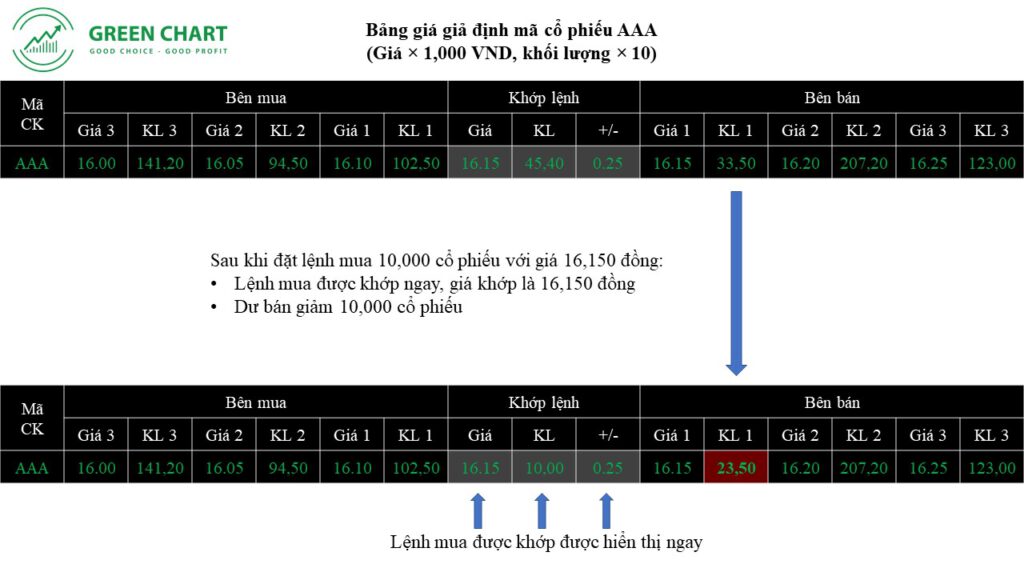
Buy 10,000 shares at VND 16,200: Your order is also matched immediately, at a price of VND 16,150, lower than the price you set. The matching sell orders are those at VND 16,150. This makes sense: your buy order says you are willing to buy at VND 16,200 or less, and sell orders at price 1 take priority.
Buy 10,000 shares at VND 16,100: There are no sell orders at this price yet, so your order is not matched and goes into the pending queue. The bid volume at price 1 increases by 10,000 shares. If an investor later places a sell order at VND 16,100, your order will be matched (once the earlier buy orders at the same price have been matched, because of time priority).Buy 10,000 shares at VND 16,050: As above, this buy order is not matched immediately, and the bid volume at price 2 increases by 10,000 shares. This order has lower priority than buy orders at price 1.
Sell 10,000 shares at VND 16,100: This order is matched immediately because there are already pending buy orders at this price.

Sell 10,000 shares at VND 16,000. The order goes into the pending queue because there are no buy orders at this price yet.
So you can see that a limit order placed on the exchange is matched immediately if:
- Buy order: order price > ask price 1
- Sell order: order price < bid price 1
Buy and sell orders like these are called active buy orders or active sell orders. In all other cases, your order goes into the pending queue. Pending orders are only matched when an opposing order arrives at the same price.
When an order is matched, there are two possibilities: it is filled in full or partially filled. The order is filled in full if the opposing sell orders have enough volume to cover your buy order. It is partially filled if the volume of opposing sell orders is less than the volume of your order.
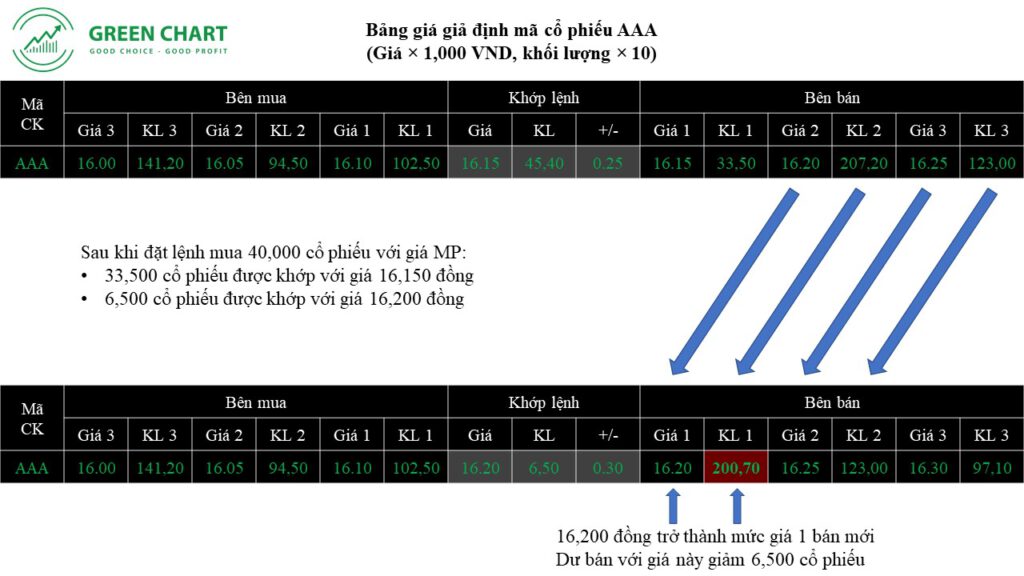
For example, as I just showed, an order to buy 10,000 shares at VND 16,150 will be filled in full. But if we place an order to buy 40,000 shares at VND 16,150, it will only be partially filled, because the opposing sell orders at that price total only 33,500 shares, not enough to cover the buy order. The matched volume for this order will therefore be 33,500 shares, and the remaining 6,500 shares will sit in the pending queue.

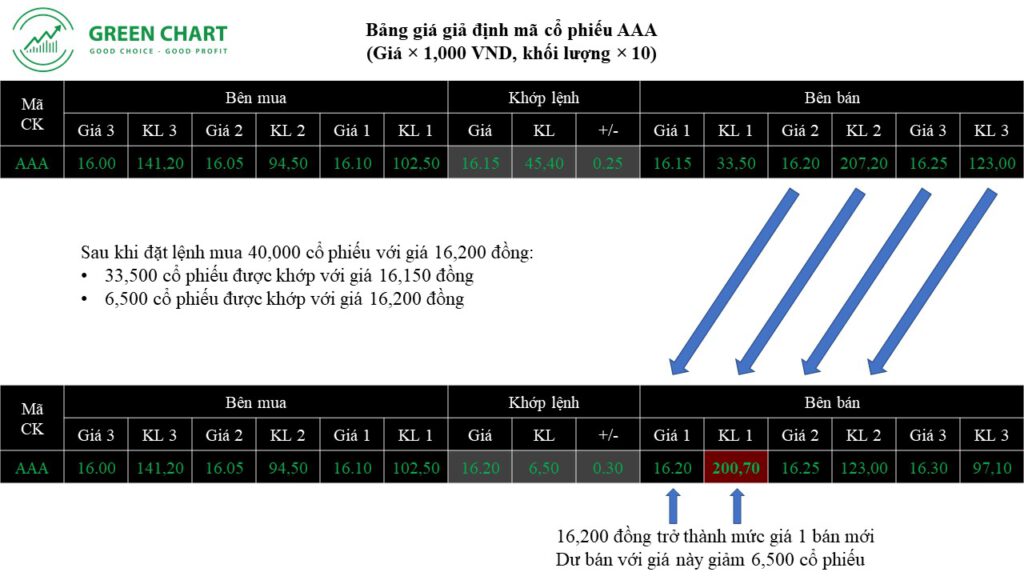
In another case, an order to buy 40,000 shares at VND 16,200, the matching works slightly differently. First, 33,500 shares are matched at VND 16,150, then the remaining 6,500 shares are matched at VND 16,200.

On trading platforms, placing a limit order is very simple. Go to the order entry screen and fill in the order details: buy or sell, ticker, quantity and price. The system treats it as a limit order by default.
Market orders (MP)
An MP (market price) order is an order to buy or sell at the best price available in the market. Unlike a limit order, it has only one variable, quantity, and it is matched immediately (except in special cases).
Note that MP orders are only available on HOSE; HNX and UPCoM do not have this order type. In addition, MP orders can only be placed during the continuous matching session.
Examples of MP orders
- Buy MP 4,000 STB shares
- Sell MP 1,000 VJC shares
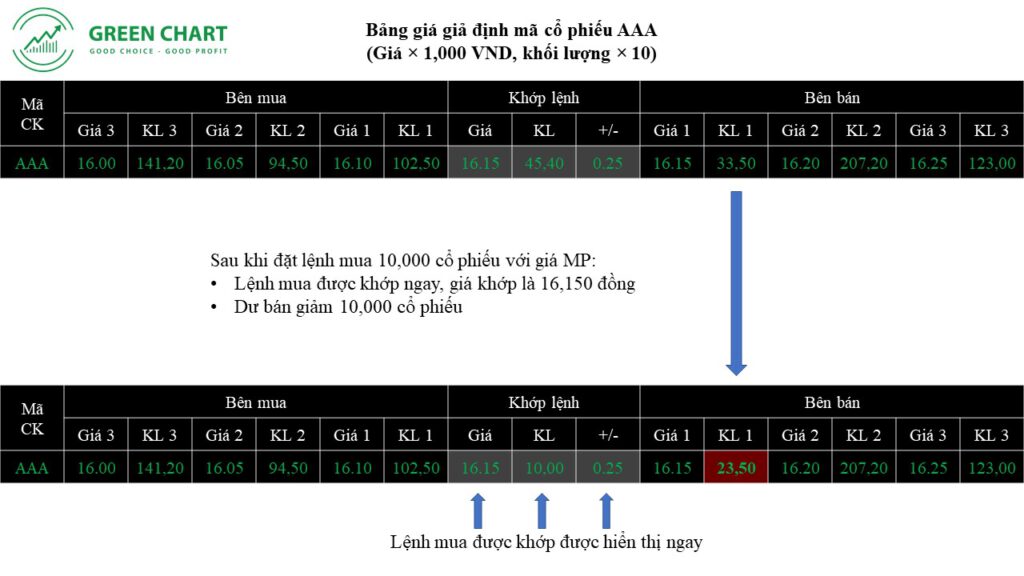
When you place an MP order, you want to buy or sell the stock immediately at the best market price at that moment. For a buy order, the matched price will be ask price 1; for a sell order, it will be bid price 1. An MP order is always an active order.
Continuing the example above, I place an MP order to buy 1,000 AAA shares. I will buy immediately at VND 16,150, the lowest ask price.
An MP order is like being determined to buy an iPhone 13 Pro Max at any cost as a gift for your girlfriend on Vietnamese Women’s Day (20 October). You check the prices at every shop selling the phone and buy from the one with the lowest price.
If I place an MP order to sell 1,000 AAA shares, I will sell immediately at bid price 1, VND 16,100.
If the volume at price 1 is not enough to fill the MP order, the rest of the order continues to be matched at price 2, then price 3, and so on. If the order cannot be filled in full and is only partially filled, the remainder is converted into a limit order one tick higher.
For example, if you place an MP order to buy 40,000 AAA shares, you will first be matched for 33,500 shares at VND 16,150; then, once those pending orders are used up, the remaining 6,500 shares are matched at price 2, VND 16,200.
Or take MCP stock, with the price board shown in the picture, where you place an MP order to sell 2,000 shares. Since total bid volume is only 1,000 shares, your order cannot be filled in full. The 1,000 unmatched shares are converted into a limit order one tick lower, here VND 26,050, below the lowest matched price of VND 26,100.
A special case is when a stock has no buyers or no sellers at all (no pending buy or sell orders, which usually happens when the stock is at its ceiling or floor price). In this case, you cannot place an MP order, and the system will return an error if you try.
MOK orders
An MOK (match or kill) order is a market order on HNX that must be filled in full or cancelled. It has only one variable, quantity, and once you place it there are only 2 outcomes: filled in full or not filled at all.
If the order quantity exceeds the total pending volume on the opposite side, the order is not matched and no trade takes place. Otherwise, it is matched in the same way as an MP order.
The HNX price board has two extra columns showing total bid and ask volume, as in the picture, so you can tell whether your MOK order will be matched.

Take GDW stock as shown in the picture. If you place an MOK order to buy 5,000 shares but the ask volume is only 2,100 shares, your order will not be matched. If you place an MOK order to buy 1,000 shares, it will be filled in full, matched in the same way as an MP order.
MAK orders
An MAK (match and kill) order is a market order on HNX that is filled as far as possible and the rest cancelled. It has only one variable, quantity, and differs slightly from the MOK order above.
If the order quantity exceeds the total pending volume on the opposite side, the order is partially filled and the remainder is cancelled (this is the difference from an MOK order). Otherwise, it is matched in the same way as an MP order.
Continuing with GDW as shown in the picture: you place an MAK order to buy 5,000 shares, but the ask volume is only 2,100 shares, so you are matched for 2,100 shares, following the same matching rules as the MP order I just described. The 2,900 unmatched shares are cancelled.
MTL orders
An MTL (market to limit) order is a market order on HNX. It has only one variable, quantity, and behaves like an MP order. If an MTL order is not filled in full, the remainder is converted into a limit order at the same price. This is where it differs from an MP order, whose remainder is converted into a limit order one tick higher or lower.
Suppose you place an MTL order to buy 1,000 GMA shares as shown in the picture. The ask volume is 500 shares, so you are matched for those 500 shares. The 500 unmatched shares are converted into a limit order at VND 62,000, equal to the highest matched price.

PLO orders
A PLO (post limit order) is used in the after-hours matching session on HNX. In this session the closing price has already been set, so investors can only trade at that day’s closing price. The matched price of a PLO order is therefore always the closing price from the same day’s ATC session. The order has only one variable, quantity.
Matching in this session is very simple. PLO buy orders are matched against PLO sell orders, at the ATC price. An order may be filled in full immediately, partially filled, or left pending.
During the PLO session, the price board only shows pending PLO bids and asks. For example, in the picture below, for SHS during the PLO session you can see 6,100 shares pending on the bid side at the PLO price. The PLO price is the ATC price, shown here in the Matched column in the middle as VND 36,500.
If you place a PLO order to sell 2,000 shares, it will be matched immediately because there are already opposing buy orders. If you place a PLO buy order, it will not be matched yet and will show up in the pending queue.

ATO and ATC orders
How matching works in the ATO and ATC sessions
These two order types are used in the periodic (call auction) matching sessions: the opening session (ATO, at the opening) and the closing session (ATC, at the close). Traders can also place limit orders during these sessions.
In the continuous matching session, when opposing buy and sell orders appear, they are matched immediately and the trade takes place. In the periodic matching session, this is not the case. At a given moment you may see buy and sell orders at the same price, yet neither is matched. As the session’s name suggests, orders placed during this session are not matched immediately, but only at a single point in time: the end of the session.
During the session, orders are placed on the exchange, and the matching price is then set at the level where the largest volume of buy and sell orders meet. This is called the ATO or ATC price, depending on which session it occurs in.
Let’s go through the example below to see clearly how matching works in this session.
Take AAA stock in the ATC session, and suppose 10 people place orders during the session, as in the table below:

Obviously, these orders are not matched during the session and are only matched at the end. So what will the matching price be at the end of the session?
For example, if the matching price is VND 16,200, buy orders at VND 16,200 or higher will be matched, and sell orders at VND 16,200 or lower will be matched. In the example above, the total buy volume meeting this condition is 5,000 shares, while total sell volume is 10,000 shares, so the matched volume in the ATC session would be 5,000 shares if the matching price were VND 16,200.
For other possible matching prices, we get the table below.
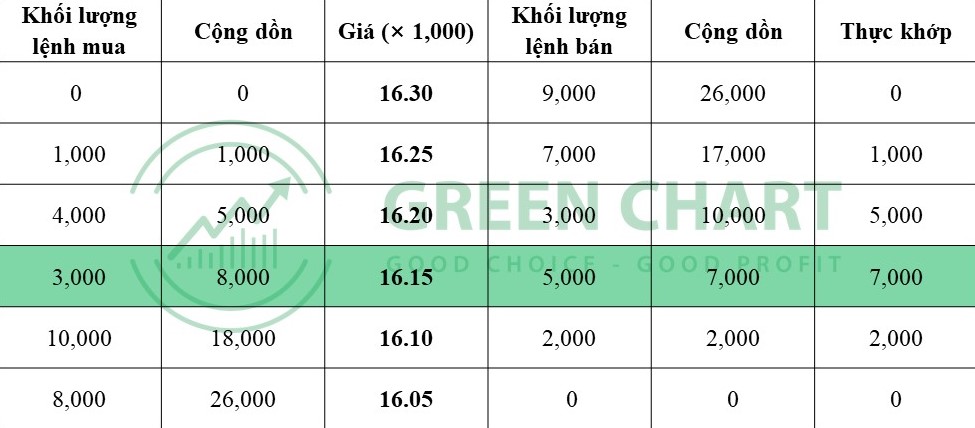
At VND 16,150, the largest volume of buy and sell orders meet, so this becomes the matching price, i.e. the ATC price, and the matched volume is 7,000 shares.
ATO and ATC orders
In the example above, I assumed all orders placed were limit orders. In practice, traders can also place ATO and ATC orders during the periodic matching sessions. These orders have only one variable: quantity.
An ATO or ATC order says you want to buy or sell the stock at any price in the opening or closing session. These orders therefore take priority over ordinary limit orders.
Trading hours and order placement
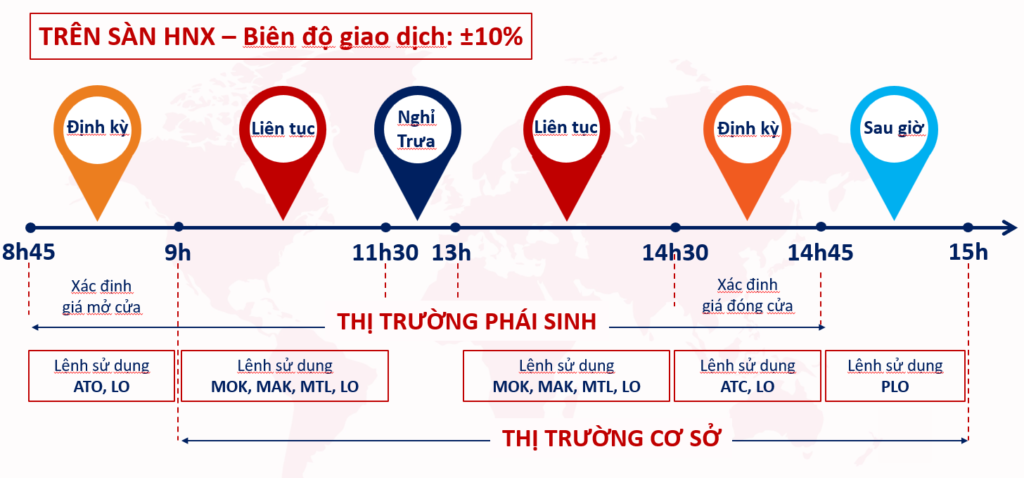
The Vietnamese stock market is open from 9:00 to 15:00, Monday to Friday, except public holidays. Each trading day is divided into smaller sessions; the way trading works differs between sessions, as do the order types allowed. The tables below show trading hours and the permitted order types in detail.

Rules for amending and cancelling orders
Matched orders certainly cannot be changed. So before placing an order, especially MP, MAK, MOK and MTL orders, think it through carefully. Some pending orders can be amended or cancelled.
During periodic matching sessions, orders cannot be amended or cancelled.
During the continuous matching session, HNX and UPCoM let you cancel orders as well as amend them (price and quantity). HOSE only lets you cancel orders, so the indirect way to amend an order is to cancel it and place a new one. This changes your time priority, whereas on HNX and UPCoM, time priority is not affected when an order is amended.
PLO orders cannot be cancelled or amended.
Happy trading!
The “Stock Trading For A Living” course
Green Chart designed this course to give students a solid foundation in fundamental analysis & stock valuation (Fundamental Analysis), and to show them how to integrate it effectively into their existing trading system, especially for traders who already use technical analysis (Technical Analysis). The program consists of 5 theory sessions and 6 months of hands-on guided trading in the live market with the lecturer.
See full details of the course here.