
Contents of this article
How do you buy and sell odd lots of shares on the stock market? This is a question many new investors ask as they start trading. Let’s find out in the article below
How to buy and sell odd lots of shares
What are odd-lot shares?
Odd lots are share holdings smaller than one board lot as defined by each exchange (the board lot is currently 100 shares). Odd lots arise from stock dividends, stock splits, bonus share issues or the exercise of subscription rights.
Odd-lot rules in the Vietnamese market
Since 2021, the SSC has applied a common rule across all 3 exchanges, HOSE (HSX), HNX and UPCoM, with a uniform board lot of 100 shares. Investors must therefore trade at least 100 shares, or multiples of 100, in each order. At the same time, under the direction of the Ministry of Finance, the Ho Chi Minh City Stock Exchange is working to reinstate trading in lots of 10 shares as soon as possible.
Buying odd lots on HNX – UPCoM
Placing an odd-lot buy order works the same way as placing a normal buy order, and orders are executed through both continuous matching and negotiated trades. You can follow liquidity and odd-lot buy and sell orders on HNX – UPCoM on a separate price board:
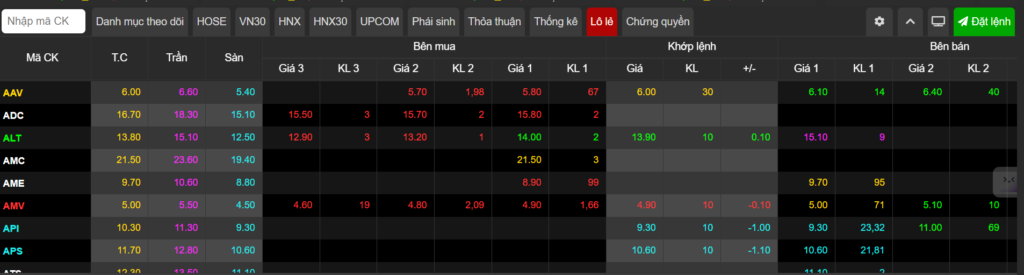
Odd-lot price board
Today, as technology develops, trading apps offer ever better services and features, giving investors plenty of options when buying odd lots. You can place orders yourself through your brokerage firm’s online platform, place orders through your account manager or the call centre, or, more time-consuming but more certain, go to the brokerage firm in person to make the trade.
Settlement for matched odd-lot orders works the same way as for normal orders. Note that odd-lot trading is not allowed on the first trading day of a newly listed stock, or on the first day a stock resumes trading after a suspension of 25 days, until a closing price has been established.
HOSE (HSX) now also has rules on trading odd lots of fewer than 100 shares, similar to HNX.
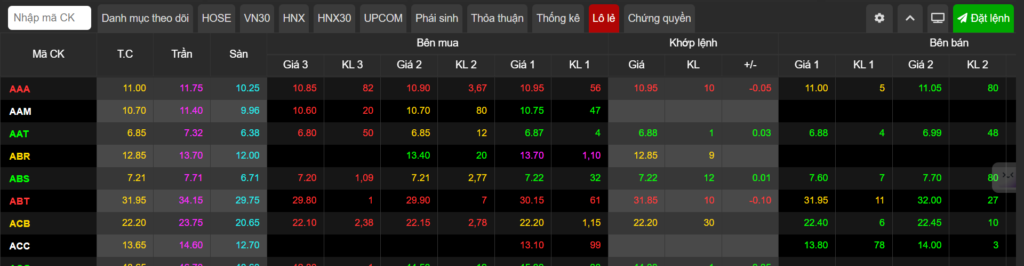
HOSE odd-lot price board
For odd-lot buybacks, each brokerage firm has its own list of stocks it will buy back, published on its main website, so investors should check the odd-lot buyback list of the brokerage firm they trade with. The information investors need to be sure of when selling odd lots includes: the execution period, how the trade value is determined, the settlement date and the trading method.
Buying and selling odd lots with VPS’s FS orders:
This standout feature from VPS lets domestic investors place buy and sell orders for any amount of money or any number of shares, with no minimum trade amount or volume.
How to trade with FS orders:
Go to “Stocks” => choose “Buy”/”Sell” => select the FS order type and enter the amount or quantity you want to buy or sell => finally, press “Confirm order”
Example of a buy order for HPG:
A client wants to buy VND 9,500,000 worth of HPG stock at VND 51,000 per share.
- The system works out that the client can place a normal order for 100 shares at that price
- The remaining money (9,500,000 – 100 x 51,000 = VND 4,400,000) is matched as an FS order at the MP price
(The calculated quantity includes fees and taxes.)
Example of a sell order for VNM:
A client places an FS order to sell VND 1,000,000 worth of VNM stock from their portfolio.
- The system calculates that this is 11.86 shares at the MP price
- The order is queued until it adds up to a full board lot and is then sent to the exchange
(The calculated quantity includes fees and taxes)
FS orders can be used on all exchanges: HOSE (HSX), HNX and UPCoM. For odd-lot trading on HNX/UPCoM using FS orders, you can turn this feature ON/OFF (via the settings icon in the top right corner) as needed:
- ON: HNX/UPCoM odd-lot orders are automatically handled under the FS order mechanism
- OFF: HNX/UPCoM odd-lot orders follow the exchange’s standard odd-lot order rules
Happy trading!
The “Stock Trading For A Living” course
Green Chart designed this course to give students a solid foundation in fundamental analysis & stock valuation (Fundamental Analysis), and to show them how to integrate it effectively into their existing trading system, especially for traders who already use technical analysis (Technical Analysis). The program consists of 5 theory sessions and 6 months of hands-on guided trading in the live market with the lecturer.
See full details of the course here.