
Contents of this article
- 1. Stick to your trading strategy
- 2. Accept that the market is random
- 3. Evaluate your trading performance
- 4. Beware of “experts”!
- 5. Face your losses
- 6. Do not be greedy
- 7. Accept that you were wrong
- 8. Be decisive with your trading strategy
- 9. The market is infinite
- 10. Keep your emotions in check
- 11. I can do it!
- Technical Analysis course – CMT Level 1

Trading is very easy to start: you just open a brokerage account and deposit money. Trading profitably, however, is another matter, and statistics show it is far from easy for more than 90% of retail traders. Choosing good habits and a sound investment mindset from the very beginning is what separates the winners from the losers.
1. Stick to your trading strategy
In business, owners constantly analyse their company’s profitability in order to set future strategy and drive even faster growth. Trading is no different.
You have spent hours, weeks, even months researching a trading system, and it seems to give you a fairly high win rate of 60%. Of course, because the market is random, your first 10 trades will not always follow the 6-right, 4-wrong pattern; sometimes you may well get all of the first 10 wrong. Seasoned traders understand that probabilities only play out over the long run, once you have made a large enough number of trades, as long as your trading system and analysis are genuinely logical.
New traders, however, make what seems the more sensible choice: re-analysing, fixing and optimizing their trading system. That is a normal human reaction to protect yourself, especially when the money in your account comes from your own hard work. But this behaviour is actually a trap: however well optimized a trading system is, it only has a certain probability of being right, and it cannot escape the laws of losing streaks (I will cover this in more detail in another article). What you need is to give your trading system enough time and opportunity to prove itself.
I am not telling you to stop “learning”. Learn everything you can, but distil what you learn into the trading strategy that suits you best, then be patient and disciplined with it.
2. Accept that the market is random
Have you ever felt that you did everything right and considered almost every angle to predict the market’s next move, yet the result was not what you expected? Sometimes the market will follow your analysis, and that feels comfortable. But there will be many times when the market follows nothing at all. That is Mr. Market.
The longer you trade, the more you will realize that your analysis exists only in your head, and nothing will happen if nobody else in the market thinks the way you do. Only when the market is in tune with you will price move the way you expect. Drop the thought “I have analysed everything logically, so the market must move this way”; instead, understand that it is all a game of probabilities.
3. Evaluate your trading performance
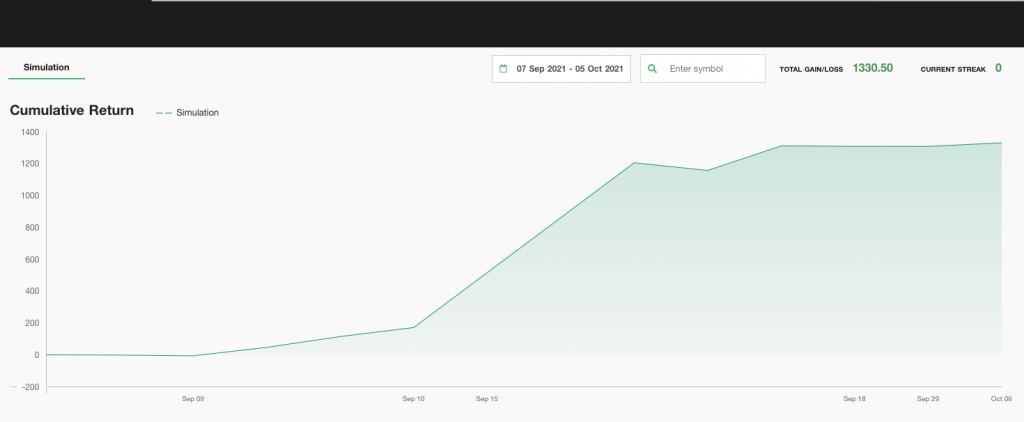
New traders often spend a lot of time analysing each trade, looking for what went wrong in their losing trades and changing their method, perhaps by improving how they place stops or by switching to a different moving average. This can be useful, but it can take a heavy toll on your trading psychology.
Experienced traders usually care little about each small loss. They pay more attention to profitability over the whole process. They do not focus too much on losing a single trade; what matters more to them is how much profit they have made after a month, a quarter or a year. To do this, we need to build a chart that tracks our returns.
4. Beware of “experts”!
In today’s age of the Internet and social media, you have probably come across posts like this on Facebook.
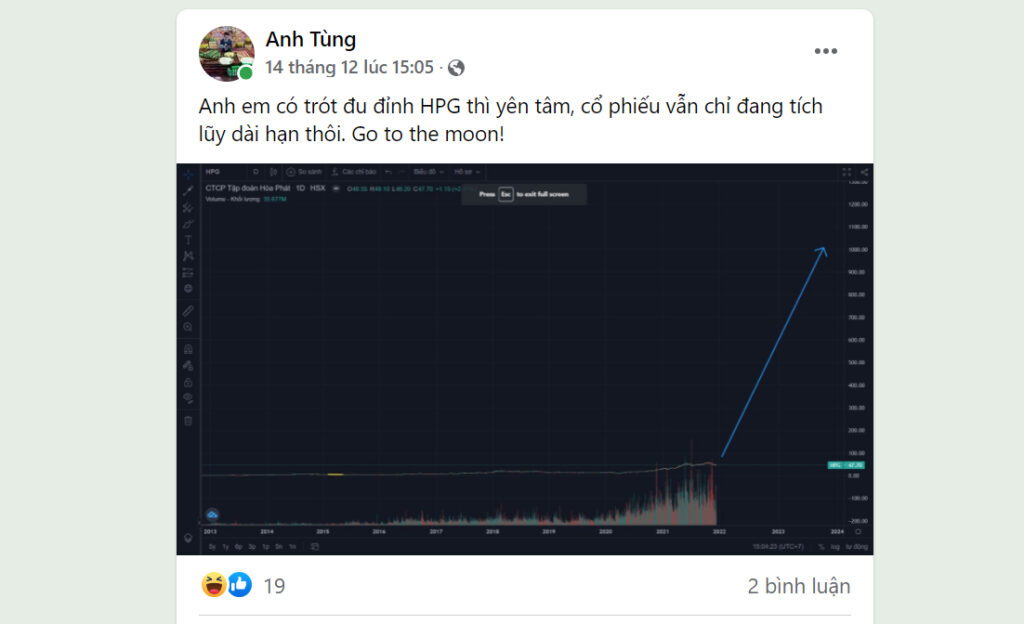
Posts like this on social media may come from people who genuinely know what they are talking about, or from people with little real knowledge who call themselves “experts”. So be genuinely wary of them.
Setting the negatives aside, you can listen to genuine experts and learn from their perspectives, but even the best of them disagree with one another. So you also need your own view and to keep control of your own path as a trader.
If you feel confused by the flood of social media posts and are afraid they will affect your trading plan, the best thing to do is stop following stock forums and pundits and stick to your own trading strategy. I am not stopping you from learning or reading other people’s views, but if you are not strong enough to defend your own opinions, leaving social media is the best option. You are better off spending your time learning real, highly practical knowledge that helps you plan and build your own trading ideas.
5. Face your losses
Have you ever sold a stock as soon as you saw it dip, before price had even hit your stop-loss? If so, what was the point of setting a stop-loss?
Perhaps you felt the stock was not moving the way you expected, and you wanted to close it out (even though it had not hit your stop) before things got worse. This is a psychological behaviour many people fall into. Reducing your position size so the amount at risk at your stop-loss is acceptable, and being comfortable with unavoidable losses, is the formula of successful traders.

6. Do not be greedy
We have talked about cutting losses. What about taking profits?
You buy a stock currently priced at VND 50,000; by gathering and assessing its financial information, you estimate its true value could reach VND 60,000. Of course you should buy: a 20% return is very attractive, isn’t it?
A few days later, the stock jumps and reaches VND 60,000 very quickly, hitting the target in your trading strategy. But because it has risen so fast, you think, “buying pressure is still strong, let’s hold on and see.” At this point you start getting greedy, hoping the stock can reach VND 70,000 or 80,000, and you keep holding. The figure you are hoping for is illogical (because you have no solid reasoning to support it), so it seems almost impossible. In the end, the stock turns around and, instead of a profit, you even have to cut your loss.
Stay true to your trading strategy and do not get greedy without good reason. Know when to take profits and look for new trading opportunities in other stocks.
“If you don’t take your profits, someone else will take them for you.”
7. Accept that you were wrong
Remember, the market is completely random, so when you lose, accept that you were wrong.
For example, if you set your risk–reward ratio at 1:3, stick to it absolutely. Because this ratio demands a large profit, you will certainly have more losing trades than winning ones. But as long as your winning trades hit the profit you planned (three times the risk), your trading system is fine. You will accept small losses and correct course on new trades, instead of stubbornly holding on to losing positions.
More importantly, you will start to think of the market as a game of probabilities. You will always have an X% probability of winning and a (100 – X)% probability of losing. As long as you maintain a positive expectancy, you will win in the market.
8. Be decisive with your trading strategy
Let me stress it once again: trading is a game of probabilities. As we discussed earlier, losses can hurt. The reason you always hesitate just before entering a trade is that you are not managing risk properly, or you have broken your own rules.
The market does not care if you have just lost a lot of money. It will do whatever it wants, and you never know when you will lose.
The market always keeps us on edge. It is like a first date with someone you really like: however carefully you prepared at home, you can still end up tongue-tied when you are face to face. Have you ever analysed a stock exactly according to your trading system and been sure it was a good buy point? In reality, you often feel uncertain, constantly asking yourself whether your analysis is right, what if the stock falls tomorrow, and so on.
If your system gives a valid buy signal, buy, and set your stop-loss and take-profit exactly according to your trading plan. Act decisively and accept the risk. Otherwise, you will put yourself under needless stress.
9. The market is infinite
If you have read Market Wizards by Jack D. Schwager, you will know it is a book about traders who have made enormous profits over many years. Many of them turned a few thousand US dollars into hundreds of millions. What these traders have in common is that they always stick rigidly to their trading strategies. More importantly, they do not set profit targets for themselves (such as making 20% a year).

They have their own trading systems and follow their rules. They let the market do whatever it wants. If their trading system gives no buy signal, they wait patiently until one appears. Discipline is essential to stop the market’s randomness from affecting your trading psychology.
10. Keep your emotions in check
Never become so proud of yourself after a winning streak that you ignore your trading rules. Do not let your emotions affect your trading system; this will help you master your own trading psychology.
Conversely, do not get too discouraged when you lose. At such times, read books, review your trading journal and seek advice from an expert to see what you can adjust in your trading strategy if it has gone off the rails. Treat losses as part of the game, not as a threat.
11. I can do it!
Finally, you can only enjoy the feeling of winning if you truly have an optimistic spirit. Always carry this positive energy into every trade. Do not give up whenever you fail; get back up and keep believing in your trading strategy, and you will succeed.
Technical Analysis course – CMT Level 1
Green Chart designed this course specifically for candidates who want to study and prepare for the CMT Level I exam in Vietnam. The 28-session programme covers theory, practice questions and mock exams. Students also receive free course materials, question banks and mock exams for their exam preparation, plus free lifetime retakes of the course.
Find out more about the course here.
Happy trading!