
Contents of this article
- What is a warrant?
- Key terms of a covered warrant
- How to calculate a warrant’s profit or loss at expiration
- Exercising the warrant
- What is the warrant conversion ratio?
- What factors affect a warrant’s price?
- What are the benefits and risks of trading covered warrants?
- Benefits of trading warrants
- Risks of trading warrants
- What is a warrant worth? Valuation with the Black-Scholes model
- Underlying stock price
- Remaining term
- Implied volatility
- How to trade warrants
What is a warrant?
A warrant is a stock options contract that gives the holder the right (but not the obligation) to buy or sell a stock at a predetermined price on a predetermined date; it is usually issued by the company whose shares are the underlying. In Vietnam, the covered warrant (CW) is a type of call warrant but, unlike a conventional warrant, a CW (covered warrant) is issued by securities companies. From here on, unless otherwise noted, I will simply call it a CW or a warrant.

Key terms of a covered warrant
Like any other options contract on the market, a covered warrant must specify the following five basic terms:
- Warrant type: There are two main types of warrants: call warrants, which give the holder the right to buy the stock, and put warrants, which give the holder the right to sell the stock. In Vietnam, only call warrants exist at present.
- Underlying security: the stock used as the underlying asset of the warrant, which defines what the warrant holder has the right to buy.
- Strike price: the price at which the underlying stock changes hands when the warrant is exercised. The strike price is fixed at the time the warrant is issued.
- Conversion ratio: the ratio at which warrants convert into shares on exercise; for example, 2 CWs for 1 share.
- Maturity: the period from issuance to expiration.
There are also several additional terms that describe a warrant more fully:
- Issue date: the date the securities company issues the warrant and investors can start subscribing in the primary market.
- First trading day: the date the warrant starts trading in the secondary market, where investors buy and sell among themselves. The first trading day is not necessarily the issue date.
- Expiration date: on this day traders exercise (or do not exercise), after which the CW expires completely.
- Last trading day: two business days before the expiration date. After this day, no investor can buy or sell the warrant on the market. The rule exists because of T+2 settlement on the Vietnamese stock market.
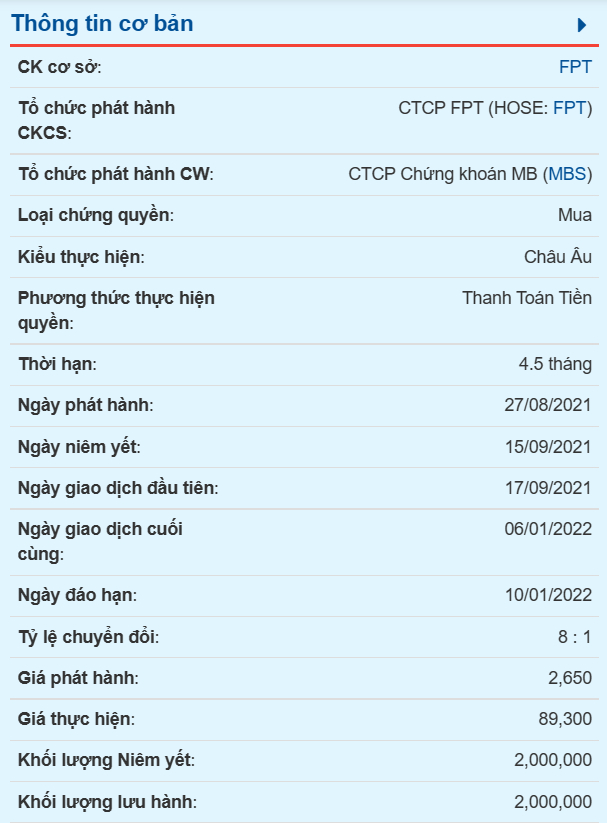
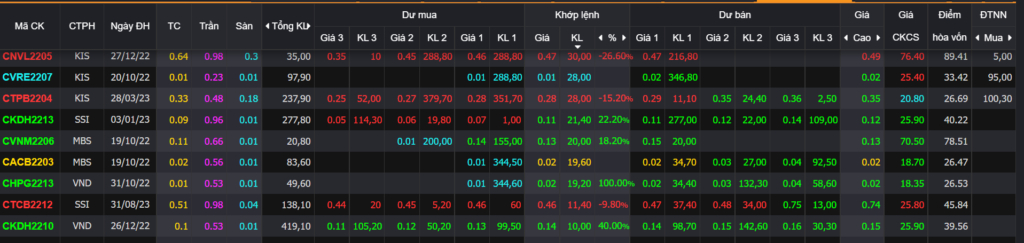
- Warrant symbol: HOSE specifies the format “CXXXYYZZ”, where XXX is the ticker of the underlying stock, YY is the year of issue and ZZ distinguishes warrants with the same underlying and year of issue. For example, CFPT2106 is a warrant on FPT stock issued in 2021. The number 06 distinguishes it from other warrants of the same kind, such as CFPT2104 and CFPT2105.
- Exercise style: explained in more detail below.
- Settlement method: explained in more detail below.
- Issue volume: the total number of warrants the securities company issues in one offering.
- Outstanding volume: the total number of warrants circulating freely on the market. A securities company may not sell all the CWs it issues.
How to calculate a warrant’s profit or loss at expiration
Exercising the warrant
Covered warrant holders can choose whether or not to exercise, unlike VN30 futures contracts, where buying or selling is mandatory at expiration. Warrants in Vietnam are European style (European options): they can only be exercised on the expiration date.
If the trader chooses not to exercise, the covered warrant expires worthless, and the holder loses nothing beyond the amount originally paid for it.
If the trader exercises under traditional physical settlement, the holder buys the underlying stock from the warrant issuer at exactly the strike price. However, under cash settlement, as used in Vietnam, the holder is assumed to buy the stock at the strike price and immediately sell it at the settlement price, and simply receives the gain (or pays the loss) on the price difference from the issuer. The amount the issuer pays you is therefore (Settlement price – Strike price).
The settlement price is defined as the average price of the last five sessions before the expiration date.
What is the warrant conversion ratio?
Naturally, to get the best result, a holder only exercises when the settlement price exceeds the strike price; otherwise, they do not exercise.
Example: a covered warrant on stock ABC is priced at VND 10,000 per CW, with a conversion ratio of 4:1 and a strike price of VND 50,000. You own 200 CWs, which convert into 50 shares on exercise. If:
- The settlement price of ABC is VND 100,000, you receive (100,000 – 50,000)*50 = VND 2,500,000. Subtracting the VND 200*10,000 = 2,000,000 you paid for the CWs, you make a profit of VND 500,000.
- The settlement price of ABC is VND 40,000: exercising would lose money, so you do not exercise. Your loss is limited to the amount you originally paid (VND 2,000,000).
- The settlement price of ABC is VND 70,000, you receive (70,000 – 50,000)*50 = VND 1,000,000. Subtracting what you paid for the CWs, you end up with a loss of VND 1 million. Even though you are losing, you should still exercise, because otherwise your loss would be larger: VND 2 million.
The higher the settlement price, the larger the difference and the larger the profit. The relationship between the settlement price and profit therefore looks like the chart below.

As the example and the chart show, exercising a CW is profitable only if the settlement price exceeds the strike price by enough to recover what you originally paid for the CW. The lowest settlement price that guarantees you a profit is called the break-even point. Following the logic above, the break-even point is calculated as:
SBE = X + qc0 (where SBE is the break-even price, X is the strike price, q is the conversion ratio and c0 is the CW price when you bought it).
In other words, when you buy a CW, you should expect the underlying stock price to rise above the break-even point.
What factors affect a warrant’s price?
| When factor … rises | Call option price | Put option price |
| Underlying security price | Rises | Falls |
| Strike price | Falls | Rises |
| Time to expiration | Rises | Rises |
| Volatility | Rises | Rises |
| Interest rates | Rises | Falls |
What are the benefits and risks of trading covered warrants?
Benefits of trading warrants
In the warrant market, traders seek profit in one of two ways: by exercising the warrant, or by trading it to capture price differences.
Essentially, when the price of the underlying stock rises, the price of a call warrant rises (because exercising becomes more profitable), and vice versa. Traders can use this property to trade warrants and profit from price changes.
To own a warrant, you need to buy it on the market at its premium. You can then exercise it when it is profitable to do so. Otherwise, you are free not to exercise. The maximum loss when you are long a warrant is therefore the premium; in other words, the risk of a warrant is limited.
Compared with the underlying stock, a covered warrant usually costs far less. This lets you speculate on the trend of the underlying stock with much less money while still benefiting from its price changes. In other words, a covered warrant is a leveraged instrument.
Let us try an example. Investor A buys one share at VND 50,000 and holds it for six months. Investor B buys a CW on the same stock at VND 10,000, with a strike price of VND 50,000, a 1:1 conversion ratio and a six-month term, and holds it to expiration. I will compare the two investors’ returns under different scenarios after six months.
| Stock price after 6 months (VND) | Investor A profit (VND) | Investor A return | Investor B profit (VND) | Investor B return |
| 100,000 | 50,000 | 100% | 40,000 | 300% |
| 70,000 | 20,000 | 40% | 10,000 | 100% |
| 55,000 | 5,000 | 10% | -5,000 | -50% |
| 35,000 | -15,000 | -30% | -10,000 | -100% |
| 20,000 | -30,000 | -60% | -10,000 | -100% |
As you can see, the warrant’s return is much higher than the underlying stock’s, while the risk is always capped at VND 10,000. The constraint here, however, is time. We will analyse this more closely with the model below.
Risks of trading warrants
Leverage risk: leverage is a double-edged sword. Buying a large number of covered warrants can greatly increase your profit when you are right but, conversely, leverage can wipe out your net worth when the warrant price moves against your expectations.
Liquidity risk: the covered warrant market in Vietnam is still at a very early stage, and many stock market investors have not yet been exposed to, or fully understood, the concept and how warrants are traded. As a result, investors may find it hard to trade (buy and sell) covered warrants because market liquidity is very thin.
Price volatility risk: covered warrant prices swing far more than those of the underlying securities, because warrants are currently not subject to a daily price limit the way the underlying securities are.
What is a warrant worth? Valuation with the Black-Scholes model
Like other financial assets, covered warrants are traded on an organized exchange, so they also have a market value (called the premium). Covered warrants are first issued by securities companies and sold in the primary market through subscription; at that stage the price is set by the securities company and is called the issue price. After that, the covered warrant trades freely in the secondary market from the first trading day, and its price is set by market supply and demand. By regulation, the initial issue price of a CW is determined using the Black – Scholes model.
This is the famous options pricing model developed in 1973 by three economists, Fischer Black, Robert Merton and Myron Scholes (it is sometimes called the Black-Scholes-Merton model). Applied to warrant valuation, the model’s formula is shown below:

Where:
- C: the price of the call warrant (adjusted for the conversion ratio).
- St: the current price of the underlying stock.
- K: the strike price of the CW.
- t: the remaining term (time from now until the expiration date).
- σs: the implied volatility of the stock.
- r: the risk-free interest rate.
- N: the standard normal distribution.
You almost certainly cannot memorize the formula above! You do not need to, either, because all we need is to understand what it means. A warrant’s price is a function of six variables: the underlying stock price, the strike price, the conversion ratio, the remaining term, implied volatility and the risk-free rate; in other words, these six factors drive the price of a CW. Three of them are fixed: the strike price, the conversion ratio and the risk-free rate (assuming interest rates stay constant). The other three vary, and we will look at their effects in more detail.
Underlying stock price
The higher the stock price, the further it moves above the strike price and the more profit the CW delivers on exercise. This makes the CW more attractive, so demand rises and the CW price goes up.
Remaining term
The longer a CW’s term, the more room the stock has to rise above the strike price and the more profit exercising can deliver. A longer-dated CW will therefore be priced higher than a shorter-dated one, all else being equal.
For any given CW, the remaining term shrinks toward zero over time, and the CW price converges toward (current stock price – strike price); in other words, the extra profit potential from exercising converges toward zero.
Implied volatility
This is the single most important factor in the options market as a whole. Whereas historical volatility measures how much the stock price has fluctuated in the past, usually as a standard deviation, implied volatility reflects investors’ expectations for how volatile the stock price will be in the future. High implied volatility means investors think the stock price will move a lot in the future.
When implied volatility is high, the stock price could rise far above the strike price, but it could also plunge. That may be a risk for the stock, but for a CW it is a different story. In the rising scenario, your profit on exercise obviously grows, while in the falling scenario, your loss is capped. The warrant’s expected profit therefore rises, making the CW more attractive and pushing its price up. As a result, CW prices and implied volatility move in the same direction.

This property backs up a saying among options traders around the world: “Trading options is trading implied volatility.” The same goes for CWs: you can trade CWs based on the implied volatility of the underlying stock. If you think the stock will become more volatile in the future, buy CWs.
Combined with the price factor, you will see that CWs work best in a clear uptrend. You can calculate a CW’s value yourself with the Black – Scholes model here.
How to trade warrants
In Vietnam, warrants are still a fairly new product, so they are mostly used for speculation. Warrants suit investors with the following preferences:
- Small capital: because covered warrants are highly leveraged, you only need a small amount of capital to own them and benefit from movements in the stock price.
- A fixed risk limit: because their risk is capped, warrants suit risk-averse traders who still want stock exposure; they can invest indirectly through warrants.
- Trading implied volatility: as mentioned above, if you think a stock will become more volatile in the future, buy covered warrants.
Covered warrants are leveraged and carry limited risk, but they also have many drawbacks. For example, if you trade CWs to capture price differences, you will find that CWs only really work in a clear uptrend. In the example above, if the stock price is VND 55,000, investor A makes money while investor B, who bought the CW, still loses. So only invest in CWs if you think the stock will rise strongly in the future.
One important point to keep in mind is timing: consider when major company news is due, such as financial statement releases, capital increases, divestments or updates on new projects. Will they happen, and affect the stock price, before your covered warrant expires?
That is everything Green Chart wanted to share about covered warrants. We hope this article helps you as you learn about covered warrants in particular and the stock market in general.
Happy trading!