

Contents of this article
In the stock market, alongside individual investors, there are also institutional investors. Many people ask whether a securities company can buy and sell securities just like its individual or institutional clients.
The answer is yes, and when a securities company does this it is called proprietary trading. In this article, we will look at what the term means and some related topics, starting with:
What is proprietary trading?

Put simply, proprietary trading is when securities companies buy and sell securities for their own account to profit from price differences or from investment income (dividends, bond coupons, investment fund distributions, etc.).
Vietnam’s Law on Securities (No. 54/2019/QH14, issued in 2019) states: “Proprietary trading is the purchase and sale of securities by a securities company for its own account” (Clause 30, Article 4).
Proprietary trading is one of the four common lines of business of securities companies, alongside brokerage, underwriting and securities investment advisory.
The purpose of proprietary trading
As a core business of securities companies, the purpose of proprietary trading is, above all, to generate profit for the securities company.
To see how important this line of business is, look at the revenue items in the income statements of Vietnamese securities companies: it always accounts for a very large share of revenue.
For example:
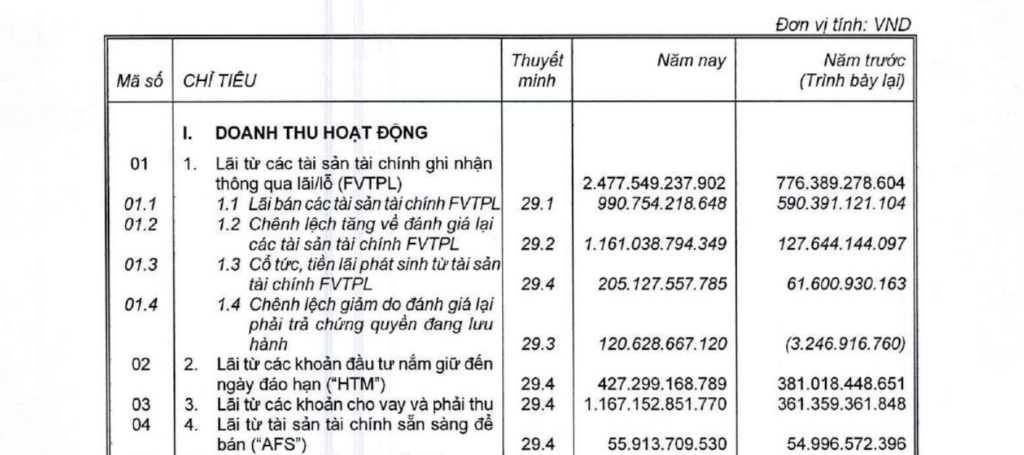
Revenue from proprietary trading at VNDirect Securities:
A securities company’s proprietary trading revenue is mainly reported through financial assets at fair value through profit or loss (FVTPL). In 2021, gains on FVTPL assets made up more than 40% of VNDirect Securities’ total operating revenue.
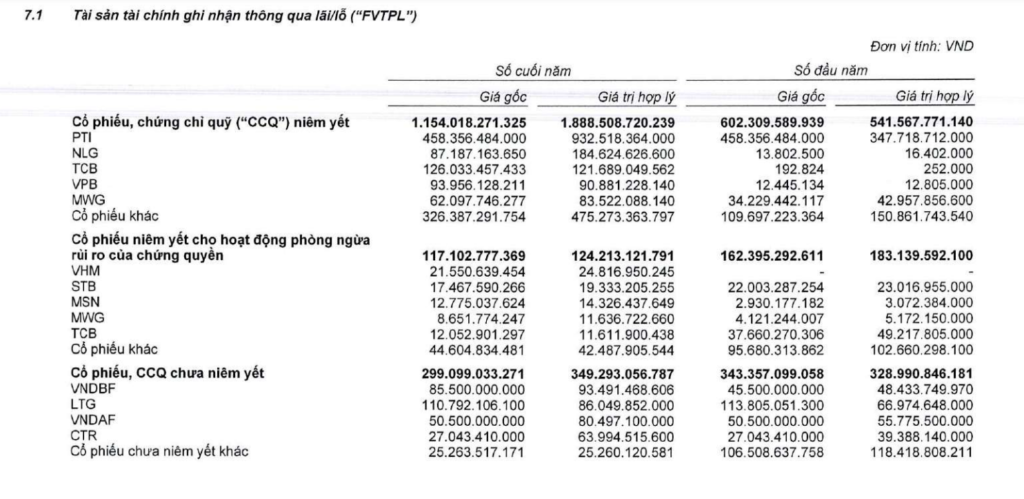
VNDirect’s proprietary trading portfolio.
With their information advantage and teams of professional market analysts, securities companies can speculate on price differences. Proprietary trading also allows securities companies to take equity stakes in other companies and businesses. Specifically, by holding shares or convertible bonds, securities companies become shareholders of joint-stock companies.
In addition, when the market is highly volatile, usually to the downside, proprietary trading lets securities companies step in to support prices and stabilize the market. Specifically, when the market shows signs of falling, securities companies may be allowed to trade to stabilize it at the request of the regulator, and to protect themselves or their clients during share issuances or underwritings.
To do this, however, securities companies have to join forces as a “price stabilization syndicate”, i.e. form a financial consortium (according to Securities Business Operations by Assoc. Prof. Dr. Thai Ba Can and MSc. Dang Lan Huong, 2014).
Since 17 May 2022, HOSE has published data on proprietary trading activity on its website; you can find it here.
Regulations on proprietary trading
Under Clause 2, Article 72 of Vietnam’s Law on Securities on the business lines of securities companies, a securities company may only be licensed for proprietary trading if it is licensed for securities brokerage. In addition, a securities company must be licensed for proprietary trading before it may be licensed for securities underwriting.
Securities companies must also meet the following strict conditions before they can engage in proprietary trading:
Legal capital requirements
Under Point b, Article 175 of Decree 155/2020/ND-CP, the legal capital for proprietary trading at securities companies in Vietnam requires a minimum charter capital of VND 50 billion.
Rules on proprietary trading activity
Under Article 22 of Circular No. 121/2020/TT-BTC, the rules for a company’s proprietary trading are as follows:
“1. A securities company must ensure it has sufficient cash and securities to settle orders for its own account.
A securities company’s proprietary trading must be carried out in its own name; it may not borrow another party’s name, trade in an individual’s name, or let others use its proprietary trading account.
The following are not considered proprietary trading:
- Buying or selling securities to correct post-trade errors;
- Buying or selling its own shares.
A securities company must give priority to executing clients’ orders before its own orders.
A securities company must disclose to the client when it is the counterparty in a negotiated trade with that client.
Where a client’s order to buy or sell a security could significantly affect its price, the securities company may not buy or sell the same security for itself ahead of the client, or disclose the information to a third party to trade in that security.
When a client places a limit order, the securities company may not buy or sell the same security in the same direction for itself at a price equal to or better than the client’s price before the client’s order has been executed.”
Account rules
The State Securities Commission has added detailed guidance on securities companies opening proprietary trading accounts in Circular 120/2020/TT-BTC, as follows:
“A securities company that conducts proprietary trading and is a trading member of the Vietnam Exchange (VNX) may open only one proprietary securities trading account, at the company itself.”
That covers the basics of proprietary trading at securities companies. In the next article, we will look at another key line of business for securities companies: brokerage.
Happy Trading!
The “Stock Trading For A Living” course
Green Chart designed this course to give you a solid grounding in fundamental analysis & stock valuation, and to show you how to integrate it effectively into your existing trading system, especially if you already trade with technical analysis. The programme includes 5 theory sessions and 6 months of hands-on trading guidance in the live market with the lecturer.
Find out more about the course here.