
Contents of this article

Exchange-traded funds – ETFs
What Is an ETF?
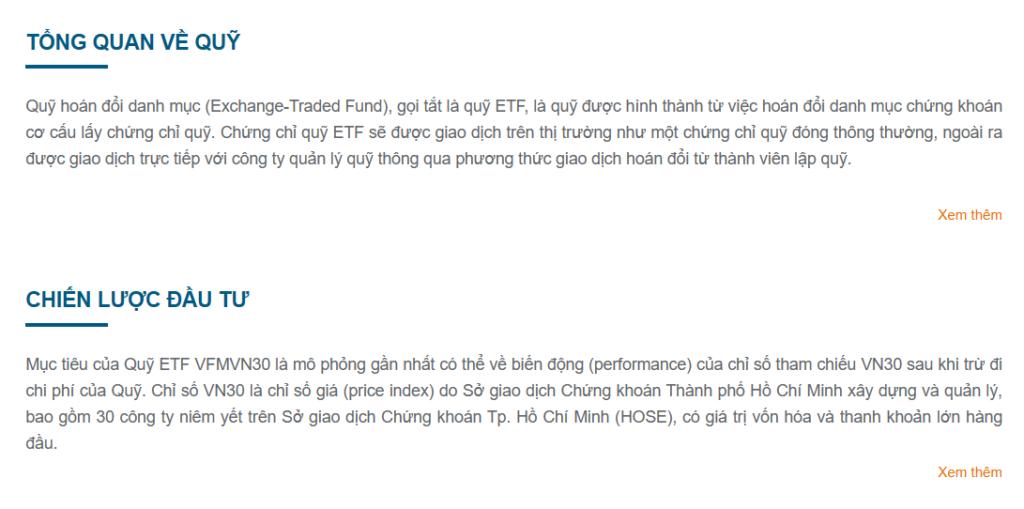
An ETF (exchange-traded fund, known in Vietnam as a “portfolio swap fund”) is a passive investment fund whose units trade on a centralized secondary market (hence the name exchange-traded).
An ETF’s portfolio usually focuses on a particular asset class, such as stocks, bonds, commodities or currencies…
In this article we will focus on equity ETFs. These can include:
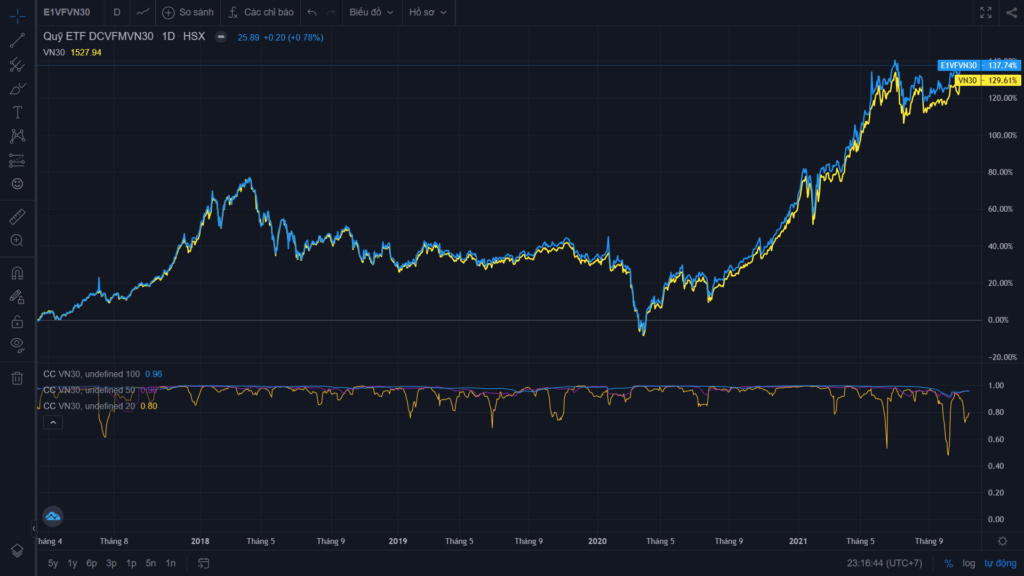
- Index ETFs: the fund’s portfolio holds all the stocks that make up an index, in the same weights. For example, the VFM VN30 fund from Dragon Capital is an ETF that tracks the VN30 index.
- Sector ETFs: invest in stocks in specific sectors such as technology, banking or real estate.
- And many other types of ETF with other investment criteria.
How Does an ETF Work?
An ETF is a passive investment fund: its managers simply buy the stocks in the fund’s specified portfolio and hold them for the long term. This differs from actively managed funds, whose managers buy and sell securities to profit from price moves and aim to beat a benchmark (such as the VN-Index).
An ETF simply replicates a stock portfolio or index by holding it for the long term, so your return from an ETF mirrors the rises and falls of its reference index.
As a result, ETFs trade less often than active funds. They usually trade only at certain predetermined times of year, known as rebalancing periods. For example, the VFM VN30 fund rebalances every January and July, in line with HOSE’s rebalancing of the VN30 index.
ETFs work much like open-ended funds, but not every investor can buy and sell fund units directly with the fund. Only certain institutional investors authorized by the ETF (Authorized Participants – APs) may deal directly with the fund; in Vietnam, APs are usually the ETF portfolio desks of securities companies.
As a result, the price of an ETF unit usually stays close to the fund’s NAV (not exactly equal, but the difference is negligible). For index ETFs, the unit price moves in step with the reference index.
Creation and Redemption
An ETF can regulate the number of units outstanding through its APs. When an ETF wants to issue more units, APs buy the underlying stocks in the market in exactly the fund’s portfolio weights. The fund then issues new units and swaps them for the APs’ basket of stocks at equivalent value. This is called creation, and now you know why ETFs are called “portfolio swap funds” in Vietnamese.

Conversely, APs can buy ETF units in the market and then sell them back to the fund or swap them for an equivalent basket of stocks, reducing the number of units outstanding.
Keeping the Market Price in Line
The fund’s NAV depends on the prices of the assets in its portfolio, but the unit price depends on supply and demand for the units themselves. This creates gaps between NAV and the unit price. APs take advantage of these gaps to earn arbitrage profits, which also brings the unit price back close to the fund’s NAV.
For example, if the fund’s NAV is VND 25,000 per unit but units trade at VND 24,000, APs buy units in the market at VND 24,000, swap them for the ETF’s underlying stocks at the NAV of VND 25,000, and finally sell those stocks in the market, earning VND 1,000 per unit through arbitrage. This trading also raises demand for the units and the supply of the stocks, pushing the two prices closer together.
ETF Units
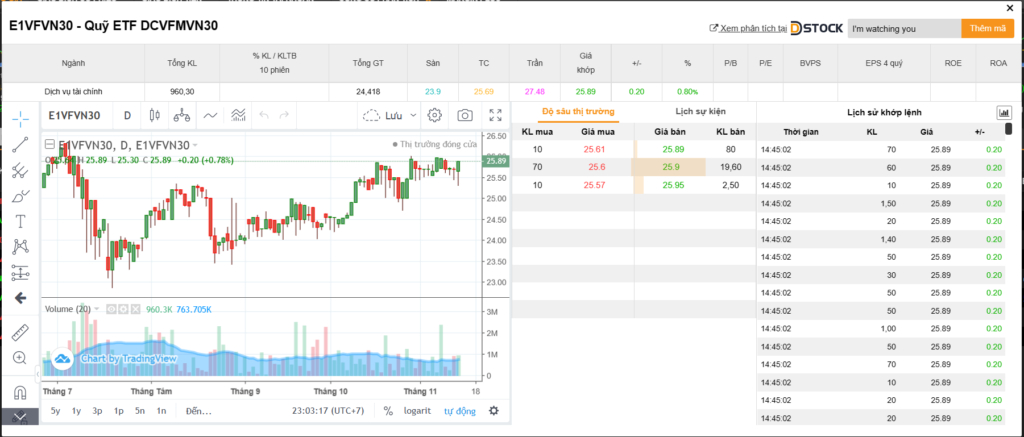
An ETF unit is a security representing your ownership of part of the fund’s capital. ETF units are listed and traded on the exchange just like stocks. You can easily place buy and sell orders for them in your brokerage account.
ETFs in Vietnam
Domestic ETFs
These are ETFs run by Vietnamese fund management companies and listed on HOSE. There are currently 8 ETFs trading in the market, each tracking a different index (except SSIAM VN30 and VFM VN30, which both track the VN30).

Foreign ETFs
Besides domestic funds, several large foreign ETFs also invest in Vietnamese stocks. For example:
- FTSE Vietnam ETF: an ETF from FTSE Russell in the UK, listed on the LSE, tracking the VNAllShare Index (90% of the largest-cap stocks on HOSE).
- VanEck Vietnam ETF: VanEck’s US ETF, listed on CBOE, investing in Vietnamese stocks or stocks of companies with Vietnamese ties.
- iShares MSCI Frontier and Select EM ETF: an iShares ETF in the US, listed on the NYSE, investing in stocks in frontier markets and some emerging markets, including Vietnam.
When Should You Invest in an ETF?
If you have ample capital but are still unclear about your investment strategy, you can choose to invest through funds. Actively managed open-ended funds, as described in our article on open-ended funds, pursue active strategies to beat benchmark indexes. ETFs simply replicate benchmark indexes, so your return from an ETF will roughly match the index, though of course with lower risk than investing in individual stocks.
Beating an index is not easy. The data below shows that active funds in Vietnam have not managed to outperform the VN30 index either.

In addition, ETF units trade on the exchange just like a stock, so trading is more flexible. You only need a small amount of capital, can buy and sell whenever you like, and pay much lower asset management fees than with other open-ended funds. Open-ended funds require higher starting capital and involve more fees and paperwork to buy and sell.
Happy trading !
“Stock Trading For A Living” Course
Green Chart designed this course to build a solid foundation in fundamental analysis & stock valuation (Fundamental Analysis), while showing students how to integrate it effectively into their existing trading system, especially for traders who already use technical analysis (Technical Analysis). The program includes 5 theory sessions and 6 months of hands-on trading guidance in the live market with the instructor.
See full course details here.