
Contents of this article
The Black-Scholes model, or Black-Scholes-Merton model, is a mathematical model used to price certain financial products, most notably European-style options. The model was introduced by Fischer Black and Myron Scholes in their 1973 paper “The Pricing of Options and Corporate Liabilities”, published in the Journal of Political Economy.

Pricing options with the Black-Scholes model
What is the Black-Scholes model?
An option is an asset traded on an organized exchange, so it also has a market value, determined by market supply and demand.
As we know, market value is created by investors’ expectations; in other words, it is a function of investors’ various expectations. Options are valued with the Black – Scholes model, which is likewise based on market expectations.
This is the famous options pricing model developed in 1973 by three economists, Fischer Black, Robert Merton and Myron Scholes (it is sometimes called the Black-Scholes-Merton model). Applied to option valuation, the model’s formula is shown below:

The option pricing formula
Where:
- C is the price of the call option (adjusted for the conversion ratio)
- St is the current price of the underlying asset
- K is the strike price of the option
- t is the remaining term (time from now until the expiration date)
- σs is the implied volatility of the stock
- r is the risk-free interest rate
- N is the standard normal distribution
You almost certainly cannot memorize the formula above! You do not need to, either, because all we need is to understand what it means. An option’s price is a function of five variables: the underlying price, the strike price, the remaining term, implied volatility and the risk-free rate; in other words, these five factors drive the price of an option. Two of them are fixed: the strike price and the risk-free rate (assuming interest rates stay constant). The other three vary, and we will look at their effects in more detail.
How does the underlying price affect an option?
The higher the asset price, the further it moves above the strike price and the more profit the option delivers on exercise. This makes the option more attractive, so demand rises and the option price goes up.
As you know, when you exercise a call option you are paid the underlying price minus the strike price. This difference is called the exercise value of the option. For example, for the CSTB2112 covered warrant below, the stock price is VND 31,550 and the strike price is VND 31,000, so the exercise value = 31,550 – 31,000 = VND 550. This is also the figure shown (in the S-X field).

The CSTB2112 covered warrant
An option’s value will always be higher than its exercise value, because if the opposite were true, traders would exploit it through arbitrage, buying the option and exercising it immediately to make a profit without taking any risk.
What is the remaining term?
The longer an option’s term, the more room the asset price has to rise above the strike price and the more profit exercising can deliver. A longer-dated option will therefore be priced higher than a shorter-dated one, all else being equal.
The difference in option prices across maturities is captured by a quantity called time value. You can think of an option’s price as its exercise value plus its time value. Over time, the remaining term shrinks toward zero, time value approaches zero, and the option price converges toward its exercise value.
Take the CSTB2112 warrant above. You can calculate its exercise value as VND 550, so its time value is 3,400 – 550 = VND 2,850. This figure shows that, for investors who have just bought the warrant, the underlying stock must rise by another VND 2,850 for their position to break even. With two months remaining, this means traders are buying this CW in the expectation that the price will rise by VND 2,850 within two months.
Over time, this time value will approach zero and the warrant’s value will decline.
Implied volatility
This is the single most important factor in the options market as a whole. Whereas historical volatility measures how much the stock price has fluctuated in the past, usually as a standard deviation, implied volatility reflects investors’ expectations for how volatile the stock price will be in the future. High implied volatility means investors think the stock price will move a lot in the future. Implied volatility is usually expressed as annualized volatility.
When implied volatility is high, the stock price could rise far above the strike price, but it could also plunge. That may be a risk for the stock, but for an option it is a different story. In the rising scenario, your profit on exercise obviously grows, while in the falling scenario, your loss is capped. The option’s expected profit therefore rises, making the option more attractive and pushing its price up. As a result, option prices and implied volatility move in the same direction.
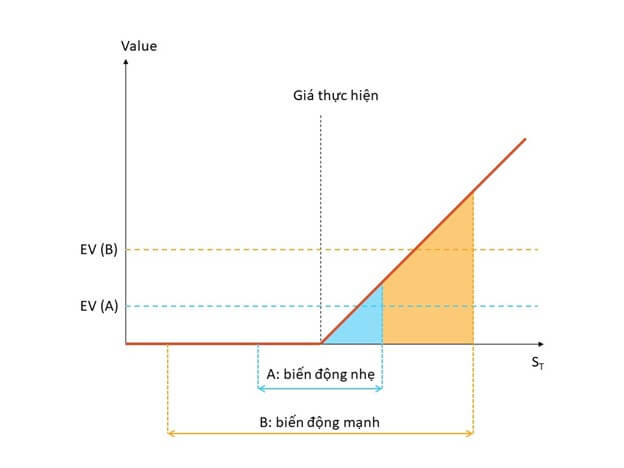
The relationship between option prices and implied volatility
This property backs up a saying among options traders around the world: “Trading options is trading implied volatility.” In practice, you can trade options based on the implied volatility of the underlying stock. If you think the stock will become more volatile in the future, buy options.
Calculating an option’s value with the Black-Scholes model
Combined with the price factor, you will see that options work best in a clear trend. You can calculate an option’s value yourself with a Black – Scholes calculator. Enter the model’s five input variables and the calculator will give you the option’s theoretical value.
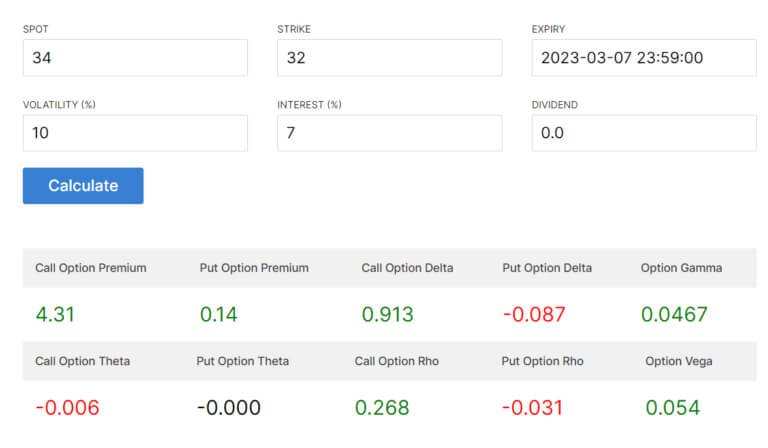
How to value covered warrants in Vietnam
For covered warrants in Vietnam, you can calculate the warrant price online. You simply select the warrant, and the system fills in all the data needed for the calculation. For example, for the CMBB2201 warrant on MBB stock, I just type the CW code into the first box, and the system automatically fills in the strike price, the current stock price, implied volatility and the risk-free rate. The calculator then tells you that the warrant’s theoretical value is VND 2,000.

However, with the warrant currently trading at VND 3,330, you can see the market appears to be overvaluing it. That said, Vietstock notes that implied volatility here is assumed to equal volatility over the past year. So, based on the warrant’s market value, you can infer that the market expects MBB shares to become more volatile in the future.
Technical Analysis course – CMT Level 1
Green Chart designed this course specifically for candidates who want to study and prepare for the CMT Level I exam in Vietnam. The programme includes 27 sessions of theory, practice questions and mock exams. Students also receive free course materials, question banks and mock exams for their exam preparation, plus free lifetime retakes of the course.
Find out more about the course here.
Happy trading!