

Contents of this article

Free cash flow (Free Cash Flow, or FCF) tells us how much cash a company generates after paying all of its expenses, such as taxes, wages, equipment purchases and factory construction.
Free cash flow is an important measure for understanding a company’s profitability. It is very hard to manipulate, and it tells a story about a company that other commonly used figures, such as net income, may not. It is also an important indicator for investors trying to determine whether a company is engaged in accounting fraud.
A company can use free cash flow for many important purposes, such as paying down debt, expanding its business or paying higher dividends to its investors. In this article, we will cover the basics of free cash flow and why it matters when analysing a company for investment.
What is free cash flow?
Free cash flow is a company’s cash flow after paying all of its debts and other financial obligations. It measures the cash a company generates, or has left over, after accounting for working capital and capital expenditure (CapEx).
In other words, it tells us how much cash the company has available to pay creditors and pay dividends to investors. The company can also use this cash to scale up, reduce debt and so on. Free cash flow is therefore an important measure for analysing a company’s financial health and operating performance.
Below is an example of a cash flow statement from:
How is free cash flow calculated?
There are two main approaches to calculating free cash flow (FCF). The first uses cash flow from operating activities as the starting point, then adjusts for interest expense, the tax shield on interest expense, and any capital expenditure (CapEx) made during the year.
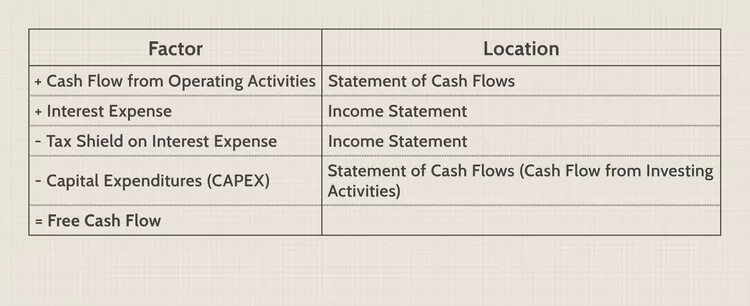
The second approach uses earnings before interest and taxes (EBIT) as the starting point, then adjusts for income tax, non-cash expenses such as depreciation, changes in working capital, and CapEx.
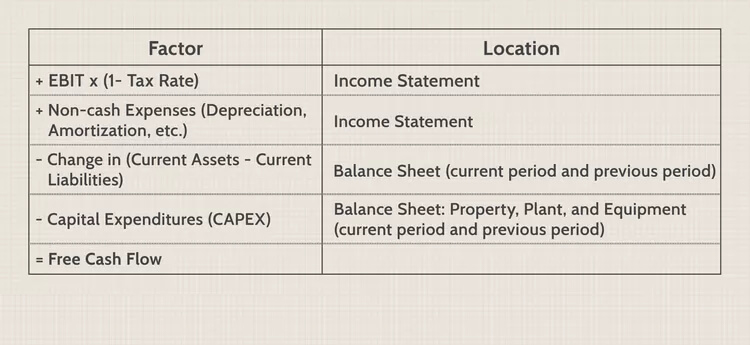

In both cases the resulting figures should be identical, but one approach may be preferred over the other depending on what financial information is available.
Types of free cash flow:
Free cash flow to equity:
Free cash flow to equity (FCFE), also known as “levered free cash flow”, is calculated from the cash flow statement by taking cash flow from operating activities (CFO), subtracting capital expenditure (CapEx), then adding net debt issued or subtracting net debt repayment.
It takes into account both the interest paid on debt and the net debt issued or repaid. It therefore shows only the cash flow available to equity investors. Free cash flow to equity is also used in financial modelling to determine the equity value of a company.
Free cash flow to the firm:
Free cash flow to the firm (FCFF) represents the cash available to investors after a company has paid all of its operating costs and invested in current assets (e.g. inventory) and long-term assets (e.g. equipment). FCFF counts both bondholders and shareholders as beneficiaries when looking at the money left for investors.
FCFF is an indicator of a company’s operations and performance. It considers all cash inflows in the form of revenue, all cash outflows in the form of ordinary expenses, and all cash reinvested to grow the business. The money left after all of these activities is the company’s FCFF.
The difference between free cash flow (FCF) and free cash flow to the firm (FCFF):
Cash flow is the net amount of cash and cash equivalents moving into and out of a company. Positive cash flow shows that the company’s liquid assets are increasing, allowing it to settle debts, reinvest in the business, return money to shareholders and pay expenses.
Cash flow is shown on the cash flow statement, which has three main sections: cash flow from operating, investing and financing activities.
FCFF is the cash a company generates through its operations after deducting all cash spending on fixed assets such as property, plant and equipment, and after accounting for depreciation, taxes, working capital and interest. In other words, FCFF is the money left after the company has paid its operating costs and capital costs.
Why free cash flow matters:

Free cash flow helps show the overall health of a company. Companies with positive FCF have enough money to pay their expenses and debts. A company whose free cash flow rises steadily is usually doing well and can expand in the future. A company with low or steadily falling free cash flow has very little money left after paying its costs.
Advantages:
Here are some of the benefits of free cash flow for:
Investors: investors use this fundamental metric to analyse companies showing signs of growth. It helps them determine whether a company is able to pay dividends.
Creditors: free cash flow helps creditors analyse a company’s ability to repay its loans. It also helps them decide whether to penalise the company for late payment or failure to repay.
Business partners: individuals looking to enter a business partnership usually assess the target company’s FCF first to gauge its operating capability before making a final decision.
Limitations:
Capital expenditure (CapEx) differs between industries. You therefore need to measure a company’s FCF over a longer period, taking into account the sector it operates in.
High FCF may also indicate that a company is not investing much in its joint ventures and associates. Low free cash flow, meanwhile, does not always mean the company is in poor financial health; it may show that the company is focused on investing for expansion and growth, and is therefore spending more cash.
Although FCFF provides a lot of valuable information that investors appreciate, it is not always entirely reliable. Fraudulent companies still go to great lengths when it comes to accounting tricks. There is no regulatory standard for defining FCFF, and investors often disagree about which items should and should not be treated as capital expenditure.
Investors should therefore keep an eye on companies with high FCFF to see whether they are under-reporting capital expenditure and R&D. Companies can also temporarily boost FCFF by stretching payment terms, tightening collection policies and reducing inventory. These actions reduce current liabilities and change working capital, but the effects may only be temporary.
In summary, free cash flow is an important metric for measuring a company’s profitability and efficiency. Alongside free cash flow, investors and analysts can analyse other financial measures to get a more complete and comprehensive picture of a company’s financial position.
Happy Trading!
The “Stock Trading For A Living” course
Green Chart designed this course to give students a solid foundation in fundamental analysis & stock valuation (Fundamental Analysis), and to show them how to integrate it effectively into their existing trading system, especially for traders who already use technical analysis (Technical Analysis). The program consists of 5 theory sessions and 6 months of hands-on guided trading in the live market with the lecturer.
See full details of the course here.