
Contents of this article
What is the Elliott Wave Principle?
In the 1930s, Ralph Nelson Elliott discovered that the up and down waves in the market move according to certain rules and patterns. He called these rules collectively the Wave Principle. Every wave has a starting point and an ending point in price and time that can be anticipated. According to Elliott, a basic wave pattern consists of five individual waves linked together to form a complete wave in an uptrend or downtrend (see Figure 1).
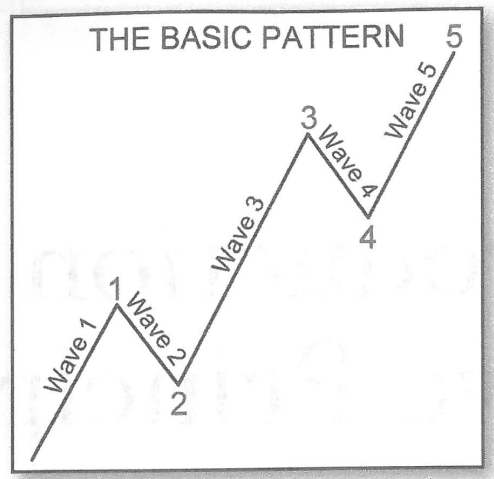
The first sequence of five waves is numbered 1 to 5 and is collectively called motive waves, because they move in the direction of the main trend.
Once the five-wave motive sequence is complete, the corrective waves begin. The corrective waves retrace, falling back after an upward motive wave. Corrective waves usually follow a three-wave structure, labelled with letters such as A, B and C (see Figure 2).
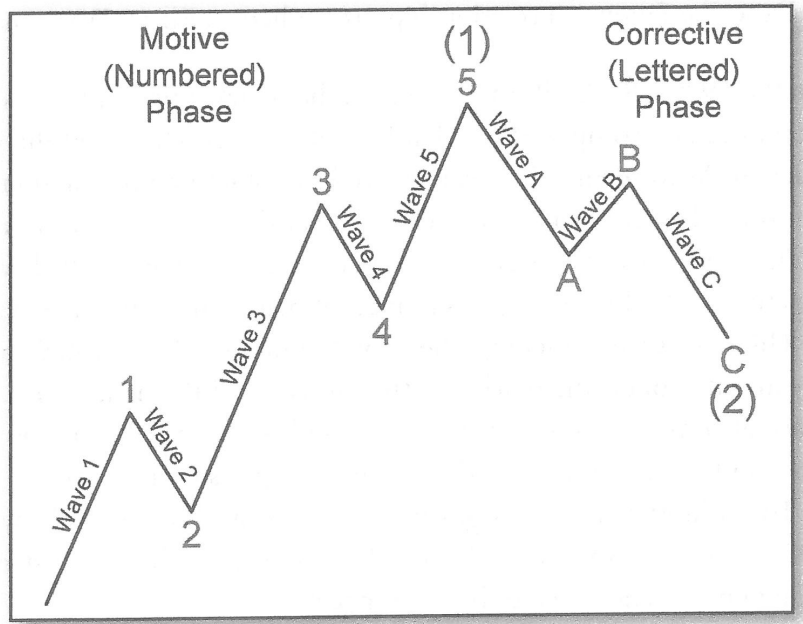
Every wave is part of other waves of a larger degree – the fractal property. Likewise, each wave we observe subdivides into waves of a lower degree (as shown in Figure 3). Motive and corrective waves can move up or down depending on the main trend.
A number of rules and guidelines – to be covered in a later article – have been researched and applied by R.N. Elliott and his successors to the formation of Elliott wave patterns. They help traders using the Elliott Wave Principle count (label) waves more easily and accurately.
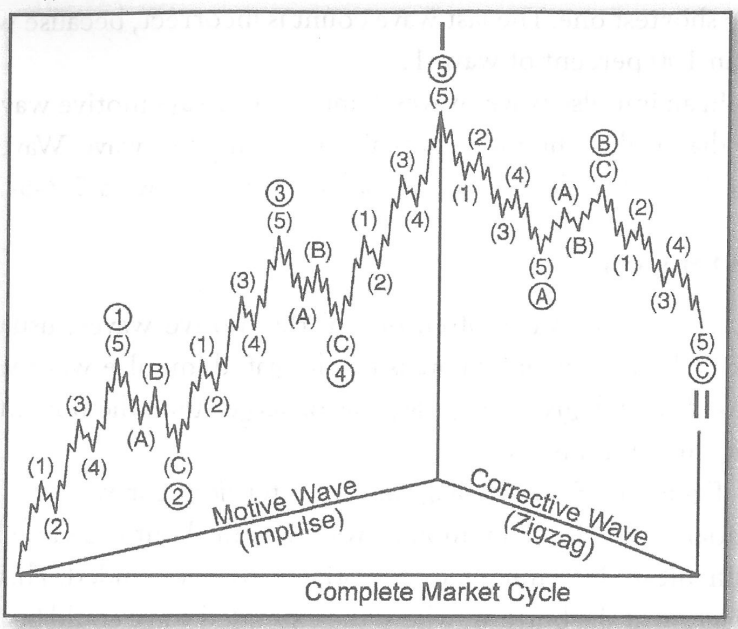
Why 5-3?
Does an Elliott wave pattern have to be five waves and three waves? In the existing research, R.N. Elliott never speculated on or dug into why the basic form of the market moves in five motive waves and three corrective waves. He simply discovered that this is what had happened and was happening.
The link between the Elliott Wave Principle and Dow Theory
Elliott was strongly influenced by Dow Theory, so the Elliott Wave Principle shares many similarities with it. In a 1934 letter to Collins, Elliott mentioned that he subscribed to Robert Rhea’s stock market service and used Rhea’s book on Dow Theory. Elliott described the Wave Principle as “a much-needed complement to the Dow Theory”.
Let’s consider the link between the Elliott Wave Principle’s five-wave advance and Dow Theory’s three phases of advance in a bull market. Elliott’s idea of three up waves separated by two corrective waves is clearly compatible with Dow Theory. Although clearly influenced by Dow Theory, Elliott believed he had gone beyond it and improved on it. It is interesting to note the influence of the “sea” on both men in building their theories. Dow compared the market’s primary, secondary and minor trends to the tides, waves and ripples of the sea. Elliott, for his part, liked to describe wave theory in terms of “tides” – a pattern that changes regularly and repeats itself.
(To be continued).
Happy trading !
Technical Analysis Course – CMT Level 1
Green Chart designed this course specifically for candidates in Vietnam who want to study and prepare for the CMT Level I exam. The programme includes 27 sessions of theory, practice questions and mock exams. Students also receive the course materials, question bank and mock exams free of charge, and can retake the course for free for life.
See full course details here.