

Contents of this article
The CAMELS model

The CAMELS model is a set of indicators that together form a system for assessing the soundness of banks. Banking supervisors use it to assess banks’ credit quality, and as a tool for monitoring and preventing risk in banking operations.
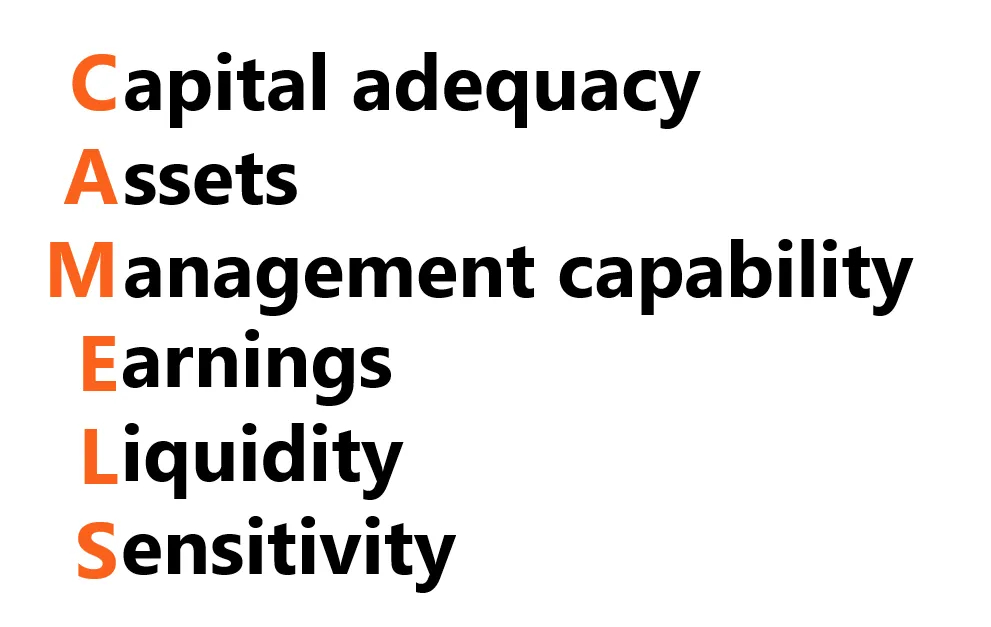
CAMELS uses financial statement data, together with industry-wide trends and each bank’s business strategy, to assign a rating from 1 to 5, where 1 is the best rating and 5 the worst. A bank’s credit quality is assessed on 6 criteria, matching the 6 letters of CAMELS:
- Capital: the bank’s capital adequacy
- Asset: the quality of the bank’s assets
- Management: the capability of the bank’s executive management
- Earning: the bank’s profitability
- Liquidity: the ability to meet short-term obligations
- Sensitivity to market risk: how do risks affect the bank?
Capital adequacy
In CAMELS, this criterion assesses the strength of the bank’s available capital, and it is the basis on which the State Bank sets and allocates credit growth limits for commercial banks. This capital must be large enough to absorb unforeseen risks that could seriously affect the bank’s operations, such as credit risk, interest rate risk or exchange rate risk.
Capital adequacy is usually measured with ratios such as the CAR (capital adequacy ratio) and leverage ratios such as assets/equity and debt/equity.
To achieve strong capital adequacy, institutions must comply with the rules on capital adequacy ratios, as well as regulations on interest and dividends. Other factors relevant to an institution’s capital adequacy include its growth plans, the economic environment and its ability to control risk.
Asset quality
On the balance sheet, a bank’s assets include cash reserves, loans to customers, investments and some other assets. Of these, assets used for lending generate the most profit for banks, and they are what CAMELS uses to assess a bank’s asset quality.
If a bank collects interest and principal on time and has little bad debt, it has good asset quality. Conversely, a bank’s asset quality is rated poor if it cannot recover its loans and has many overdue debts; its profits will suffer significantly, and its liquidity may also deteriorate if asset quality is too low.
Ratios used to assess asset quality include the non-performing loan (NPL) ratio for loan groups 3, 4 and 5, the net NPL ratio, and the loan loss provisioning ratio.
Management capability
In CAMELS, this factor reflects management’s ability to control and deal with the risks the bank may face. It also assesses management’s ability to keep the bank operating safely, by setting internal rules and an effective operating direction to reach profit targets at the lowest cost.
To rate management, assessors review corporate governance, business strategy, regulatory compliance and internal controls. In addition, some ratios are used to assess how efficiently the bank uses its assets, such as the cost-to-income ratio, cost-to-assets ratio, share of fee income in revenue, and CASA growth.
Earnings (profitability)
Maximising profit is always the goal of any business, whatever its sector. The same is true of banks: profit ensures they can sustain and expand their business. A bank’s three main sources of profit are the spread between lending and deposit rates, fee and commission income, and gains from investment and proprietary trading activities.
The most important ratio for assessing bank profitability is NIM (net interest margin), which is roughly a bank’s equivalent of net profit margin. NIM reflects the difference between the interest a bank earns on its loans and the interest it pays on customer deposits. Other ratios, such as fee income/revenue, investment income/revenue and familiar measures such as ROE and ROA are also used to assess banks’ profitability in CAMELS.
Liquidity
The liquidity of companies in general, and banks in particular, reflects their ability to repay short-term obligations. For a bank, its largest short-term liability is customer deposits. Banks need liquidity reserves to pay interest on savings and to meet customers’ withdrawal requests promptly.
One cause of liquidity risk for banks is a mismatch in the structure of their assets and liabilities. A bank that takes short-term deposits to make long-term loans is one example: when customers need to withdraw money, the bank has no reserves to meet their demands and has to incur very high costs to deal with the liquidity problem, which cuts into profit. If customers withdraw money en masse (a bank run), the bank may default and collapse rapidly.
In CAMELS, a bank’s liquidity is assessed using ratios related to its asset and funding structure, such as the CASA ratio, the loan-to-deposit ratio (LDR), and the ratio of short-term funding used for long-term lending.
Sensitivity to market risk
The final factor in CAMELS is how much the market affects the bank’s profit. Market risk comes from two main sources: interest rate risk and exchange rate risk.
If market interest rates rise, both deposit and lending rates rise: the bank can lend at higher rates but must also pay more to attract deposits. Interest rate risk therefore depends on the relative weight of lending assets and deposits. Banks try to minimise this risk by balancing the two.
The ratios used to assess interest rate risk are the duration gap (DG) and the repricing gap of rate-sensitive assets and liabilities (DR). When the gap is zero, interest rate risk is in theory eliminated. When the gap is not zero, depending on the case, the bank’s profit may fall if rates fall and rise if rates rise, or vice versa.
Exchange rate risk depends on the bank’s foreign currency position. For example, if the bank holds a lot of foreign currency, it benefits if that currency strengthens; otherwise its profit falls. In general, a bank’s exchange rate risk depends on its net foreign currency assets, i.e. the difference between foreign currency assets (including foreign currency cash and loans) and foreign currency liabilities (including foreign currency borrowings).
Exchange rate risk is also assessed through the net open foreign currency position, equal to total foreign currency bought minus total foreign currency sold.
How does the CAMELS model work?
To assess the factors above, each sub-criterion is scored on a scale of one to five. One is the best score, showing that the bank performs well and manages risk effectively. Five, on the other hand, is the worst rating, showing that the bank has a high likelihood of failure and requires immediate action.
Table: the components of the CAMELS model

- A rating of 1 shows the bank performs well, is stable and follows sound risk management practices.
- A rating of 2 shows the bank is financially stable with moderate weaknesses.
- A rating of 3 shows the bank warrants supervisory concern in several areas.
- A rating of 4 shows the bank is not operating effectively and is therefore unsafe if serious financial problems arise.
- A rating of 5 shows the bank is fundamentally unsound and does not fully implement risk management practices.
A poor (high) rating restricts a bank’s ability to expand through investment, mergers or opening more branches.
An example of CAMELS analysis
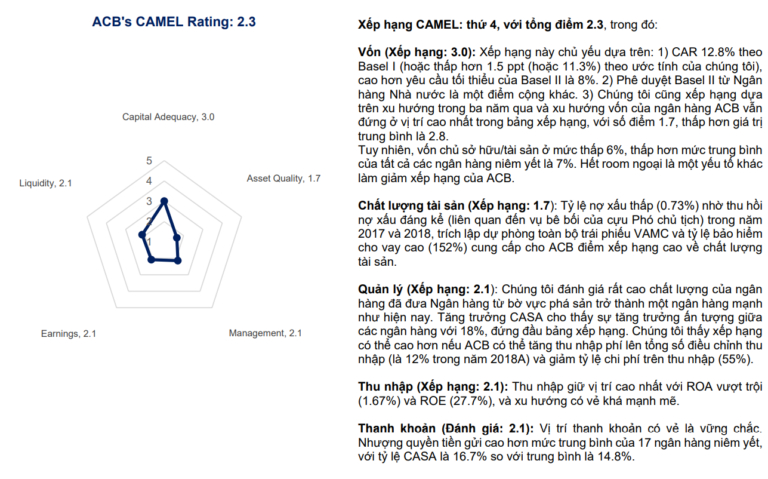
Below is a real-world application of the CAMELS model to the analysis of ACB stock, from a research report by Yuanta Securities.
Happy Trading!
The “Stock Trading For A Living” course
Green Chart designed this course to give students a solid foundation in fundamental analysis & stock valuation (Fundamental Analysis), and to show them how to integrate it effectively into their existing trading system, especially for traders who already use technical analysis (Technical Analysis). The program consists of 5 theory sessions and 6 months of hands-on guided trading in the live market with the lecturer.
See full details of the course here.