
In a company’s asset structure, shareholders’ equity represents the portion of the company’s assets that belongs to shareholders, calculated as total assets minus liabilities. However, when another investor wants to buy the company, shareholders will certainly not want to sell it for a price equal only to its equity. The reason is simple: the company has many other assets that can generate future cash flow but are not recorded on the books, such as large exclusive customers, brand value and so on.
Investors can therefore only buy the company at a price that reflects all of its future cash flows, namely its market value. More precisely, it is the market value of equity, since the company belongs to its shareholders. This value will certainly differ from the value of equity recorded on the balance sheet, known as the book value of equity. In this article, we will look at some important concepts related to book value and how they are used in stock valuation.
What is book value?
Book value is equivalent to the cost at which an asset is carried on the company’s balance sheet, calculated as the asset’s cost minus accumulated depreciation. Book value can therefore also be thought of as the company’s net asset value (NAV), calculated as total assets minus intangible assets (patents, goodwill) and liabilities. For the initial investment cost, book value may be the net value or the total of costs such as transaction costs, sales tax, service fees and so on.

The term book value comes from the accounting practice of recording assets at their historical cost on the books. Although the book value of an asset may stay the same over time under accounting measurement, the book value of a company as a whole can grow as it accumulates earnings generated by using its assets.
Because a company’s book value represents the value of shareholders’ ownership, comparing book value with the market value of the stock can be an effective valuation technique when deciding whether a stock is fairly priced. In practice, as the accounting value of a company, book value has two main uses:
- First, it is the total value of the company’s assets that shareholders would theoretically receive if the company were liquidated.
- Second, when compared with the company’s market value, book value can indicate whether a stock is undervalued or overvalued.
What is book value per share (BVPS)?
Book value per share (BVPS) is a way of calculating a company’s book value on a per-share basis, based on the equity attributable to its common shareholders. If the company is dissolved, book value per common share shows the residual value common shareholders would receive once all assets have been liquidated and all debts repaid. If a company’s BVPS is higher than its market value per share, the stock may be undervalued.
In personal finance, the book value of an investment is the price paid for a security or debt investment. When a company sells shares, the selling price minus the book value is the capital gain or loss on the investment. BVPS can be calculated with the following formula:
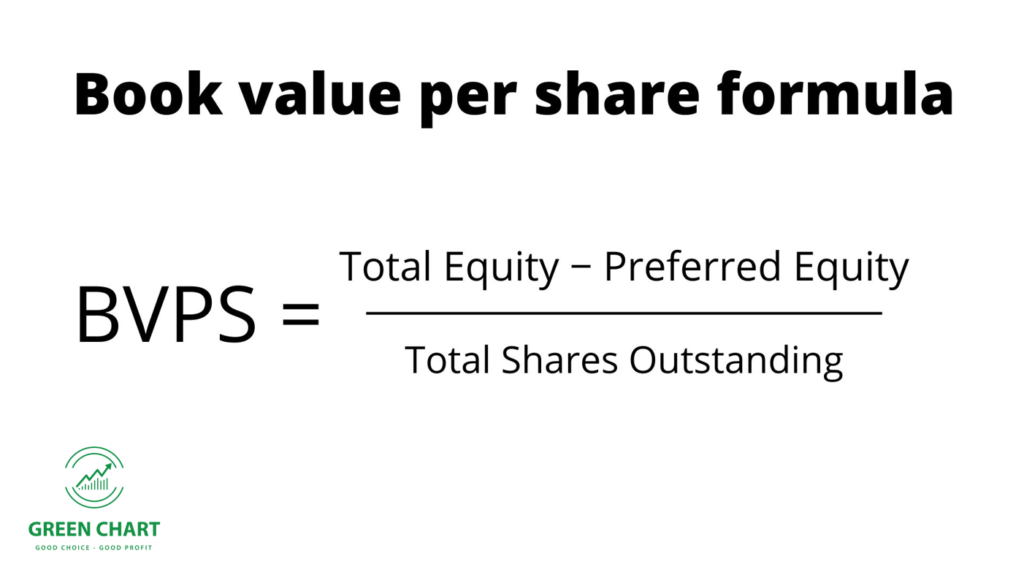
The difference between the share price and BVPS lies in the company’s future value that is not recorded on the balance sheet, and it is expressed by the P/B ratio. So:
What is the P/B ratio in stocks?
The price-to-book (P/B) ratio is a very useful valuation figure for comparing similar companies in the same industry, provided they follow a consistent accounting method for valuing assets. It may not be a valid basis for valuation when comparing companies across different sectors and industries, where some companies record their assets at historical cost and others anchor their asset values to market value.
A high P/B ratio therefore does not necessarily mean a premium valuation, and conversely, a low P/B ratio does not automatically mean a discount valuation.
The P/B ratio is the ratio of the share price to BVPS (the price-to-book ratio), calculated as follows:

P/B ratio formula
The formula also tells you how many times its book value the company is worth.
You can easily calculate P/B from readily available market data, or look it up from stock data providers.
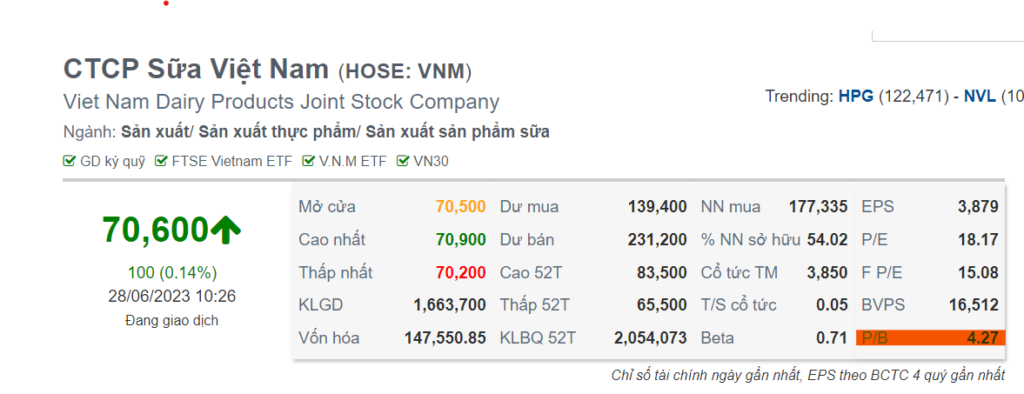
P/B of VNM stock
What the P/B ratio tells you
P/B tells us how many times its book value a company’s market capitalisation is, which lets us gauge the value of the company’s intangible assets (not recorded on the books), such as its brand, competitive advantage and customer base. A company with a reputable brand and a large market share will always have a high P/B.
A P/B of 1.0 means the market price of a company’s stock is exactly equal to its book value. For value investors, this can be a good buy signal, because a company’s market value is usually greater than its book value.
Why is that? Book value only considers the liquidation value of the company’s fixed assets and securities. It does not take into account intangible assets such as patents, intellectual property, brand value and goodwill. Nor does it consider how the company’s assets will generate profit and growth over time. Market value, which takes all of this into account, is therefore generally higher. As with the P/E ratio, safe, highly reputable stocks will have high P/B ratios, and vice versa.
Using P/B to value stocks
One use of P/B is stock valuation. The P/B valuation method is one of the most common multiple-based valuation methods, and it is used in exactly the same way as other multiples such as P/E.
To find a stock’s fair value, you need to project BVPS and a reasonable P/B, then multiply the two to get the share price.
Projecting BVPS
Projecting BVPS is a little more complex than projecting EPS. A company’s shareholders’ equity can be broken down into the following items:
Equity = Charter capital + Share premium + Retained earnings – Treasury shares
The change in equity over a period therefore comes from:
Change in equity = Profit after tax – Dividends – Treasury share purchases + Newly issued shares
Profit after tax can be projected by business segment and the company’s growth rate, while dividends may depend on the policy approved at the AGM. You should also watch the company’s plans to buy back treasury shares or issue new shares. From there, project future equity and divide by the number of shares to get BVPS.
Another approach to calculating BVPS is to estimate the fair value of equity using the formula:
Shareholders’ equity = Total assets – Total liabilities
Valuing total liabilities is fairly easy, as they usually match the debts on the financial statements. Determining the true value of the assets, however, requires a deep understanding of actual market value versus book value. For example, Company A owns a plot of land with a current market value of VND 10 billion, but it is carried on the books at its purchase valuation of VND 5 billion. In this case you will need some knowledge of real estate valuation.
Projecting P/B
When projecting P/B, a stock’s fair P/B is usually its own historical average P/B, provided the company has maintained its market share and competitive advantage within its industry. Alternatively, you can use the industry average P/B to value the stock, but, as with P/E, the fair P/B should be adjusted for the company’s risk.
A company’s P/B depends on how risky the business is. For large-cap companies that lead their industry in market share and have strong finances, risk is low and investors are willing to pay a high P/B. Conversely, small-cap companies without a strong industry position will have lower P/B ratios.
If you have no experience valuing stocks yet, it is best to refer to research reports from brokerage firms.
What advantages does P/B have over P/E? When should you use P/B?
One advantage of P/B over P/E is that the P/B method can be applied to virtually any company, because shareholders’ equity is normally positive, whereas P/E cannot be used when profit after tax and EPS are negative (the company is loss-making, or still in an investment phase and not yet profitable). In periods such as 2020–2021, when most companies suffered losses due to COVID-19, P/E valuation proved ineffective and analysts switched to P/B to value stocks.
P/B is commonly used to value companies in finance-related industries such as banking, real estate, securities and insurance, because highly liquid assets make up the largest share, or almost all, of their balance sheets (cash, investments, government bonds, loans, shares, etc.). These are easier to value and their book values are relatively close to market value.
Happy trading!