
Contents of this article
The stock market is surging, you see lots of your friends making big profits and posting status updates every day to show off their gains (which is exactly what happened in the market in 2020–2021). If you feel fine about not making money, because you clearly do not know this market, then congratulations: you are a rational person. Most people, however, will feel restless, curious and itching to invest right away, and if you are one of them, you may well have FOMO.
FOMO, the fear of missing out, is one of the most common psychological phenomena of the modern digital age. According to statistics, FOMO affects 70% of young people, and of course it can also have a significant effect on our trading in the stock market.
The fear of missing out can lead us to jump into trades without thinking, or to close trades at the wrong moment, which is exactly what many of us do every day. It can even push traders to risk far too much capital without careful research, or to follow the herd. For some people, FOMO is triggered when the market moves fast and hard, creating the feeling that there is a lot to miss out on.
To help traders better understand FOMO in trading and why it happens, we will identify its causes and how they can affect a trader’s success. There are many different tips for overcoming fear and the other emotions that can undermine trading consistency, one of the most important traits of successful traders.
What is FOMO in trading?
FOMO in trading is the fear of missing out on a big opportunity in the market, and it is a common problem that most traders experience at some point in their careers. FOMO can affect everyone, from new traders to professional forex traders.
Advances in the information age give us unprecedented access to other people’s lives, so FOMO is widespread. It stems from the feeling that other traders are more successful, and it can lead to unrealistic expectations, a lack of long-term perspective, overconfidence or underconfidence, and an unwillingness to wait.
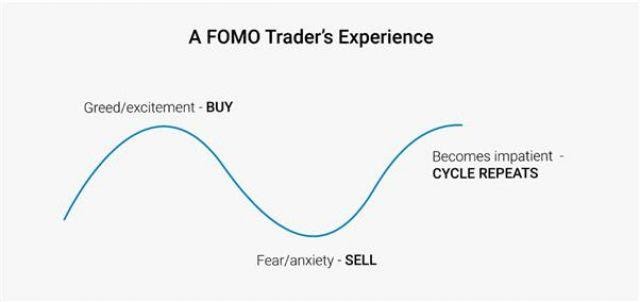
Emotions are usually the main driver of FOMO. Left unchecked, they can make traders ignore their trading plan and exceed reasonable risk limits. Common trading emotions that can create FOMO include:
- Greed
- Fear
- Excitement
- Impatience
What triggers a FOMO trade
FOMO is an internal feeling, but one that can be triggered by a range of situations. Some external factors that can lead to FOMO trades are:
Highly volatile markets
FOMO occurs in sharply rising or falling markets, where everyone wants to catch the trend; it can creep into our minds whenever the market moves strongly in either direction. No trader wants to miss a good chance to make money.
After a big winning streak
Excited by recent wins, you can easily spot new opportunities and rush into them. That is fine, because everyone else is doing it too, right? Unfortunately, winning streaks do not last forever.
The losing loop
Traders can end up in a vicious circle: entering a position, getting scared, closing it, then jumping into another trade as anxiety and frustration over the previous loss build up. This can ultimately lead to bigger losses and higher trading costs.
The crowd and social media
The combination of social media and trading can be harmful to your emotions, because there everyone appears to be trading successfully. Do you feel a pang of envy when you see investors “showing off their gains” in Facebook or Zalo groups?
Through its effect on individual traders, FOMO can directly affect the market as a whole. Market moves can be driven by emotion, as traders hunt for opportunities and entry points when they see a new trend forming.
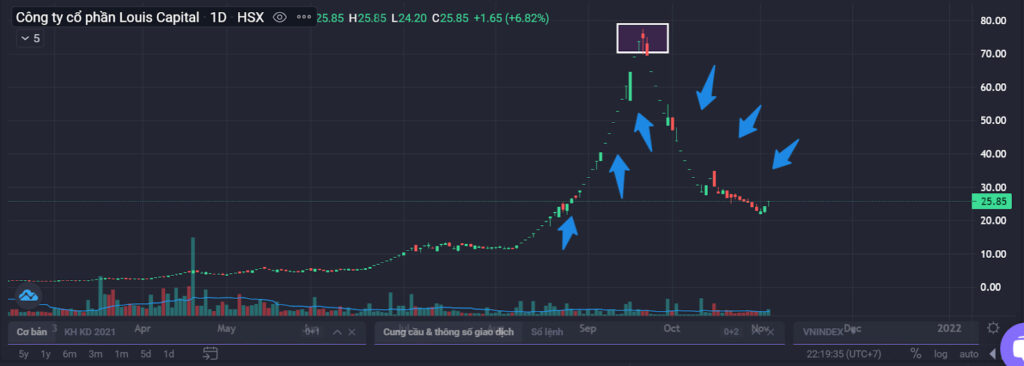
The chart below may be a good example: have you ever felt compelled to chase a stock that hit the ceiling price for dozens of sessions in a row, only to end up buying at the top?
Tips for overcoming FOMO
Overcoming FOMO starts with greater self-control and understanding the importance of discipline and risk management in trading. Although there is no simple way to stop emotions from affecting your trading and to eliminate FOMO completely, various techniques can help traders make sounder decisions and trade more effectively.
- There will always be another trade. Trading opportunities are like buses: another one is always coming along behind. It may not happen straight away, but the right opportunities are worth waiting for.
- Everyone goes through it. Realizing that this is a problem for many traders will make you less stressed and reduce your guilt over FOMO-driven mistakes. What matters is to learn from them and recover from your mistakes.
- Stick to your trading plan. Every trader should know their strategy, create a trading plan, then follow it. That is the way to long-term success.
- Take emotion out of trading. Learn to set your emotions aside; a highly disciplined trading plan will help with this and can also boost your confidence when trading.
- Only use money you can afford to lose. You can also use tight stop-losses to limit losses if the market moves unexpectedly. Never borrow money to trade.
- A deep understanding of the market is essential. Traders should do their own analysis and use it as the basis for every trade.
- Keep a trading journal. It is no accident that the most successful traders keep journals, distilling their personal experience to greatly strengthen their trading plans.
Overcoming FOMO cannot be achieved overnight; it is a long and continuous effort. This article has given you a good starting point, and the rest is up to you.
Happy trading!
Technical Analysis course – CMT Level 1
Green Chart designed this course specifically for candidates who want to study and prepare for the CMT Level I exam in Vietnam. The 28-session programme covers theory, practice questions and mock exams. Students also receive free course materials, question banks and mock exams for their exam preparation, plus free lifetime retakes of the course.
Find out more about the course here.