
Contents of this article
As you know, an underlying asset and its futures contracts usually trade at different prices at any given moment (except at expiration). For example, at the same moment the VN30 index might be at 1,400 while the VN30F1M futures contract is priced at 1,450. Why the difference? In other words, why is this futures contract priced at 1,450?

In practice, all derivatives can be priced, but the purpose of pricing derivatives such as futures differs from that of valuing stocks. Valuing a stock helps you estimate its intrinsic value, so you can tell whether it is overvalued or undervalued relative to its true worth. Pricing a futures contract, by contrast, simply tells us what the market expects of the underlying asset.
Options, another derivative, can be priced with the Black-Scholes model, which tells us about the market’s implied volatility. So what does pricing a futures contract tell us?
The futures pricing formula
Consider the following example. Trader A borrows money to buy an asset at its current price of S0 ,paying an interest rate r on the loan. At the same time, the trader opens a short position in futures on this asset at a price of F0. At expiration (after a period T), the trader delivers the asset as obliged and repays the loan with interest. This is the basic theory behind futures pricing.
Asset pricing in markets always follows the “no-arbitrage” principle: there can be no trades that generate a profit with zero capital. If there were, the market would quickly exploit them and push asset prices back to a “no-arbitrage” state.
(Arbitrage: trades that carry no risk yet earn more than the risk-free rate.)
Back to the example: the proceeds from selling the asset must equal the principal and interest on the money the trader originally borrowed:
F0 = S0(1 + r)T
This is the formula for pricing a futures contract. As you can see, the futures price depends on the spot price, the interest rate and the time to maturity. The interest rate is usually taken to be the risk-free rate.
Example: spot gold is at $1,900/oz and the risk-free rate is 2.5%. You can easily calculate the one-month gold futures price: 1,900(1 + 2.5%)1/12 = 1,903.91 (USD/oz). Note that the interest rate is annual, so a one-month term corresponds to 1/12 of a year.
But let us look at reality for a moment. Below are the prices of VN30 index futures and the underlying index.
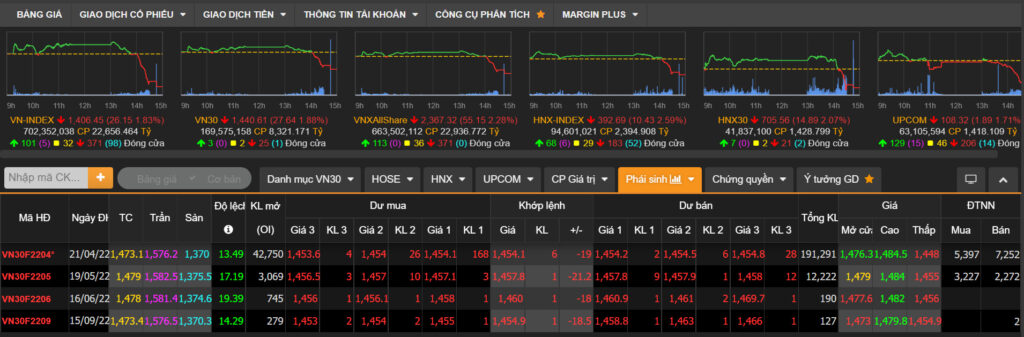
The VN30 index is at 1,440, but the VN30F1M futures contract is at 1,454
Below is another example, comparing spot and futures oil prices.
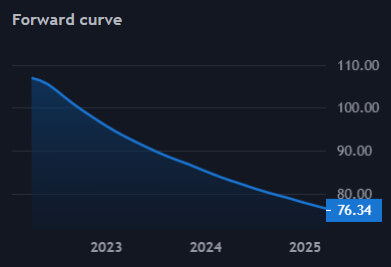
Oil futures prices across maturities: later maturities are priced below nearer ones
According to the theory above, the futures price should be higher than the spot price, yet in practice you see many cases where the futures price is lower than the spot price; in other words, futures prices do not follow the pricing formula above. What causes this difference?
One factor that can push the spot price above the futures price is the “immediate” benefit of holding the asset, which makes buyers want the physical asset now rather than later. In winter, for example, spot oil often trades above futures because of the “immediate” need for energy for heating. Likewise, if a stock has strong growth potential and a high dividend payout, investors want to own it right away rather than buy it in the future, which also pushes the spot price above the futures price. The same applies to VN30 index futures.
This benefit is reflected in prices through a value called the convenience yield.
Another factor with a big impact on futures prices is storage cost. If an asset is expensive to store, traders would rather buy it in the future than on the spot market, because they would otherwise bear the storage cost. This pushes the futures price above the spot price.
Combining these factors, we get the formula for pricing a futures contract:
F0 = S0(1 + r)T – Convenience yield + Storage cost
As expiration approaches (small T), the futures and spot prices move closer together, and they converge at expiration.
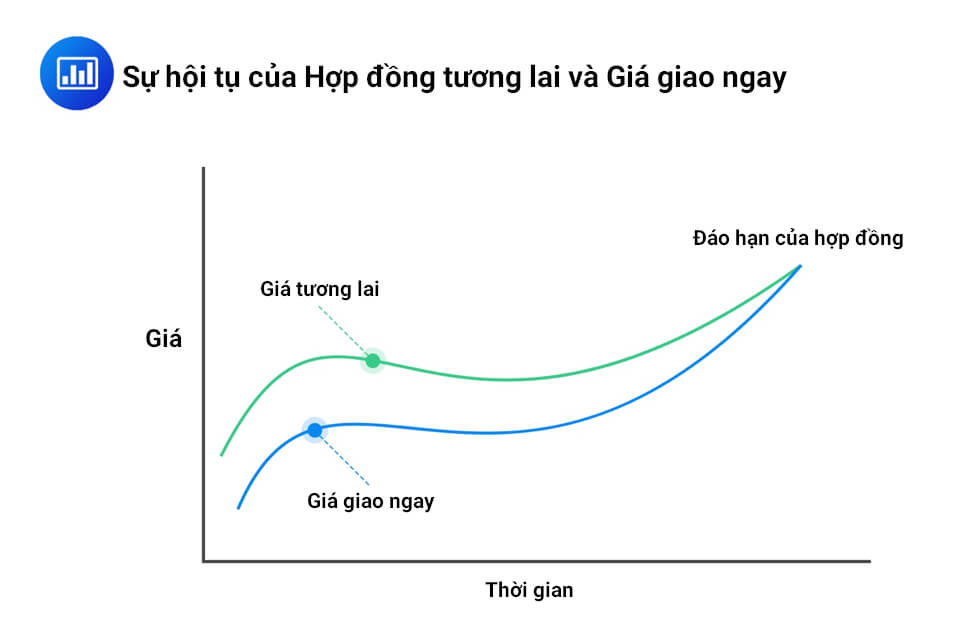
What futures pricing tells us
The price of a futures contract is the market’s expectation of the asset’s future price. For example, if the May VN30 index futures contract is priced at 1,430, traders are forecasting that the VN30 index will be at 1,430 in May. Keep in mind that this is traders’ expectation, not an accurate forecast.
By looking at the difference between spot and futures prices, you can also gauge physical demand for the asset. For example, when the spot price is above the futures price, the convenience yield is large and traders would rather buy the physical asset than the futures contract.
Technical Analysis course – CMT Level 1
Green Chart designed this course specifically for candidates who want to study and prepare for the CMT Level I exam in Vietnam. The programme includes 27 sessions of theory, practice questions and mock exams. Students also receive free course materials, question banks and mock exams for their exam preparation, plus free lifetime retakes of the course.
Find out more about the course here.
Happy trading!