

Contents of this article
Porter’s Five Forces is a model for analysing the five competitive forces in an industry in order to identify the industry’s strengths and weaknesses, which in turn helps a company choose the right business strategy. The framework was developed by Harvard University lecturer Professor Michael Porter.

Porter’s model is an industry analysis framework that helps explain why profitability differs between industries. Today it is widely used by analysts to examine the structure of an industry, and by business leaders to design the strategy that delivers the most profit for their company.
When looking at Michael Porter’s five-forces model, note the following: viewed “vertically”, we are looking at the factors that affect the competitiveness of companies operating within the same industry. Viewed “horizontally”, we are looking at the factors that affect the competitiveness of the industry’s value chain.
The ultimate goal of the Five Forces model is to show how profitable an industry is and how sustainable that profitability is.
The 5 forces in the Five Forces model are:
- Barriers to entry (the threat of new entrants).
- The threat of substitute products.
- The bargaining power of suppliers.
- The bargaining power of buyers.
- The intensity of rivalry among existing competitors in the industry.

Barriers to entry
A company’s strength is also affected by new competitors entering the market. New entrants can reduce the market share of existing companies and thereby hit the profitability of incumbents. A company entering an industry typically faces the following hurdles:
- Government barriers: in some industries, the government restricts entry because they are sensitive and have a large impact on other industries, the environment or society, so outside companies find it hard to enter. Competition between incumbents and potential outside rivals is therefore low. In Vietnam, industries where the government usually imposes strict requirements on new entrants include aviation, telecommunications and power.
- Brands and intellectual property: in practice, many industries demand extensive know-how and impose strict intellectual property requirements on would-be entrants, which is a very large barrier for outside companies. For example, the lithium battery manufacturing industry in China used to have strict patent certification requirements.
- Capital barriers: industries that require large capital investment create a barrier for companies wanting to enter.
- Economies of scale: this is also seen as a barrier to entry. When incumbents enjoy large economies of scale, it becomes even harder for new companies to break into the industry.
The threat of substitute products
When analysing competition in an industry, substitute products are one of the most important factors. Substitutes are goods or services from one business that can replace those of another at the same price and quality, but with different features or designs (pork and chicken, for example).
If a product has many good substitutes, customers have more options to meet their needs, so demand for the company’s product falls. Conversely, if a product has few full substitutes, companies’ power increases and they can charge higher prices to boost profit.
The threat of substitutes increases when:
- The cost of switching from the industry’s product to a substitute is low (low switching costs make it easier for consumers to choose a substitute over the company’s product).
- Substitutes are cheaper than the industry’s products.
- Substitutes are of equal or higher quality than the industry’s products.
The bargaining power of suppliers
The next force in the Five Forces model is the bargaining power of suppliers. In practice, almost every industry or business needs input materials for its production and operations. In some industries, inputs are the most important factor or the largest cost, so supplier power plays a crucial role in determining the industry’s profitability.
Many factors can affect supplier power. Typical signs of powerful suppliers include:
- They can raise input prices even when there is no change in demand for the goods.
- They can lower quality while keeping prices unchanged.
- When the number of suppliers in the market is limited, they can collude and adjust output to push input prices up.
- There are no substitute inputs.
- The supplier’s product is an important part of the industry’s cost structure.
- Suppliers can impose “penalties” when companies in the industry switch to another supplier.
- Suppliers can extend their own value chain without depending too much on the industry.
The bargaining power of buyers
The bargaining power of customers (buyers) also affects an industry, with a large influence on the output of companies in that industry. Buyers’ bargaining power tends to be greater when:
- Customers are highly concentrated.
- Customers’ switching costs are low, so they can easily move from the industry’s products to another industry’s.
- Customers know the industry’s products in detail.
- There are many sellers, so customers can easily change suppliers and have plenty of choice.
- The products differ little from those of other industries.
- Customers are able to produce the product themselves.
The intensity of rivalry among existing competitors
According to Porter, the first force at work in the model is competition among companies in the same industry. Existing competitors are individuals, organisations and businesses selling the same goods or products as your company, at the same price, to the same customer segment, and at comparable quality.
To assess this force, there are 2 fairly common measures: the Concentration Ratio and the Herfindahl–Hirschman Index (HHI).
The Concentration Ratio shows the share of the largest companies in the industry relative to the industry as a whole. It reflects how concentrated sellers are in the market and can therefore serve as a proxy for market structure. For example, CR4 is the combined market capitalisation of the 4 largest companies in the industry, and CR10 is that of the 10 largest. The lower an industry’s concentration ratio, the more intense the competition among its companies, and vice versa.
HHI, meanwhile, is used to determine whether a market is closer to perfect competition or to a monopoly. Competition authorities use it to assess the degree of monopoly or oligopoly in mergers and acquisitions (M&A). HHI is calculated as the sum of the squared market shares of every company in the market.
The intensity of rivalry within an industry is shaped by factors such as:
- The less differentiated the products between companies, the more intense the competition.
- The more companies there are, the greater the competition, because they have to fight each other for market share to survive.
- Low industry growth intensifies competition, because falling prices and sales force companies to work harder to hold on to their market share.
- Low switching costs also push companies to compete harder to keep their customers.
- High inventory costs in an industry force companies to work hard to find customers and sell products quickly, which intensifies competition.
- In an industry with high exit barriers, companies keep operating even at a loss, which also intensifies competition.
- Large fixed costs force companies to run at higher capacity to avoid losses, which also increases competition in the industry.
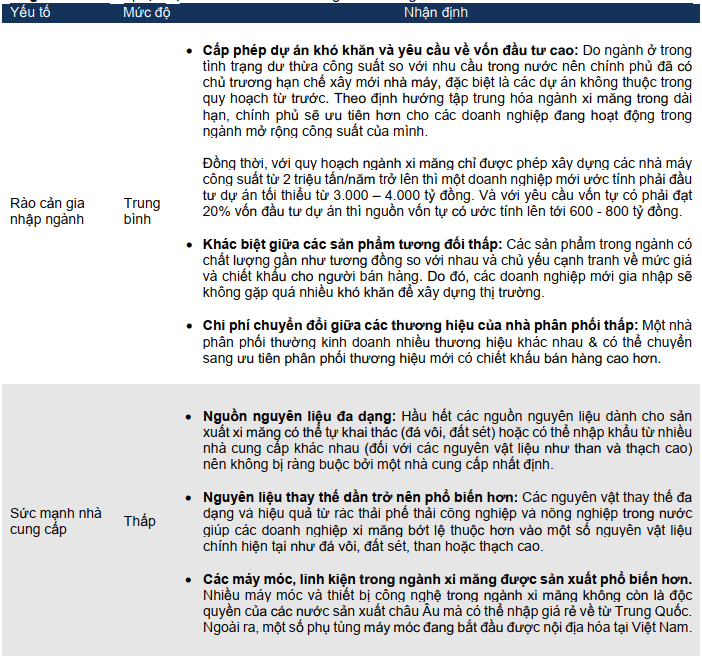
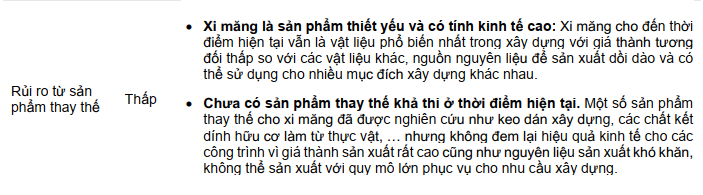
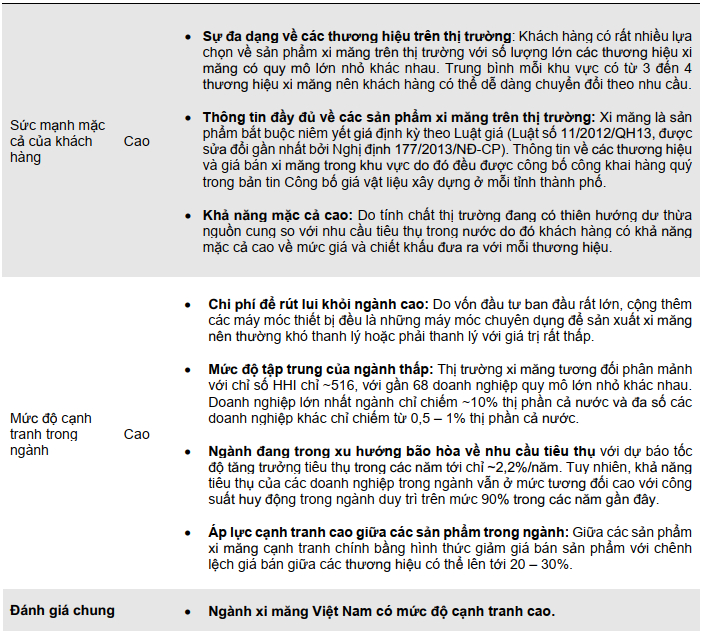
The example below illustrates applying Porter’s model to analyse the cement industry, taken from the cement industry report by FPTS.
Happy Trading!
The “Stock Trading For A Living” course
Green Chart designed this course to give students a solid foundation in fundamental analysis & stock valuation (Fundamental Analysis), and to show them how to integrate it effectively into their existing trading system, especially for traders who already use technical analysis (Technical Analysis). The program consists of 5 theory sessions and 6 months of hands-on guided trading in the live market with the lecturer.
See full details of the course here.