
Contents of this article
- Brokerage trading fees
- Some points to note about stock trading costs
- Exchange fees
- Account maintenance fees
- Margin interest
- Custody fees
- Income tax when selling shares
- Income tax on dividends
- Cash dividends
- Stock dividends
- Other statutory taxes and fees
- Derivatives trading costs
- Brokerage trading fees
- Exchange service fees
- Margin collateral management fees
- Position management fees
- Personal income tax on derivatives trading
- The “Stock Trading For A Living” course

As a new investor, before thinking about the profits the stock market can bring, which you often hear about from more experienced investors or brokers, it is wise to think soberly about the other side: stock trading costs.
These costs matter a great deal: according to a 2021 study by Dragon Capital, they are the reason more than 50% of individual investors’ brokerage accounts lose money, even in years when the VN-Index rises.
Brokerage trading fees
The stock market is currently attracting a large number of investors, and to meet demand many brokerage firms have introduced fee promotions and incentives. Brokerage fees range from 0.1% to 0.35%. Large, long-established brokerage firms with a strong position usually charge more than smaller firms, because they already have a stable client base.
Trading fees usually depend on 2 criteria: the value of your trades and whether you use a broker’s assistance. You can save quite a lot by “trading on your own” rather than relying on a broker.
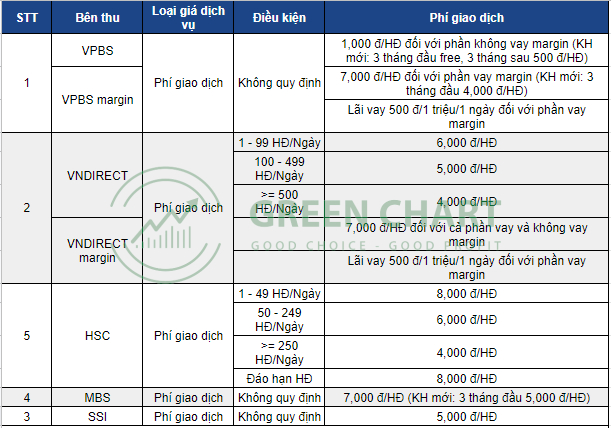
In addition, the larger your trading value, the lower your trading fee. See the summary table below of the trading fees charged by some major brokerage firms.

Some points to note about stock trading costs
Fees are charged on both BUYING and SELLING: When you buy shares, the trading fee is added directly to your cost basis, which is why many investors wonder why their cost price differs from the matched price. When you sell, you also pay a fee, just as when buying.
Example: you buy 1,000 FPT shares at VND 98,000 per share with a trading fee of 0.35%. The trade value is VND 98,000,000, so the buy fee is VND 343,000. Suppose a week later the share price rises to VND 100,000 and you want to sell to take profit. Your total trade value is now VND 100,000,000, and the sell fee is VND 350,000. Overall you made VND 2,000,000 on the trade, but paid as much as VND 693,000 in fees. With higher trading fees, you would lose even more. This is something to keep in mind if you trade short-term swings.
Fees are estimated when you place the order and actually charged when it is matched: The system estimates the trading fee as soon as you place the order and shows it together with your cost price. You only pay the fee if the order is matched. If it is not matched or you cancel it, the system refunds the money to your account.
Exchange fees
In addition to the brokerage firm’s trading fee, investors pay a fixed fee of 0.03% to the stock exchange. Some brokerage firms offer 0% fees, but investors still have to pay this fixed exchange fee.
Account maintenance fees
When you open a brokerage account, you do not have to keep any minimum balance to maintain the account, unlike a bank account.
Margin interest
Besides trading fees, one of the biggest costs is the interest you pay on a margin loan. Green Chart has a detailed article on this topic here.
Custody fees
This fee is charged to maintain the system that records investors’ shareholdings. It is very small compared with the value of the securities a client holds. It is calculated on the number of shares held, at VND 0.4 per share per month. If an investor holds 1,000 HPG shares, for example, the custody fee is only about VND 400 a month, a negligible amount.
Income tax when selling shares
Under current regulations, when transferring shares, investors pay income tax of 0.1% of the SALE value. In other words, this tax is levied only on the SELLER of the shares; the BUYER does not pay it.
Example: if you sell 1,000 FPT shares at VND 100,000 per share, the total trade value is VND 100,000,000. On this trade, the investor pays a 0.35% trading fee, i.e. VND 350,000. The investor also pays income tax on the sale of 100,000,000*0.1% = VND 100,000. The final amount the investor receives is therefore 100,000,000 – 450,000 = VND 99,550,000.
Income tax on dividends
After a profitable year of business, a company distributes part or all of its profit to its shareholders. This distribution is called a dividend. The 2 most common forms of dividend payment are cash and shares.
Cash dividends
Cash dividends are considered income for the investor, so the investor must pay tax on them. Under the regulations, investors are taxed at 5% of the cash dividend amount. This is a personal income tax (PIT) applied to shareholders when they receive dividends, at a fixed rate of 5%.
PIT payable = Taxable income x 5% tax rate.
Where:
Taxable income = Number of taxable shares x Taxable price
Taxable price:
If the sale (transfer) price ≥ par value: taxable price = par value
If the sale (transfer) price < par value: taxable price = sale (transfer) price.
Number of taxable shares: shares received as stock dividends or bonus shares are counted first.
Under the regulations, the tax authority requires listed companies to pay only 95% to shareholders, and collects the remaining 5% directly from the listed company.
Stock dividends
When you receive a stock dividend, the tax is not payable on receipt; it is collected when the investor sells the shares received as the dividend.
Other statutory taxes and fees
- Taxes and fees on gifts and inheritances of securities.
- Public tender offer fees.
- SMS notification fees and security token fees.
- Fees for cash advances against sale proceeds.
- Fees for off-exchange transactions.
Derivatives trading costs
Brokerage trading fees
This fee is set by each brokerage firm. Some firms charge nothing, but fees usually range from VND 1,000 to VND 10,000 per contract. Fees are charged on both buying and selling, so derivatives traders should choose a firm with suitable fees to keep trading costs down.

Exchange service fees
HNX currently acts as the intermediary coordinating opposing trades. When trading, investors therefore pay a fee based on the number of contracts matched during the day multiplied by VND 3,000 per contract, charged on both the buy and sell side.
Margin collateral management fees
The value of a single contract is fairly large, so to ensure liquidity and make derivatives accessible to investors, the SSC chose a partial margin system. To trade, investors must first deposit margin with the Vietnam Securities Depository (VSD).
For example, on day T, the margin balance is Y
Margin collateral management fee on day T = Y x 0.003%
Monthly margin collateral management fee = Sum of the daily margin collateral management fees in the month, but no less than VND 320,000/month and no more than VND 2,000,000/month
Position management fees
If at the end of the day you have not closed a position and want to hold it until the next day, you pay the depository a fee to hold the position. Specifically, if at the end of day T the client’s account has Z open positions:
Position management fee on day T = Z x VND 3,000
Personal income tax on derivatives trading
Since 10 August 2017, trading futures contracts on the derivatives market has been subject to personal income tax, and corporate income tax for foreign institutions, at a rate of 0.1%. Specifically:
PIT = Transfer price per transaction x 0.1%, where
Transfer price per transaction = (Futures settlement price x 100,000 x Number of contracts x Initial margin ratio)/2
The initial margin ratio is set by each brokerage firm and ranges from 13% to 20%.
Example: an investor buys 1 VN30F1M contract at 1,000 points. The tax investor A must pay is: 1,000 x 100,000 x 1 x 13%/2 x 0.1% = VND 6,500.
We can also use the following shortcut formula:
PIT = 6.5 x Futures settlement price
Happy trading!
The “Stock Trading For A Living” course
Green Chart designed this course to give students a solid foundation in fundamental analysis & stock valuation (Fundamental Analysis), and to show them how to integrate it effectively into their existing trading system, especially for traders who already use technical analysis (Technical Analysis). The program consists of 5 theory sessions and 6 months of hands-on guided trading in the live market with the lecturer.
See full details of the course here.