Contents of this article

In Vietnam, the derivatives market is still fairly new (it launched in 2017), and individual investors have access to only three main products: VN30 index futures, government bond futures and covered warrants.
In this article, we will look at the most popular of them: VN30 index futures.
Understanding forward contracts
Let me give a basic example of a forward contract (forwards). Trader A plans to buy 100 kg of corn in one month. Corn currently costs VND 7,000/kg, and he expects it to rise to VND 9,000/kg within a month. Right now, investor A does not have enough money to buy 100 kg of corn, but if he waits a month, the price will rise and he will have to pay more. So investor A enters into a forward contract with investor B, in which A commits to buying corn from B at VND 7,500/kg in one month. One month later, even though corn has risen to VND 9,000/kg, A only has to buy 100 kg of corn at VND 7,500/kg as agreed.
Here, corn is the underlying asset, and the price of this forward contract depends on the price of corn. The risk of corn price moves (up or down) is exchanged between the two parties: A bears the risk of a price fall, while B bears the risk of a price rise. One party’s risk is the other party’s profit.

This is the most basic example of a forward contract. Today, as markets have developed, the derivatives market has grown enormously, covering many different asset classes with high liquidity.
Futures contracts
A futures contract is an agreement under which the buyer is obliged to buy the underlying asset at a predetermined future date, at a predetermined price.
In essence, a futures contract is a standardized forward contract: it trades on an organized exchange, the contracts are standardized, and margin is mandatory. The features of a futures contract include:
- A standardized underlying: if one contract specifies an obligation for 100 kg of corn, you will never come across futures on 50 kg or 500 kg of corn (which forwards can have) on the same exchange.
- Expiration date: the date on which both parties to the contract settle their obligations on the underlying asset. After this date, the futures contract no longer trades on the market.
- Exchange-traded: futures trade on an organized exchange, much like the stock market, and are regulated by the exchanges. As a result, futures prices change constantly, minute by minute and second by second, even faster than the underlying stock market. This also means the estimated profit or loss on a futures position is marked continuously, just like a stock.
- Two-way trading: unlike traditional markets, futures, like other derivatives, can be sold short. Traders can open both long and short positions without holding the asset, whereas with stocks you must own the shares in order to sell them.
- Mandatory margin: with the forward in the example above, money and goods change hands only at expiration, and no cash moves before then; futures are a little different. Your cash still does not change while the position is open before expiration, but a certain amount in your account is set aside as margin, meaning it is frozen. It is used to guarantee payment at expiration or when you close the position. Futures therefore carry no bad-debt risk the way forwards do, since forwards are not backed by any collateral. The margin ratio is set by the exchange and equals the required margin divided by the value of the futures contract.
- Leverage: traders do not need cash equal to the full value of the futures contract to open a position. They only need enough to post margin at the required margin ratio.

VN30 index futures
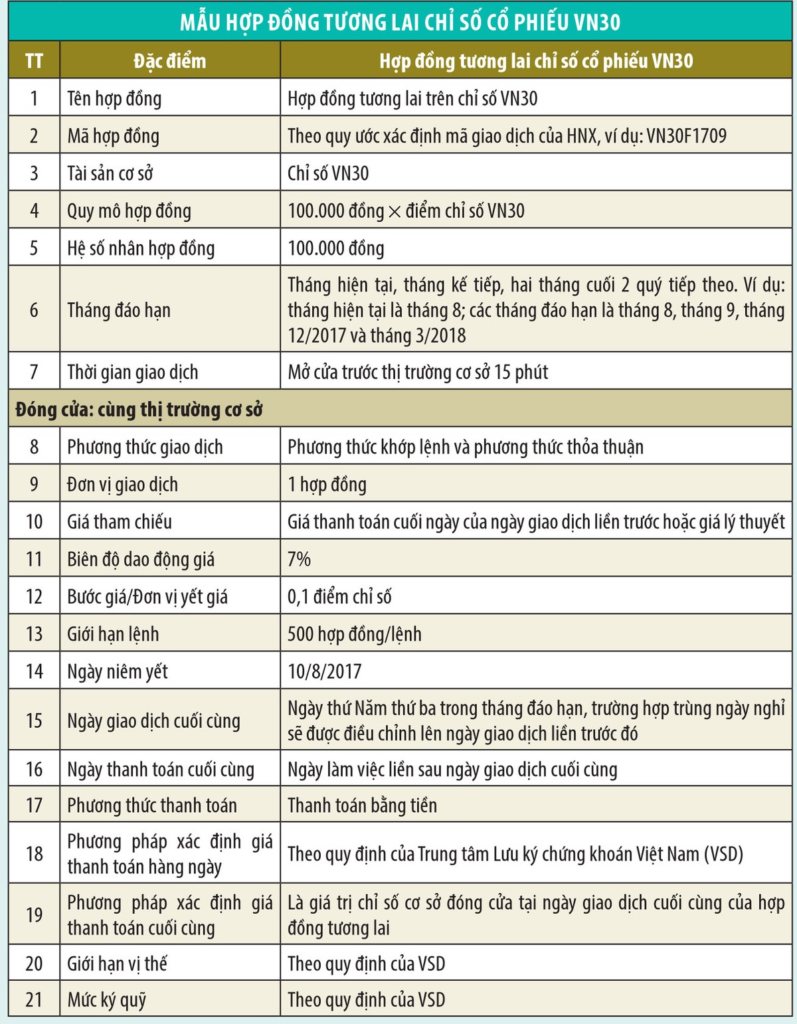
This was the first derivative product launched in Vietnam. It has all the futures features I just described, with the VN30 index as the underlying. The standardized terms of the contract are:
- The value of each contract equals the index level multiplied by VND 100,000. For example, one futures contract with the VN30 index at 1,500 points is worth VND 150 million.
- Four maturities: 1 month, 2 months, 1 quarter and 2 quarters. The contract codes are VN30F1M, VN30F2M, VN30F1Q and VN30F2Q respectively.
- Expiration date: the Thursday of the third week of the expiration month. For the F1Q and F2Q contracts, the expiration month is the last month of the current quarter and of the next quarter. Contract codes written by expiration date take the form VN30FXXYY, where XX is the last two digits of the expiration year and YY is the expiration month. For example, VN30F2110 is the futures contract expiring on 21 October 2021 (the Thursday of the third week of October 2021).
- Settlement: in cash. Traders do not have to pay to buy the index (there is no delivery of the underlying); instead, profit and loss are calculated by comparing the value of the VN30 index on the expiration date with the price at which you entered. The securities company transfers money from the losing accounts to the winning accounts.
Note: at the time of writing, 6 October 2021, the VN30F1M and VN30F2110 contracts were the same. In general, however, they are not the same contract. VN30F1M is the front-month futures contract, while VN30F2110 is the October 2021 futures contract. On 8 September 2021, for example, VN30F2110 was the VN30F2M contract, and VN30F1M was VN30F2109. This means that if you plot VN30F1M on a technical chart, it is a continuous chart built from futures contracts of different maturities rolled together.
How to calculate profit and loss on futures
Let us work through the example below. You may want to reread my guide to reading the derivatives price board. In the image, the VN30F2110 contract is priced at 1,452 points, or VND 145,200,000 under the rule above. If the margin ratio is 30%, you need VND 145,200,000 * 30% = 43,560,000 in your account to post margin and place the trade. When you buy this contract, you commit to buying the VN30 index at exactly 1,452 points at expiration.

Suppose that on 21 October 2021 the VN30 index closes at 1,467 points, while you bought at 1,452 points. You have made 15 points (because you bought 15 points below the current price), and you are paid a profit of 15 * 100,000 = VND 1,500,000.
If instead the VN30 index closes at 1,440 points, you have lost 12 points (because you bought 12 points above the current price), and the securities company deducts VND 1,200,000 from your account. If you had shorted the contract at 1,452 points and the VN30 closed at 1,440 points on expiration, you would make 12 points (think of it as selling at 1,452 and buying back at 1,440).
In addition, just as with stocks, investors can profit from changes in futures prices. Say you go long one contract at 1,452 points today; if the price rises to 1,458 points tomorrow and you short one contract to close the position, you make 6 points. If you short at 1,452 points today and buy back tomorrow at 1,441 points to close the position, you make 9 points, or VND 900,000 per contract.
How to trade futures
First and foremost, futures were designed to hedge an underlying portfolio. In the example at the start of this article, Mr. A feared that corn prices would rise, so he went long a forward to hedge that risk. You can likewise use VN30 futures to hedge your investment portfolio. For example, if you hold a portfolio of many stocks but fear the market could crash unexpectedly, you can short VN30 index futures: if the market falls, your stocks lose value but the gain on the short futures position offsets it. Once the market stabilizes again, you can take profit on the short position and keep holding your stock portfolio.
Because you can trade price differences, futures can also be used for speculation. If you expect prices to rise, you open a buy (long) position; conversely, if you expect prices to fall, you open a sell (short) position and profit from the market’s short-term declines. This is almost the only way to make money when the market falls. However, the risk is correspondingly large, because high leverage can lead to large losses in a short time.
Happy Trading!