
Contents of this article
- What Is a Bond?
- What Is the Bond Market?
- How Are Bonds Issued?
- What Are the Key Features of a Bond?
- What Types of Bonds Are There?
- By Issuer
- By Maturity
- By Interest Rate
- Bond Market Price
- What Is a Bond’s Yield?
- Returns and Risks of Trading Bonds
- How to Invest in Bonds in Vietnam
- “Stock Trading For A Living” Course

What is a bond?
What Is a Bond?
A bond is a security that represents the issuer’s debt obligation to its holder, which is why bonds are also called debt securities. According to Investopedia, a bond can be thought of as an I.O.U. between a borrower and a lender that sets out the details of the loan and its payment obligations.
Bond issuers are typically companies, banks, credit institutions, local authorities or governments that raise capital in the form of debt to fund projects and operations. Bond owners can be individuals or institutions and are called bondholders.
Issuers are obliged to pay principal and interest to bondholders at the interest rate and on the schedule specified on the bond. In other words, buying a bond means lending money to the issuer.
What Is the Bond Market?
The bond market – often called the debt market, the fixed-income market or the credit market – is the collective name for all trades and issues of debt securities, according to Investopedia. Unlike bank loans, bonds can be traded freely on the secondary market, which means a bondholder can sell their bonds to another investor, or buy bonds from another holder who wants to sell. When that happens, the issuer’s debt obligation passes to the new bondholder.
The bond market is broadly divided into two silos: the primary market and the secondary market. The primary market is often called the “new issues” market, where transactions take place directly between bond issuers and bond buyers. In essence, the primary market creates brand-new debt securities that have not been offered to the public before.
On the secondary market, securities already sold on the primary market are bought and sold at later dates. Investors can buy these bonds through a broker, who acts as an intermediary between buyer and seller.
The bond market is much larger than the stock market. Thanks to a long history of development supported by a long-term downtrend in interest rates, institutions, especially governments and companies, can easily access financing through this market. By some estimates, the global bond market has more than tripled in size over the past 15 years and now exceeds USD 100 trillion.
By contrast, S&P Dow Jones Indices puts the value of the global stock market at about USD 64 trillion. In the United States alone, the bond market is worth nearly USD 40 trillion, compared with around USD 20 trillion for the stock market.
According to data from the industry group SIFMA, bond trading volume also dwarfs stock trading volume, at nearly USD 700 billion of bonds a day versus around USD 200 billion of stocks a day (as of 2021). The relative size of the bond market shows how important it is to the financial industry, even if it is not top of mind for most investors.
How Are Bonds Issued?
For corporate bonds, securities companies play a key role in advising on the issue. They vouch for the company’s creditworthiness and advise on a suitable interest rate for the bonds.
In Vietnam, a company may make a public bond offering if it meets the following basic conditions:
- Paid-up charter capital at the time of registering the offering is more than VND 30 billion.
- The company made a profit in the year before the issue, has no accumulated losses and has no liabilities more than one year overdue.
- The issuer or the bonds being registered for offering must be rated by a credit rating agency licensed by the Ministry of Finance.
- The issuer commits to, and must, list the bonds on the securities trading system after the offering ends.
- The company must have an issuance plan and a plan for using and repaying the capital raised, approved by the General Meeting of Shareholders or the Board of Directors
Government bonds, on the other hand, are issued and offered through auctions, typically to commercial banks, investment funds, insurance companies and similar buyers…
What Are the Key Features of a Bond?
When studying bonds, investors should pay attention to the following basic features:
Face value (par value): the bond’s value at maturity, and also the amount the issuer uses as the reference for calculating interest payments.
Example: investor A buys a bond above face value (at a premium) for USD 1,090; investor B later buys the same bond at a discount for USD 980. Even so, when the bond matures, both investors receive its face value of USD 1,000. In Vietnam, the face value of a bond is set at VND 100,000.
Coupon rate: the interest rate on the bond’s face value that the issuer must pay bondholders each year. For example, a bond issued with a face value of VND 100,000 and a coupon rate of 10% means the issuer pays the bondholder VND 10,000 in interest per year.
Coupons can be paid once a year (annually), every six months (semi-annually), every quarter (quarterly) and so on, depending on the agreement between the issuer and the bondholders. In the same example, if the bond paid interest every 3 months, the issuer would pay the bondholder VND 2,500 every 3 months.
The coupon rate can be fixed or floating. For floating-rate bonds, the coupon is set by reference to market rates (for example, bond A pays LIBOR + 3%). There are also zero-coupon bonds.
Maturity: the period from the issue date to the maturity date. On the maturity date, the issuer repays the full principal, equal to face value, to the bondholder, and the debt obligation ends. Maturities vary widely, from a few months to 1, 2, 5 or 30 years, and some bonds have no maturity at all.

Example of a corporate bond
Two features of a bond – credit quality and time to maturity – are the main factors that determine its interest rate. If the issuer has a poor credit rating, the risk of default is higher, so naturally those bonds must pay a higher rate to compensate investors for their concern.
Likewise, bonds with very long maturities usually have to pay higher rates. This extra compensation reflects the greater interest-rate and inflation risk bondholders bear over a long period.

Credit ratings for a company and its bonds are assigned by credit rating agencies such as Standard and Poor’s, Moody’s and Fitch Ratings. The highest-quality bonds are called “investment grade”, and the most typical examples are US government bonds and bonds issued by companies with very stable growth.
Bonds that are not investment grade but are not currently in default are called “high-yield” or “junk” bonds. They carry a higher risk of future default, and investors demand a higher coupon to compensate for that risk.
Bonds and bond portfolios rise or fall in value as interest rates change. Their sensitivity to changes in the interest-rate environment is called “duration”. Using the term in this context can confuse new bond investors, because it does not refer to how long the bond has left until maturity. Instead, duration describes how much a bond’s price moves when interest rates change.
The rate of change in a bond’s or bond portfolio’s sensitivity to interest rates (that is, in its duration) is called “convexity”. These measures are hard to calculate, and the analysis is usually carried out by professionals.
What Types of Bonds Are There?
There are many types of bonds, classified in many different ways. This article introduces only some of the most common.
By Issuer
- Corporate bonds: issued by companies and corporations. Most issuers are banks or credit institutions.
- Government bonds: issued by a country’s government, with the Treasury acting as issuer. Government bonds can be issued in the domestic currency, or in foreign currency to raise funds for international payments.
- Municipal bonds: issued by local authorities (provinces, cities, states)
By Maturity
- Bonds with maturities under 1 year: mainly Treasury bills and commercial paper (issued by companies).
- Bonds with maturities over 1 year.
- Perpetual bonds with no maturity.
By Interest Rate
These include fixed-rate bonds, floating-rate bonds and zero-coupon bonds, as described above.
Bond Market Price
Because bonds are widely traded, they also have a market value, which is determined by supply and demand.
While a bond’s face value is set at issue and does not change until maturity (except for some special bonds), its market value (market price) moves freely with supply and demand. What if you buy a bond with a face value of VND 100,000 for VND 90,000? It means that, on top of the regular coupons, you earn an extra VND 10,000, because at maturity the issuer must still repay you VND 100,000 of “principal” even though you only paid VND 90,000 for it! However, when the market values a VND 100,000 debt at only VND 90,000, that partly signals that the bond’s quality is not good and that investors doubt the issuer’s ability to repay. Bonds whose market price is below face value are called discount bonds.
However, a discount bond does not always signal higher-than-normal risk. For many bonds with maturities under 1 year, for example, paying coupons is unnecessary because it would disrupt the issuer’s short-term cash flow and be inconvenient for bondholders. These bonds are therefore issued without a coupon and trade below face value so that investors still earn a return.
In addition, rising market interest rates also push bond prices down, as I explain in the next section.
Conversely, what if you are willing to pay VND 110,000 for a bond with a face value of VND 100,000? Your actual return will be somewhat lower, but the market sees the issuer as lower risk. Bonds whose market price is above face value, as in this example, are called premium bonds. Bonds whose market price equals face value are called par bonds.
What Is a Bond’s Yield?
Because a bond’s market price differs from its face value, the coupon rate is only nominal and does not reflect the investor’s true rate of return. Instead, investors should focus on the figure that accurately reflects the return on the bond: the bond yield.
There are several kinds of yield based on different interpretations, but in this article we will cover only the most common one, which is quoted on technical charts and used to build the yield curve: yield to maturity (YTM).
This yield accurately reflects the annual rate of return on the exact amount you paid for the bond if you hold it to maturity. It is calculated on a compounding basis (the starting capital, minus the coupon withdrawn, becomes the capital for the next period).
Suppose a bond has a face value of VND 100,000, a 3-year maturity and a 5% annual coupon, and you buy it at VND 92,269. Its yield is then 8%, meaning the return on your initial investment (VND 92,269) is 8%. In other words, a VND 100,000 debt at 5% interest is equivalent to a VND 92,269 debt at 8% interest, as follows:
In the first year, your VND 92,269 earns 8% interest, so the end-of-period balance is 92,269 × 1.08 = 99,650.
The issuer pays a coupon of 100,000 × 5% = 5,000, so the end-of-period balance after the coupon is 99,650 – 5,000 = 94,650. Repeating this for the following years gives the table below:
| Year | Opening balance | Closing balance before coupon | Coupon | Closing balance after coupon |
| (A) | (B) = A × 1.08 | (C) | (D) = (B) – (C) | |
| 1 | 92,269 | 99,650 | 5,000 | 94,650 |
| 2 | 94,650 | 102,222 | 5,000 | 97,222 |
| 3 | 97,222 | 105,000 | 5,000 | 100,000 |
As you can see, the balance at the end of year 3 is exactly VND 100,000, the bond’s face value. When the bond matures, you receive VND 100,000 in principal and the issuer’s debt obligation ends. Using the bond’s market price and its basic features, you can calculate its yield with the following equation:

Formula for calculating a bond’s yield
From this formula, it follows that:
- Yield and bond price move in opposite directions: when price rises, yield falls, and vice versa.
- For a par bond, the yield is exactly equal to the coupon rate.
- For a discount bond, the yield is higher than the coupon rate.
- For a premium bond, the yield is lower than the coupon rate.
The relationship between bond price and yield
Looked at another way, a bond’s yield also represents its total return if (i) the investor holds it to maturity, (ii) the issuer pays principal and interest on time and (iii) the coupons are reinvested at the same yield. This approach gives a clearer picture of the risks of investing in bonds, though its drawback is that coupons cannot always be reinvested at the same yield.
Returns and Risks of Trading Bonds
In the capital structure of an organization, corporation or government, debt is always repaid before equity. So the risk of bonds can be considered much lower than that of stocks. But, as the saying goes, “high risk, high return”: bonds deliver lower returns than stocks.
Investors can earn returns from bonds in two ways: from interest, and from the difference between the purchase price and market value. If you hold a bond to maturity, you are certain to make a profit as long as the issuer does not default, regardless of whether its price rises or falls along the way.
Although bonds are considered less risky than stocks, they do carry certain risks to be aware of. The biggest is the risk that the issuer defaults or can no longer repay its debt (default risk). Corporate bonds always carry some level of this risk, whereas government bonds issued in the domestic currency carry essentially none, because the government can collect taxes or print money to repay its debt.
Thanks to that guarantee, government bond rates are almost always lower than corporate bond rates. Government bonds issued in foreign currency always carry default risk, depending on the country’s foreign exchange reserves. The recent case of Argentina, which was unable to pay interest to its lenders, is one example.
Interest-rate risk is another hidden risk of investing in bonds. Market interest rates and bond yields are not always the same, but they are closely linked.
When market interest rates fall, bond yields fall too, because investors pour money into higher-yielding assets (as soon as market rates drop), pushing bond prices up and yields down. You can then sell the bonds you hold to lock in an immediate profit. The risk when rates fall, however, is that you will have to reinvest your money at lower rates (reinvestment risk).
Conversely, when market interest rates rise, bond prices fall and yields rise. This creates price risk if you sell the bond straight away; however, you do not face reinvestment risk as in the previous case, because you will have opportunities to invest in other assets at higher rates.
How to Invest in Bonds in Vietnam
Today, investors can easily buy corporate bonds in Vietnam through securities companies. However, Vietnam’s bond market is still less developed than its stock market, so investors can only buy the bonds their securities company has selected. For example, investors can easily buy Vingroup and Masan bonds through the securities company TCBS, while at VNDirect they can only trade bonds of IPA, C4G, BHB and a few others…
The bond price board shows all the key information, such as face value, coupon rate, maturity, market price and yield. Placing buy and sell orders for bonds is no different from placing orders for stocks.
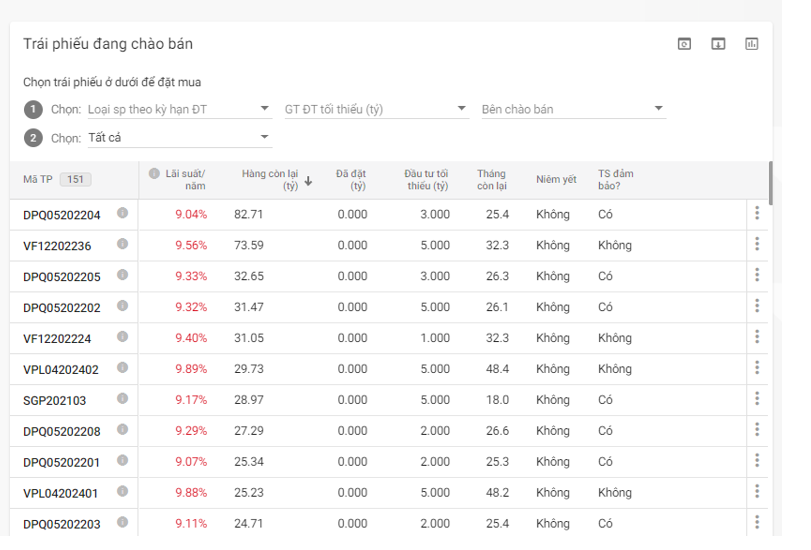
Bond price board
Investors also need to meet certain conditions set by the securities company to buy bonds. At VNDirect, for instance, investors need a minimum of VND 10 million to buy bonds, and some unlisted bonds can only be bought by professional investors (with a NAV above VND 2 billion, a securities practising certificate, or pre-tax income above VND 1 billion).
Government bonds can be bought by placing negotiated (put-through) orders on HNX through a securities company, or through some banks’ accounts under the Bond investment section.
Overall, government bonds are not a very attractive investment for individual investors with small amounts of capital, because of their low yields (2–3% a year).
Happy Trading !
“Stock Trading For A Living” Course
Green Chart designed this course to build a solid foundation in fundamental analysis & stock valuation (Fundamental Analysis), while showing students how to integrate it effectively into their existing trading system, especially for traders who already use technical analysis (Technical Analysis). The program includes 5 theory sessions and 6 months of hands-on trading guidance in the live market with the instructor.
See full course details here.