Contents of this article
Depending on how centralized it is, the stock market can be divided into 2 types: the centralized (exchange) market and the decentralized (over-the-counter) market. Many readers will be very familiar with the centralized stock market, traded through exchanges such as HOSE and HNX. So how is the decentralized market, or OTC market, different?

The OTC Stock Market
The OTC stock market is a decentralized market where buyers and sellers of shares trade by negotiating prices, connected through an intermediary. OTC stands for over-the-counter, meaning trading across a counter, and here the “counter” is the intermediary.
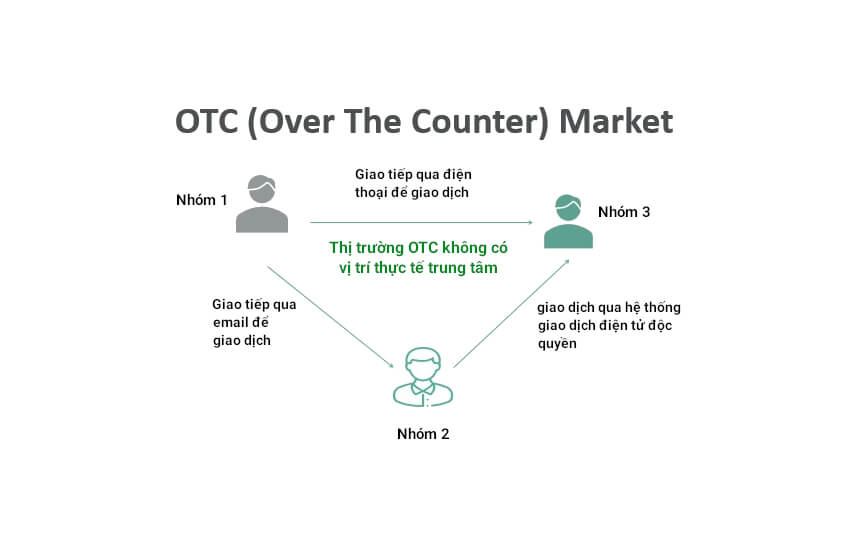
When trading on the OTC market, investors place buy and sell orders for the number of shares they want; the intermediary then connects buyers with sellers, and the two sides negotiate to agree on the price and the number of shares. The price is set by a willing buyer and a willing seller, not by any outside factor.
Characteristics of the OTC Market
While listed stocks trade on the centralized market through exchanges such as HOSE and HNX, the OTC market is where unlisted stocks trade. Because they are unlisted, these companies are less widely known to the public and less closely supervised, so investors have access to less information. That said, listed stocks can also be traded on the OTC market.

The OTC stock market is relatively less liquid than the centralized market because of its negotiated trading method, and limited access also keeps trading volumes in these stocks low. As a result, the OTC market is riskier and not suitable for every investor.
Negotiated trading also makes it harder to establish a market price than centralized trading does. To improve liquidity and market efficiency, intermediaries now also quote prices to the market, and traders buy and sell shares directly with the intermediary.
For example, when many traders place buy orders for a stock at VND 50,000, the intermediary may bid VND 50,000 or more for that stock, and that price can be treated as the reference market price. Traders who want to sell can then sell directly to the intermediary. The intermediary can also offer the stock at a price above its bid and profit from the spread between the two prices.
So an intermediary on the OTC market can play 2 roles: arranging trades (broker) and trading with investors itself (dealer).
Settlement arrangements also vary: T+0, T+1, T+2 and so on, depending on each market and each stock. Trading hours are not restricted as they are on HOSE and HNX, so you can trade in the evening or at weekends.
The Appeal of the OTC Market

Although the OTC market still has many limitations compared with the centralized market, it attracts many investors thanks to some appealing features.
First, OTC stocks often deliver higher returns than listed stocks, because they are not yet known to many investors, which makes the market less efficient. As a result, you can find many attractive stocks priced well below their true value (undervalued).
In addition, unlisted stocks are often shares of young companies, which usually grow much faster than mature listed companies.
What Are the Risks of OTC Trading?
Alongside attractive returns, the OTC market also carries quite a few risks compared with the centralized market. The first is liquidity risk: with low trading volume and wide bid-ask spreads, investors will find it very hard to buy and sell shares at prices close to the market price.

In addition, because the OTC market is not as closely supervised as the centralized market, price manipulation happens more often and harms many investors. Limited access to company information also makes it hard for traders to analyze stocks, since the companies are not required to publish financial statements or annual reports under the rules of the State Securities Commission of Vietnam (SSC).
How Do You Trade OTC Stocks?
To trade OTC stocks, you first need an account with an intermediary on the OTC market. Some reputable OTC intermediaries in Vietnam today include Sanotc.com and Giacophieu.vn…
“Stock Trading For A Living” Course
Green Chart designed this course to build a solid foundation in fundamental analysis & stock valuation (Fundamental Analysis), while showing students how to integrate it effectively into their existing trading system, especially for traders who already use technical analysis (Technical Analysis). The program includes 5 theory sessions and 6 months of hands-on trading guidance in the live market with the instructor.
See full course details here.
Happy trading !