Contents of this article
The derivatives market is an indispensable part of modern financial markets, and understanding what derivative products are and the role they play gives traders a significant competitive edge.
What is a derivative?
A derivative instrument, or derivative contract (derivatives), is a type of financial asset that trades on the market and uses a basic asset (stocks, commodities, currencies, etc.) or an economic index (such as an interest rate) as its underlying.
The term derivative refers to a financial contract whose value depends on an underlying asset, a group of assets or some benchmark value. Derivatives are set up between two or more parties and can be traded on an organized exchange or in the over-the-counter (OTC) market.
Derivative contracts can be used to trade any quantity of an asset, and they carry their own risks. The price of a derivative is derived from movements in the underlying asset. These securities are often used to gain access to certain specialized markets and can be traded to hedge risk. Derivatives can be used to reduce risk (hedging) or to speculate. Derivative contracts are also a tool for transferring risk from risk-averse investors to risk seekers.
In a derivative contract, the buyer and seller exchange the risk and reward of the underlying asset, and the contract requires both parties to carry out rights or obligations related to that underlying.
In Vietnam, the derivatives market is still fairly new (it launched in 2017), and individual investors only have access to futures and options. VN30 index futures were the first product launched in Vietnam, followed by government bond futures and, most recently, commodity futures. Covered warrants are currently the only options product traded in Vietnam, and commodity options may follow soon.
Traditional assets such as stocks, bonds and commodities trade on the spot market, where trading happens the traditional way: the buyer pays and receives the asset from the seller straight away (T+0, T+1 and T+2 can all be considered spot).
Derivative contracts, on the other hand, trade on the derivatives market and are based on underlying assets from the spot market. The way trading works, and the way cash and assets are exchanged, is also quite different from the underlying market.
A derivatives market can be either an exchange-traded market or an over-the-counter (OTC) market.
What role does the derivatives market play?
A derivative contract is created from an underlying asset, so its risk and return characteristics are similar to those of the underlying. So why create derivative products at all?
The answer is that the derivatives market was created to overcome the weaknesses of the spot market. Specifically, in the underlying stock market, investors are only allowed to sell shares they actually own, so they cannot profit when the market falls. The derivatives market, by contrast, allows investors to sell short. In general, the derivatives market lets you trade in both directions, long and short, so you can profit whether prices rise or fall, and it lets you use short hedging if you still want to hold your underlying portfolio in adverse market conditions.
The derivatives market also increases market liquidity. In commodities, for example, trading on the spot market means taking physical delivery, which is cumbersome and involves heavy transport and storage costs (especially if you trade crude oil or gas). Commodity derivatives were created so that traders can trade online much more easily.
Characteristics of the derivatives market
From the purposes of the derivatives market, you can already infer some of the defining features of the market and its products: risk and return characteristics similar to the underlying, two-way trading and high liquidity. The market also has other features, such as:
- High leverage: the trading leverage of derivatives is far greater than that of the underlying assets. VN30 futures allow leverage of 5.6 times, while some commodity futures allow leverage of up to 18 times.
- Low trading fees: fees on derivatives are much lower than on the underlying assets.
Common types of derivative contracts
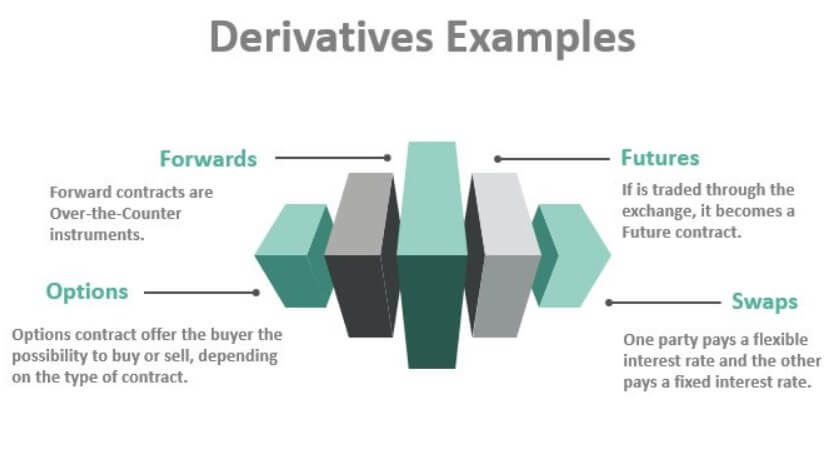
Derivatives fall into four main types: forward contracts (forwards), futures contracts (futures), swap contracts (swaps) and options contracts (options).
Forward contracts (forwards)
This is the most basic of all derivatives. A forward contract is an agreement under which the buyer (seller) is obliged to buy (sell) the underlying asset at a predetermined future date, at a predetermined price.

Example: trader A plans to buy 100 kg of corn in one month. He enters into a forward contract with investor B, in which A commits to buying 100 kg of corn from B at VND 7,500/kg in one month. One month later, A is obliged to buy 100 kg of corn at VND 7,500/kg as agreed. Even though the price of corn has by then risen to VND 9,000/kg, A only has to pay VND 7,500/kg.
Here, corn is the underlying asset, and the price of this forward contract depends on the price of corn. The risk of corn price moves (up or down) is exchanged between the two parties: A bears the risk of a price fall, while B bears the risk of a price rise. One party’s risk is the other party’s profit.
Forward contracts are usually traded OTC.
Futures contracts (futures)
Like a forward, a futures contract is an agreement under which the buyer is obliged to buy the underlying asset at a predetermined future date, at a predetermined price. What sets futures apart from forwards is that the contracts are standardized. With corn as the underlying, for example, a futures contract is standardized at 5,000 bushels, with expiration months of March, May, July, September and December each year (CBOT corn futures), whereas you may come across other quantities and expiration dates when trading forwards.
Futures are also traded on an organized exchange, which gives them stronger legal standing than forwards. Futures differ from forwards in many other ways too; you can read more in our article on futures contracts. Traders use futures to hedge or to speculate on the price of an underlying asset. The parties involved are obliged to honour their commitment to buy or sell the underlying asset.
Example: suppose that on 11 June 2022, Company A buys an oil futures contract at USD 62.22 per barrel, expiring on 19 December 2022. The company does this because it needs oil in December and is worried that prices will rise before it needs to buy. Buying an oil futures contract hedges the company’s risk, because the seller is obliged to deliver oil to Company A at USD 62.22 per barrel when the contract expires. Suppose the oil price rises to USD 80 per barrel by 19 December 2022: Company A can accept delivery of the oil from the futures seller or, if it no longer needs the oil, it can sell the contract before expiration and keep the profit.
In this example, both the futures buyer and seller are hedging their risks. Company A needs oil in the future and wants to offset the risk of a price rise in December with a long position in oil futures. The seller could be an oil company worried about falling oil prices that wants to eliminate that risk by selling, or shorting, a futures contract that locks in the price it will receive in December.
It is also possible that one or both parties are speculators with opposite views on the direction of December oil prices. In that case, one may benefit from the contract and the other may not. For example, West Texas Intermediate (WTI) crude oil futures trade on the CME in lots of 1,000 barrels. If the oil price rises from USD 62.22 to USD 80 per barrel, the trader with the long position, the buyer, in the futures contract gains USD 17,780 [(80 – 62.22) x 1,000 = 17,780]. Conversely, the trader with the short position, the seller, loses USD 17,780.
Swap contracts (swaps)
Swaps are another common type of derivative, typically used to exchange one stream of cash flows for another. For example, a borrower can use an interest rate swap to switch from a floating-rate loan to a fixed-rate loan, or vice versa.

For example, traders A and B agree to enter into a swap in which, at the end of each year, A pays B interest at 5%, while B pays A interest at LIBOR + 2%, on the same notional amount of VND 1 billion. The cash flow B pays A varies with the floating LIBOR rate, so the profit and risk for both parties depend on interest rates. In this example, if LIBOR > 3%, the interest B pays A will exceed what A pays B, so B loses and A gains.
Swaps can also be structured to exchange currency-exchange rate risk or default risk on a loan or on cash flows from other business activities. Swaps on the cash flows and default risk of mortgage bonds are an extremely common type of derivative around the world. In fact, historically, it was the counterparty risk of swaps that pulled the market into the spiral of the 2008 credit crisis.
Options contracts (options)
An options contract is a derivative that gives the holder the right to buy or sell an underlying asset at a predetermined price.
An options contract is similar to a futures contract in that it is an agreement between two parties to buy or sell an asset on a predetermined future date at a specific price. Options can also be used to hedge or to speculate on the price of the underlying asset.
In Vietnam, the first and only options product traded so far is the covered warrant (CW).
The fundamental difference between options and futures is that, with an option, the buyer is not obliged to carry out the agreement to buy or sell. The option holder has the right, but not the obligation, to buy or sell the underlying asset at a predetermined price at the time of exercise.
Example: an investor owns 100 shares worth $50 per share and believes the stock will rise in value in the future. However, the investor is worried about potential risks and decides to protect the position with an option. He can buy a put option (long put) that allows him to sell those 100 shares at $50 per share (the strike price) on a specific future date (the expiration date).
Suppose the stock falls to $40 per share by the time the option expires, and the put buyer decides to exercise by selling the shares at the agreed strike price of $50 per share. If the put cost the investor $200 to buy (the option premium), they lose only the cost of the option, because the strike price equals the stock price at the time they originally bought the option. A strategy like this is called a protective put, because it hedges the risk of the stock falling.
Alternatively, suppose an investor sees a stock currently priced at $50 per share and believes it will rise over the next month (and does not yet own it). He can buy a call option (long call) that allows him to buy the stock at $50 before or at expiration. Suppose this call costs $200 and the stock price rises to $60 before expiration. The investor can now exercise the option and buy a $60 stock at the original $50, making $10 per share before subtracting the cost of the option, the premium or any brokerage commission.
In both examples, the seller is obliged to honour the terms of the contract if the buyer chooses to exercise. However, if the stock price is above the strike price when the option expires, the put option will be worthless and the seller (the option writer) keeps the premium. Conversely, if the stock price is below the strike price when the option expires, the call option will be worthless and the call seller keeps the premium.
Who participates in the derivatives market?
The main purpose of derivative contracts is to help traders hedge risk. The derivatives market lets traders manage risk easily without having to trade the spot asset.
Take the forward example above: if the current price of corn is VND 7,000/kg and it is expected to reach VND 9,000/kg in one month, investor A fears the price will rise and he will have to buy at a high price. So investor A buys a forward contract to reduce this risk, without having to pay the full cost of the corn up front.
The derivatives market is also used for speculation. A trader opens a long position if they think prices will rise, and vice versa. Low trading fees, high leverage and the ability to go both long and short make the derivatives market extremely attractive.
Happy Trading!