

Contents of this article
What is a value chain?
A value chain (value chain) is a series of activities that add value to a product at each step of a process. For a given product, the value chain covers all the steps that turn an idea into a finished product, such as product design, extracting and producing raw materials, manufacturing the product and delivering it to consumers.
A company carries out value chain analysis by assessing the detailed procedures involved in each step of its business. The purpose of value chain analysis is to increase production efficiency so the company can deliver maximum value at the lowest possible cost.
With price competition intensifying, companies must constantly review the value they create in order to maintain their competitive advantage. The value chain can help a company identify the inefficient parts of its business, then implement strategies to optimise its processes, improve efficiency and maximise profit.
Besides ensuring that production runs smoothly and efficiently, companies also need to keep customers feeling confident and secure enough to stay loyal, and value chain analysis can help with this too.
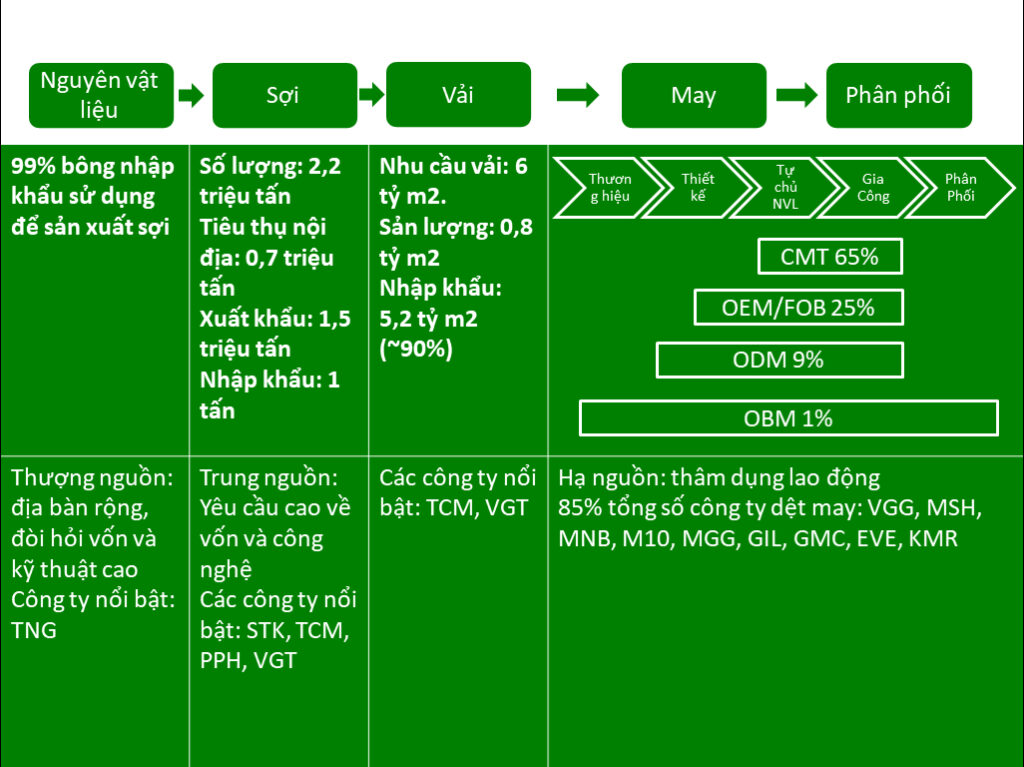
Looking at the value chain, we can easily see that producing a finished shirt starts with harvesting cotton to make yarn, then using the yarn to weave fabric, and finally sewing the shirt that reaches the consumer. Each of these steps adds value to the product (cotton -> yarn -> fabric -> shirt), and together they form the textile and garment value chain.
What are the benefits of value chain analysis?
The value chain framework helps companies understand and assess how efficiently they use their costs. Value chain analysis can help a company in the following ways:
- Supporting decisions across different business activities.
- Identifying inefficiencies so corrective action can be taken.
- Understanding the links and dependencies between different activities and areas of the business. For example, human resources and technology issues can affect almost every business activity.
- Optimising activities to maximise output and minimise organisational costs.
- Creating a cost advantage over competitors.
- Understanding core competencies and areas for improvement.
Value chain analysis can deliver important benefits; however, due attention still needs to be paid to the company’s overall strategy, not just to the value chain on its own.
A company’s position in the value chain
After analysing the value chain, investors can assess a company’s position in it based on its business activities. In the textile and garment example above, May 10 (M10) buys fabric and then makes clothing, so M10 is considered a company operating in the garment segment of the value chain.
Century Synthetic Fiber (STK) imports virgin plastic pellets and fibres to produce synthetic polyester yarn, so it operates in the yarn segment, while Thanh Cong Textile Garment (TCM) operates in all 3 segments, yarn, fabric and garments, giving it a more complete value chain than the other two.
Very few companies in the industry can handle every stage of the value chain, so companies in the same industry at different positions in the chain are all important links in creating the product. For example, STK produces yarn and sells it to TCM to weave fabric; the fabric is used as an input by M10 to sew clothing, which is then supplied to Adidas and distributed to consumers, and so on.
The early stages of the value chain are classified as upstream, followed by midstream and downstream. Companies in the value chain earn profit from the value they add to the product. For example, STK profits from the spread between the price of yarn and the price of virgin plastic pellets, while Adidas profits from its brand value.
The components of the value chain
According to Porter’s value chain theory, a company’s activities fall into 2 main groups: primary activities and support activities. Primary activities are the main activities that add value to the product, including:
- Inbound logistics: purchasing, storage and inventory management.
- Operations: production activities that turn raw materials into products.
- Outbound logistics: distributing products to customers
- Marketing and sales: activities that promote the product and make it easier for consumers to access.
- Service: activities that improve the user experience, such as customer care and warranties.
Besides the primary activities, the value chain also includes support activities that help the company’s primary activities run more smoothly. There are 4 of them: procurement, technology, HR and infrastructure, as follows:

The role of support activities is to make the primary activities more efficient. When a company improves the efficiency of any of the four support activities, it benefits at least one of the five primary activities. These support activities usually show up as overheads on the company’s income statement:
- Procurement: how a company obtains its raw materials.
- Technology development: used in a company’s research and development (R&D) stage, such as designing and developing production techniques and automation processes.
- Human resource management (HR): recruiting and retaining the employees who will execute the company’s business strategy and help design, market and sell its products.
- Infrastructure: the company’s systems and the management team that runs them, such as planning, accounting, finance and quality control.
How to analyse a value chain
In industry and company analysis, value chain analysis helps analysts understand the factors that can affect an industry and a company, and helps companies improve their competitive advantage. The steps in value chain analysis are:
- Identify the product’s value chain and the company’s position within it.
- Identify the company’s inputs and outputs. For example, M10 is a garment maker that uses fabric as an input and produces finished clothing as its output. Because it has to buy fabric, a fall in fabric prices will improve its profit margin. Its output is finished clothing, so it depends on the volume of orders from distributors.
- Look at the profit margins of companies in the industry to assess the intensity of competition. In the textile and garment industry, for example, the yarn segment usually has the lowest margins because it has a large number of companies and intense competition. This is partly because the basic investment cost in yarn is significantly lower than in weaving and garments.
Happy trading!
The “Stock Trading For A Living” course
Green Chart designed this course to give students a solid foundation in fundamental analysis & stock valuation (Fundamental Analysis), and to show them how to integrate it effectively into their existing trading system, especially for traders who already use technical analysis (Technical Analysis). The program consists of 5 theory sessions and 6 months of hands-on guided trading in the live market with the lecturer.
See full details of the course here.