Contents of this article
- What Is an IPO?
- Round 1 – Angel Investors
- Round 2 – Venture Capital
- Round 3 – Debt and Retained Earnings
- Round 4 – Private Equity
- Round 5 – Initial Public Offering (IPO)
- Key Things to Know About IPOs
- What Is the Purpose of an IPO?
- Other Reasons for an IPO
- The Role of Investment Banking
- What Happens After the IPO?
- Some Major Successful IPOs in Vietnam
- “Stock Trading For A Living” Course
In this article, we walk through the stages of a company’s growth, from the initial idea to becoming a company listed on the stock market (IPO). It is a useful way to understand the nature of the stock market, especially for anyone starting out on the path of founding and building their own business.
What Is an IPO?
An IPO (initial public offering) describes a company offering its securities to the public for the first time. It is a way of raising capital from investors by listing shares for the first time on a stock exchange or issuing them through brokerage intermediaries. After the IPO, the privately held company becomes a public company.

Let’s start with the example of an imaginary clean-food business called Green Food and follow how it grows.
Round 1 – Angel Investors
Imagine a young entrepreneur with a great business idea – selling a clean tomato sauce made from produce grown on his own farm. With quality-assured farming, a delicious tomato sauce recipe inherited from his grandmother and eye-catching packaging, he is confident the business will succeed and is enthusiastic about turning the idea into a company.
As a typical start-up founder, the young CEO faces the typical start-up problem: first of all, where is the money? Let’s assume that, with little business experience, he has almost no chance of attracting any large, serious investors at this early stage. So the first people he approaches are his family and friends, to pitch the idea and raise some initial capital. He could also go to a bank for a loan, but that is not the best option at this point.
Let’s assume the CEO puts in VND 400 million of his own and persuades two good friends to invest another VND 100 million in his business (Mark Zuckerberg was not much luckier in the early days of building Facebook). These two friends are investing before the company has any revenue, betting on their “faith” in the young CEO; they are called angel investors. Note that money from angel investors is not a loan; it is a genuine investment.
So let’s imagine that the young CEO and the angels (I’ll just call them angels, because to our start-up CEO that is exactly what they are) have raised a total of VND 500 million to launch the project. The initial money he has to start his business is called the “seed fund”. It is important to note that the seed fund does not sit in the CEO’s personal bank account but in the company’s bank account. Once this capital reaches the company’s account, it is treated as the initial charter capital .
In return for the seed investment, the three original backers (the CEO and the 2 angels) are issued a number of shares and become shareholders of Green Food.
At this stage, the company’s only asset is VND 500 million in cash. Issuing shares is quite simple: the company sets each share at VND 10,000 and authorizes 50,000 shares. Here, VND 10,000 is the share’s par value, and the total of 50,000 shares is the company’s authorized share capital. Some of these shares must be allocated to the CEO and the two angels, and the rest held back for future shareholders.
So, assuming the CEO takes 40% and the two angel investors take 5% each, the company still has 50% of its shares unallocated. The ownership structure now looks like this:
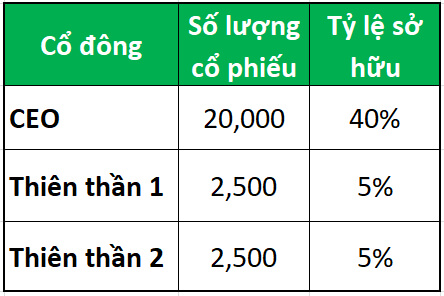
You can easily see that, with VND 100 million invested by the two angels in exchange for 10% of the shares, Green Food is currently valued at VND 1 billion.
Note that the company still holds the remaining 50%, or 25,000 shares. These shares are authorized but not yet issued.
Now, backed by its founding shareholders and a healthy seed fund, the young CEO launches his business. He wants to start cautiously, so he opens just one small production workshop and one shop to sell his tomato sauce.
Round 2 – Venture Capital
The young CEO’s efforts pay off and the business takes off. By the end of its first two years, the company is profitable. The CEO is no longer a novice; he understands his business better and is, of course, more confident.
With that confidence, the CEO wants to expand Green Food by adding another production workshop and a few more tomato sauce shops in the city. He draws up a plan and calculates that the expansion will need a new investment of VND 1 billion.
He is now in a much better position than two years ago. The big difference is that his business is profitable, and its healthy revenue stream underpins the company’s potential. The CEO can now approach more knowledgeable investors with deeper pockets. Suppose he meets one such professional investor, who agrees to pay VND 1 billion for 10% of Green Food (this may start to sound familiar from Shark Tank).
Investors who typically invest at this early stage of a business are called venture capitalists (VCs), and the money the business receives at this stage is called the Series A round.
After the company agrees to sell 10% of its authorized shares to the VC, the shareholder structure changes as follows:

Note that 40% of the shares are still held by the company and have not been issued to anyone. Something interesting to notice here: by buying 10% for VND 1 billion, the venture capitalist has valued the whole of Green Food at VND 10 billion. Compared with the initial valuation of VND 1 billion, the company’s value has risen tenfold (wow!). This is the first success of a good business plan, confirmed by a healthy income stream.
With the higher valuation, the original angels’ investments have also risen tenfold. This is the reward for those who take the risk of joining a company very early (in real life, the first two friends who helped Mark build Facebook have both become billionaires).

With the higher valuation, the original angel investors’ investments have also risen tenfold.
Back to our story: the young CEO now has the capital he needs to expand. As planned, the company adds a processing workshop and a few more shops in the city. Everything is going brilliantly: the tomato sauce is becoming more and more popular, bringing in higher revenue. The management team is becoming more professional, improving efficiency and delivering better profits.
Round 3 – Debt and Retained Earnings
Another three years pass and Green Food has been extraordinarily successful. The company decides to open branches in 3 more cities. To do so, it plans to increase production capacity and buy more machinery for its processing workshop; in financial terms, this is called investing in “capex” – capital expenditure.
The CEO and management estimate that they need VND 5 billion for their capex. So how can the company raise this money?
There are several ways to raise capital at this point:
- The company has made some profit over the past few years, so it can reinvest part of its retained earnings instead of paying dividends to shareholders.
- The company can approach other venture capitalists and raise a new VC round by allocating some of the remaining 40% of shares – this is called the Series B round.
- The company can approach a bank and take out a loan. A bank will readily approve it, as long as the company has collateral to pledge and is performing well.
Suppose the company decides to use all three options: reinvesting VND 1.5 billion of retained earnings, raising money from venture capitalists in a Series B round by selling 5% of its shares for VND 1 billion, and borrowing VND 1.5 billion from a bank.
Note that at VND 1 billion for 5% of the shares, the company is now valued at VND 20 billion. Green Food’s shareholder structure at this point is as follows:

Note that the company still has 35% of its shares unallocated, worth another VND 7 billion. This example may sound far-fetched, but the whole point of the story is to help you understand how businesses are formed and grow, and how talented CEOs build wealth.
Classic real-life examples of such stories include Google, Facebook, Twitter and WhatsApp… or successful Vietnamese companies such as VNM, HPG, MSN and VIC…
Round 4 – Private Equity
A few more years pass. As Green Food, now worth VND 20 billion and more than 10 years old, keeps growing, so do the CEO’s ambitions. The company decides to scale up and open branches across the country. It also decides to diversify its revenue by franchising its tomato sauce brand in provinces nationwide.
The capex required for this new ambition is now estimated at VND 10 billion. The company does not want to raise more money through debt, because this would increase its interest burden and eat into its profits.
The company decides to use its unallocated shares to raise a Series C round. At its current size, it can no longer go through individual venture capitalists as before. This is where private equity (PE) investors come in.
PE investors (funds) are professional investment institutions with high expertise and deep investment experience. With ample capital, PE shareholders usually invest to fund large capex expansion needs. They do not invest in a company’s early stage, which carries a lot of risk; instead, they prefer companies that already have revenue and have been operating for a few years. PE investors usually require a seat on the investee company’s Board of Directors to make sure the company is run in the agreed direction. Raising PE capital and deploying it for capex can take several years.
Suppose the PE investors agree to buy 20% of the shares for VND 10 billion, meaning they now value the company at VND 50 billion. Once again, let’s look at the current shareholder structure.

Suppose the PE investors take 20% of the shares for VND 10 billion, meaning they now value the company at VND 50 billion. Once again, let’s look at the current shareholder structure.
Round 5 – Initial Public Offering (IPO)
At this point, the company still holds 15% of its shares unallocated to any shareholder. Five years after the PE investment, the company is doing very well. It has successfully grown its product range and expanded its chain of stores to every major city in the country. Revenue is good, profitability is stable, and the investors are delighted. But the young CEO doesn’t want to stop there. He now dreams of taking his tomato sauce brand global, with a presence in cities all over the world, starting with Southeast Asia and Asia.
This means the company needs to invest in international market research to understand demand in other countries, in a market development team and in expanding production capacity.
The capex required at this stage is very large, and management estimates it at VND 100 billion. The company has several options to fund it:
- Fund capex from undistributed profits.
- Raise a Series D round from another PE fund.
- Borrow from banks
- Issue corporate bonds (another form of borrowing)
- Raise capital from the public – individual investors (IPO).
To keep things simple, let’s assume the company decides to fund part of its capex from retained earnings and raise the rest through an IPO. When a company files for an IPO, it must offer its shares to the public. The public – retail investors – subscribe for Green Food shares by bidding a certain price in a public auction. This is the IPO concept we mentioned at the start of the article.
Back to our example: the company is now at a crucial point where several questions need answering:
- Why has the company decided to go public? In other words, why do companies want to list and issue shares on the stock market?
- Why didn’t the company file for an IPO when it was raising its Series A, B and C rounds?
- What happens to the existing shareholders after the IPO?
- What does the public look for before subscribing to an IPO?
- How does the IPO process unfold?
- Which financial intermediaries take part in the IPO market?
- What happens after the company goes public?
Let’s look at these now.
Key Things to Know About IPOs
One of the first important things to know about the IPO market, also called the primary market, is that it sometimes attracts companies that offer their shares to the public without having gone through healthy, structured funding rounds in the past as Green Food did.
A few funding rounds from reputable VC and PE funds validate the quality of a business and help investors trust it. You can use this as a criterion when assessing an IPO company, by checking whether its pre-IPO shareholder structure includes several large, reputable institutions and investment funds.
What Is the Purpose of an IPO?
When a company decides to file for an IPO, the main reason is always to raise capital to meet its business expansion needs. A business owner has 3 key reasons for taking the company public:
- He is raising funds to meet the company’s expansion needs, i.e. to invest in capex.
- He is avoiding taking on more debt, which means he does not have to pay additional interest costs, helping to protect profitability.
- Whenever you buy shares in a company, you are essentially agreeing to share risk with the business owner. Of course, how much risk depends on how many shares you hold. But whether you like it or not, buying shares means accepting risk. So when a company goes public, the owner wants to spread both the risk and the rewards to other investors.
Other Reasons for an IPO
- A chance for early investors to take profits: once the company lists, its shares start trading publicly. Any existing shareholder, including the CEO, angel investors, venture capitalists and PE funds, can use this opportunity to sell their shares in the market and take profits after years of waiting.
- Rewarding employees – employees can be given company shares as an incentive. This is known as an ESOP (Employee Stock Ownership Plan). Shares are granted, or sold at a discount, to long-serving staff. Once the company lists, employees have the chance to profit from rises in the share price.
- Boosting brand recognition and credibility – being publicly traded certainly raises the company’s profile with the public and improves its standing with customers and investors.
Let’s return to our Green Food story to look at its IPO journey in more detail.
As described above, the company needs VND 100 billion to fund its capex, and management has decided to fund it partly from retained earnings and partly through an IPO. Recall that the company still has 15% of its charter capital, or 7,500 shares, unallocated.
So if the company offers this last 15% to the public, it will hope to raise at least VND 100 billion – and of course, the more the better. If the offering goes better than expected and the 15% sells out for VND 150 billion, Green Food will be valued at VND 1,000 billion – 1,000 times its value at founding. Congratulations once again to the far-sighted shareholders!
The Role of Investment Banking
Having decided to offer shares to the public, the company must now do a number of things to make the offering a success. The first and most important step is to find an advisory and underwriting firm (investment banking, IB), usually a securities company. The IB’s job is to support the company through the various stages of the IPO process, including:
- Carrying out due diligence on the company filing for the IPO and ensuring compliance with the law and approval from the State Securities Commission of Vietnam (SSC).
- Preparing listing documents such as the prospectus, financial statements and valuation report…
- Setting the number of shares to sell and the starting price.
- Helping the company run roadshows with investors – a kind of advertising and marketing campaign for the company’s IPO.
- Organizing the share auction.
- Underwriting the share issue – by underwriting, the underwriters essentially agree to buy all or part of the IPO shares, then hold them or resell them to the public.
What Happens After the IPO?
During the share auction (on the IPO date), investors can bid for shares at a specific price within the permitted price band (for example, +/- 20% for stocks listing on HOSE). The whole process on the IPO date, where people bid for newly issued shares, is called the primary market.
After the IPO, the shares start trading publicly between investors. This is called the secondary market.
Once the shares move from the primary to the secondary market, they trade every day on the stock market. This is also the main trading activity that retail investors like us take part in, and the focus of Green Chart’s later lessons.
Some Major Successful IPOs in Vietnam
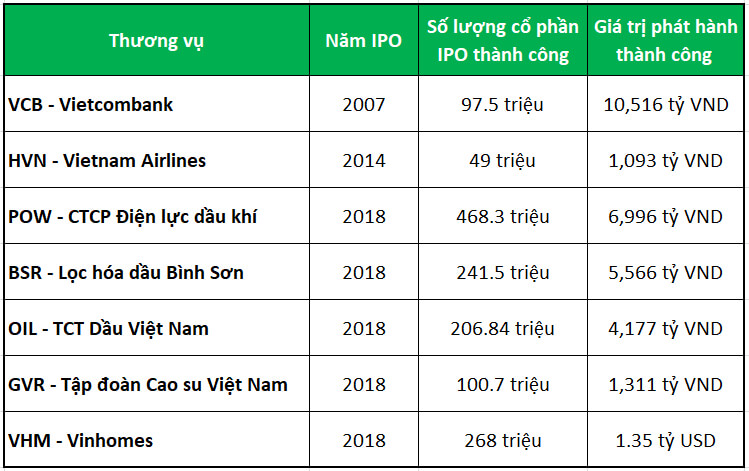
In the next article, we will look at some of the ways companies raise capital after their IPO and listing. These concepts are closely tied to the term “capital-raising game” – very popular in the Vietnamese stock market.
Happy trading !
“Stock Trading For A Living” Course
Green Chart designed this course to build a solid foundation in fundamental analysis & stock valuation (Fundamental Analysis), while showing students how to integrate it effectively into their existing trading system, especially for traders who already use technical analysis (Technical Analysis). The program includes 5 theory sessions and 6 months of hands-on trading guidance in the live market with the instructor.
See full course details here.