

Contents of this article
Personal finance management is a great topic that has filled countless pages, and it is perhaps one of the most essential skills for a young person. If you have inherited a huge fortune, or have a natural talent that earns you hundreds of thousands or even millions of dollars a year, this article is probably not for you. But most of us are ordinary people with ordinary jobs and ordinary incomes, and making sound financial decisions is vital to achieving our life goals.
In this article, I will show you how to build 2 personal financial statements and share my approach to personal finance from the perspective of someone who works in finance, in the simplest and clearest way possible. Some of the terms here are borrowed from companies’ financial statements. Let’s get started.

How to build your personal financial statements
Income and Expense Statement
Somewhat like a company’s income statement, I use a simple Excel sheet to record my monthly sources of income and expenses, including year-to-date totals. Your income may come from your main job, your own business, or returns on your investments such as dividends or profits from business partnerships. Note that gains or losses in the value of your investment assets are not recorded in this statement.
When listing income and expenses, record the actual cash flows that occur in the month, rather than estimated or projected income. Things get much more complicated if you record dividend income in November – when the company you invested in announces the dividend – but you only actually receive the money in December. In that case, the dividend income should be recorded in December’s statement.
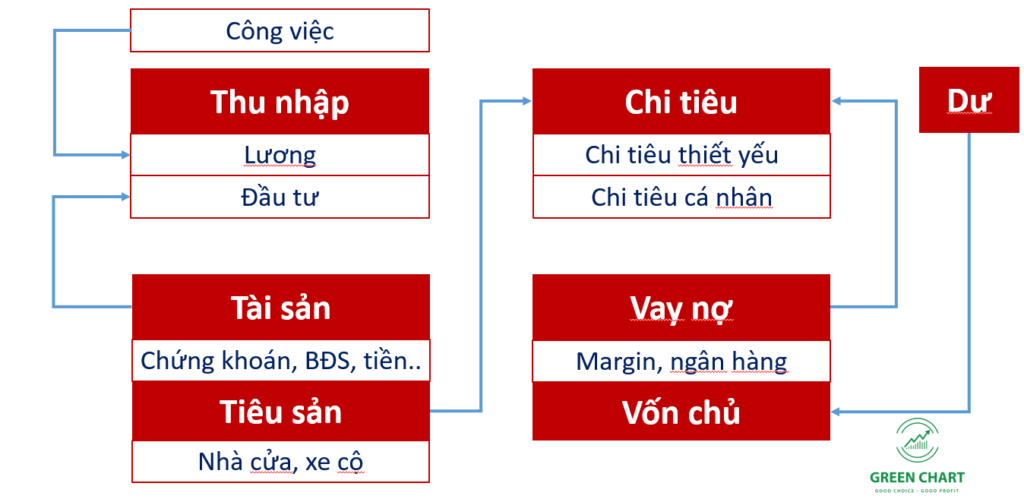
How you see assets and liabilities will also affect how you record a purchase. To me, assets are things that store value and grow in value over the time you hold them, such as stocks and company shares, real estate (the land, not the house), gold, bonds or savings deposits earning an average rate above inflation. Anything that does not fit this description I treat as a liability. You may consider a new car an expensive asset, but to me, unless I someday decide to buy it to drive for Grab, it is a liability, and it goes into my income and expense statement as a large expense depreciated over the next 5–10 years.
Depreciating large items (for example, > VND 100 million) with long useful lives (> 1 year) in installments reduces short-term expenses and makes the income and expense statement look less alarming. The car’s remaining undepreciated value is then listed under Total assets, which I explain in more detail below.
A simple way to keep track of your income and spending is to break down the share of each income source and expense, to see which source is your main income and which expense takes the biggest share of your spending. The next step is to optimize them by maximizing income and minimizing expenses. I will come back to this later in the article. For now, let’s move on to an equally important statement.
Statement of Assets – Your Personal Balance Sheet
Once you have an income and expense statement, the next step is to list the assets you own and the sources of capital behind them.
Under Assets, list everything you own in as much detail as possible: cash, stocks, bonds and savings deposits, gold and US dollars, real estate and so on, at the most recent market prices available. Keeping the figures up to date makes them as reliable as possible.
Under Liabilities and Equity, list your current debts accurately. From there you can work out your Equity – the money you really have – with this formula:
Equity = Total assets – Total liabilities
The higher your equity, the more wealth you have accumulated and the stronger your financial foundation, and vice versa. A note on depreciating the car mentioned above:
Suppose you buy a car worth VND 1 billion and plan to use it for the next 10 years. If the whole VND 1 billion were recorded at once in the income and expense statement, it would create a huge, misleading distortion. So you can choose to depreciate the car gradually over 10 years – after all, it still has use value and could be resold during that time. The usual way to record it is:
- In year one, record VND 100 million as the car expense (spread evenly over 12 months), and the car’s remaining value under Assets is VND 900 million.
- In year two, record another VND 100 million as the car expense (spread evenly over 12 months), and the car’s remaining value under Assets is VND 800 million.
- Continue like this until year 10, when the car is fully depreciated, worn out and in need of replacement.
You will then have to spend money on a new car again, which is why I consider a car a liability – its value declines over time. A house is similar: you will have to rebuild it when it becomes too old to be useful, but the land beneath it does not lose its value.
Analyzing Your Personal Financial Statements
Once you have built your 2 personal financial statements, the next job is to assess and improve them, and with them your personal financial situation.
- Analyze your income: look at each source’s share of your total income. Which source is the largest? Is it stable? Can you find ways to increase it, or find a new source of income?
- Analyze your expenses: look at each expense’s share of your total spending. Which is the largest? Which expenses are fixed and cannot be cut? Which can you reduce to save more (eating out, luxury shopping, and so on)?
- Analyze your debts: use your net income and sell assets to pay off bad debts first (overdue debts that damage your personal reputation and relationships), then other interest-bearing debts from the highest rate to the lowest.
- Analyze your asset portfolio: which asset makes up the largest share of your portfolio? Is your current allocation sensible? (See my article on portfolio optimization.) What share of your portfolio is made up of liabilities (not yet fully depreciated)? On this point, my preferred ratio is usually 20% liabilities to 80% assets.
4 Ways to Improve Your Personal Finances
Clearly, improving your personal financial statements comes down to 4 main things: increasing your income, cutting your expenses, limiting borrowing and building an effective investment portfolio – one that ensures you have enough money to live comfortably in retirement.
Increase Your Sources of Income
Some ideas for growing the income side of your income and expense statement:
- Work hard and put in extra hours to earn a raise.
- Create a second income by starting a business or taking on side work you are good at, such as teaching, making YouTube videos or selling online…
- Start your own company or go into business with others.
- Invest in rental property…
The key to growing your income is scalability, so that the value you provide reaches more people and more customers. For example, you might weigh teaching a small class of 10–15 students against reaching many more students through an online course. A regular salaried job will not solve this, because your abilities and your time are clearly limited.
Cut Your Expenses
On the other side, if growing your income is too hard in the short term, you can cut unnecessary expenses to keep more of your income each month. Some ideas:
- Pay yourself first: set aside savings as soon as you receive your monthly salary.
- Cook at home instead of eating out.
- Make a shopping list before going to the supermarket.
- Don’t buy things the moment you want them; weigh their benefits and value against their cost.
- Cancel unnecessary subscriptions and paid memberships (especially credit and bank cards with fees).
- Use apps to track and record your spending. I use Money Lover to track my monthly spending, and you will be surprised at how much you spent in the first few months.

Limit Borrowing
Borrowing to invest or run a business is perfectly normal, as long as the returns cover the financing costs. But borrowing to spend or to buy liabilities such as cars, clothes or phones will give you negative cash flow over the long term, along with the burden of interest. Be decisive about saving, sell off some of your liabilities and pay off your debts as soon as possible.
Build an Effective Investment Portfolio
As with a business, the ultimate goal of personal financial management is to maximize your net worth by building a portfolio of assets with high return potential.
A portfolio full of low-risk assets such as cash and savings deposits suggests that you play it safe, or simply lack high-return investment ideas. Conversely, a portfolio with too many assets like stocks and cryptocurrencies can leave your equity exposed to high risk.
I wish you every success in managing your personal finances. See you in upcoming articles on building a personal investment portfolio.
Happy trading !
“Stock Trading For A Living” Course
Green Chart designed this course to build a solid foundation in fundamental analysis & stock valuation (Fundamental Analysis), while showing students how to integrate it effectively into their existing trading system, especially for traders who already use technical analysis (Technical Analysis). The program includes 5 theory sessions and 6 months of hands-on trading guidance in the live market with the instructor.
See full course details here.