

Contents of this article

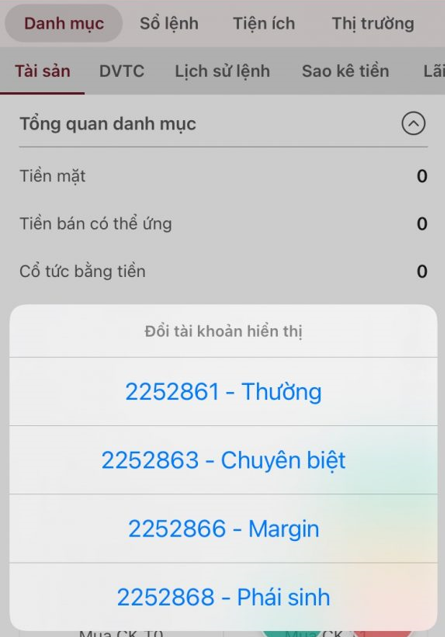
The different sub-accounts of a brokerage account
When opening an account at a brokerage firm, investors are usually asked, “Which types of accounts/sub-accounts would you like to open?”. Many investors wonder what the benefits of opening several sub-accounts are, and whether there is a fee to maintain them. This article answers those questions.
Brokerage firms usually offer three types of sub-account to serve different investors’ needs: the regular (cash) sub-account, the margin sub-account and the derivatives trading sub-account.
The regular sub-account
If you are an investor who values safety, this is the sub-account to use. When trading in this account you buy and sell with your own money. Its drawback is that when you need a cash advance to make a new purchase, you have to request it manually, rather than it happening automatically as in a margin sub-account.
At VPS Securities, the regular account is the sub-account ending in 1. Services available on the account ending in 1 include basic securities trading, bond trading, MM (money market) deposits, payment utilities and more.
The margin sub-account
Investors often increase their buying power by using leverage. Brokerage firms provide a margin account so investors can increase their buying power. It is a popular choice among investors because of its flexibility and trading efficiency. The margin ratio for each stock is set according to rules of the State Securities Commission of Vietnam. When using this account, investors need to watch account-related metrics such as the account margin ratio, buying power, margin interest rate, margin call threshold and force-sell threshold.
At VPS, the margin account is the sub-account ending in 6. Its margin ratio follows the SSC’s range of 30%–50%, with a different ratio for each stock depending on the company’s financial strength.
The account maintenance ratio is calculated with the following formula: (Total portfolio value – margin debt) / Total portfolio value
The margin sub-account is in good standing while the account ratio is above 30%
Margin call when the account ratio is between 25% and 30% (25% < account ratio < 30%)
Force sell (mandatory liquidation) when the account ratio falls below 25%. At this point the brokerage firm has to sell assets to recover the debt.
In addition, some firms, including VPS, offer specialised accounts. For detailed advice, investors should contact the VPS advisory team to understand the product policies.
The derivatives sub-account
Because of the special nature of derivatives, brokerage firms usually keep derivatives trading in a separate sub-account. These sub-accounts are linked to the Vietnam Securities Depository (VSD) for depositing margin and trading derivatives.
At VPS, the sub-account ending in 8 is the derivatives trading sub-account. Investors can deposit money and start trading immediately, because VPS has integrated automatic margin deposits with the VSD. For more on derivatives fees and taxes, see the following article.
Conclusion
Before deciding which account to trade in, investors should study the product policies of different brokerage firms carefully to find the sub-account that suits their trading needs. A regular (non-margin) account is usually the best fit for new investors.
Happy trading!
The “Stock Trading For A Living” course
Green Chart designed this course to give students a solid foundation in fundamental analysis & stock valuation (Fundamental Analysis), and to show them how to integrate it effectively into their existing trading system, especially for traders who already use technical analysis (Technical Analysis). The program consists of 5 theory sessions and 6 months of hands-on guided trading in the live market with the lecturer.
See full details of the course here.