

Contents of this article
- What is fundamental analysis?
- The fundamentals that make a good company – and a good stock
- Qualitative factors
- Quantitative factors
- What do you need to learn for fundamental analysis?
- The mindset of a fundamental analyst
- Be clear about your goals
- I’m already good at technical analysis. Do I still need to learn fundamental analysis?
- The “Stock Trading For A Living” course

What is fundamental analysis?
According to Wikipedia, fundamental analysis of stocks involves analysing a company’s financial statements and financial health, its management and competitive advantages, its competitors and the markets in which it operates. The aim of fundamental analysis is to value a company’s stock and predict how its price is likely to develop.
Fundamental analysis refers to the method of analysing economic and financial factors in the market to measure the intrinsic value of a security. Fundamental analysts believe that any macroeconomic factor, such as the state of the economy, inflation, or any fiscal or monetary policy implemented by the government, can affect the value of stocks in the stock market.
Fundamental analysis is usually carried out from the macro level first (top-down analysis), where the analyst examines the policy drivers of the government and the central bank and their impact on the state of the economy. Analysts then move down to the micro level, focusing on the growth of a specific industry and examining company-specific factors such as the make-up of the management team, the business model, the financial position and so on.
Finally, the fundamental analyst concludes by working out whether the stock is currently overvalued or undervalued relative to its current market price, and makes investment decisions accordingly.
Fundamental analysis is an effective way to study a business and its stock. When an investor wants to invest in a business for the long term (say 3–5 years), it is essential to understand the business from many different angles. It is important for an investor to filter out the short-term noise of daily share price swings and focus on the underlying business performance. The share price of a fundamentally sound company tends to rise over the long term, in line with the value the company creates for shareholders through its business.
In the Vietnamese market, you are probably familiar with VNM, HPG, FPT, REE, BMP, VCS and similar names: top companies whose businesses have grown steadily at more than 20% a year for many years. To put it in perspective, recall the compound interest example from our previous article: at a compound annual growth rate (CAGR) of 20%, you can double your investment in about 3.5 years!
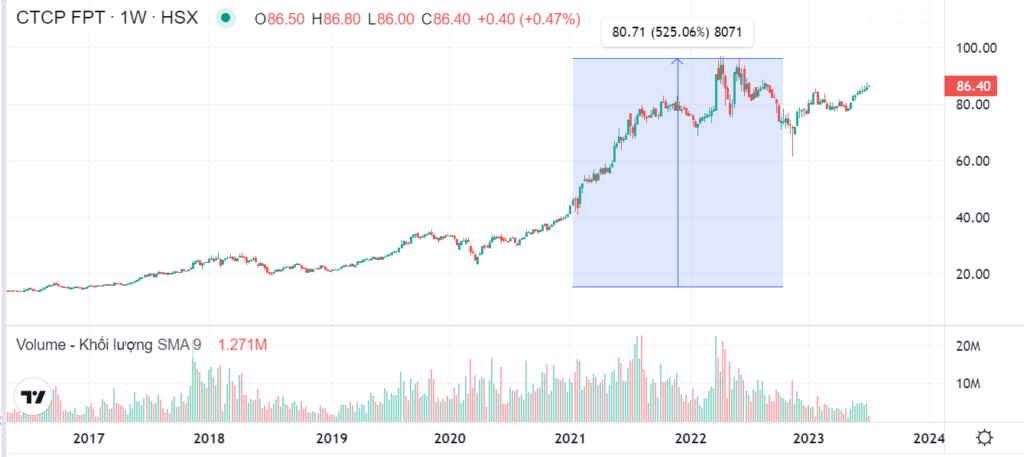
Of course, on the flip side, things can go very badly if you pick companies with weak business results.
Great companies share certain attributes that set them apart from weak ones, and fundamental analysis can help you identify them. In short, a fundamental analyst sees owning a stock as owning part of a business, and cares about the business’s performance and what they expect to receive from it. Business performance is an outcome that is reflected in many factors, such as the nature of the industry, the business model, competitive advantage, management, financial position and so on. Understanding and assessing these factors is a prerequisite for successful trading and investing. Please don’t worry that there is too much to learn: we are here to help, and we will take it one step at a time.
The fundamentals that make a good company – and a good stock
A good company – and a good investment – usually has certain characteristics that set it apart from the rest. These can be grouped into 2 categories: qualitative and quantitative. Assessing whether a company has sound fundamentals means studying both. Personally, I tend to give qualitative aspects slightly more weight than quantitative ones when selecting stocks.
Qualitative factors
Identifying these factors is mainly about understanding the non-financial aspects of the business, most of which relate to governance, such as:
- Management: who they are, their background, experience and education. The most practical approach is to listen to the promises and business plans they set out at the annual general meeting (AGM), then check them against what actually happened over the past 5–10 years.
- Business ethics – has the company been involved in price manipulation, environmental damage or unfair business practices? There are plenty of examples of this in the press.
- Corporate governance – is the company’s organisational structure appropriate? How transparent is the appointment of management?
- Major shareholders – who are the major shareholders (holding more than 5% of the shares), and what role do they play in the company’s business?
- Minority shareholders – how does management treat minority shareholders, and does it consider their interests when taking corporate actions? A typical example is management carrying out an ESOP or a large private placement of cheap shares to raise capital, at the expense of small shareholders.
- Insiders – do insiders or related persons regularly “buy at the bottom and sell at the top”?
- Management compensation – does management pay itself salaries and bonuses that are excessive as a percentage of the company’s annual profit?
- Related-party transactions – does the company have many unusual transactions with related parties that harm shareholders’ interests?

I usually choose not to invest in a company with too many governance problems, even if it has large revenue and profits. For example, if Company A has many murky transactions with related parties, such as buying input materials from Company B – a private company owned by Company A’s CEO – at prices abnormally above market, that is a sign of dishonesty and grounds for exclusion. You can never be sure you are always right, but at least you can rule out the cases with a high probability of risk.
Qualitative aspects are not easy to uncover because they are very sensitive matters. Still, a diligent investor can pick up on them by paying attention to annual reports, management interviews, company news and so on.
Quantitative factors
These relate to financial figures: dry, but very concrete. Some of the items below are simple, while others are not. For example, the cash on the balance sheet can be seen at a glance, but “inventory turnover” requires some calculation. Below is a list of some key figures; we will go into each of them in later articles.
- Revenue and profit growth rates.
- Profit margins and profitability.
- Cost-related ratios.
- Operating efficiency ratios.
- Dividend policy.
- The company’s cash flow metrics.
- Debt and financial leverage metrics.
- How well the company manages its working capital.
- Growth in assets and shareholders’ equity.
- Financial investments.
- Tax-related matters.
In the following articles, we will learn how to read and understand financial statements and annual reports, which provide all the figures needed to calculate and study a company’s qualitative and quantitative aspects.
What do you need to learn for fundamental analysis?
A common misconception is that only people who work in finance, or who have a finance or business background, can become good fundamental analysts. That is not true if you are willing to put in the effort and dig deep. That said, to become a fundamental analyst you will need some basic skills:
- An understanding of financial statements and how to analyse financial ratios, including key metrics such as profit margins, working capital, cash flow, ROA, ROE, etc.
- An understanding of macro and industry analysis: being able to assess how the macroeconomic backdrop affects the outlook for different sectors, the industry value chain, and the competitive landscape among companies in the industry. This analysis helps you grasp the specific characteristics of each sector and each company’s business model, and pick the best companies in a fast-growing industry.
- A view on what a stock is worth through valuation methods such as P/E, P/B, discounted cash flow, the dividend discount model, etc.
The mindset of a fundamental analyst
Be clear about your goals
You can choose to be a trader or an investor, as long as it suits your personality and the time you have available. There is no clear line between trading and investing, but in my view the biggest differences are how long you hold a stock and how much weight each analytical method carries in your buy/sell decisions. The longer you hold a position, the more you lean towards investing, and the more weight fundamental analysis carries in your decisions. Traders, on the other hand, tend to hold stocks for shorter periods, and technical analysis carries more weight in their decisions.
Understand compound interest
Compound interest in the stock market is one of the most important concepts to grasp before you trade or invest. Suppose you make an initial investment of VND 100 million with a compound annual growth rate of 20% (a CAGR of 20%). By the end of year one, the amount is expected to grow to VND 120 million. You then have two choices: leave the full VND 120 million reinvested, or withdraw the VND 20 million of profit. If you choose the first, you will have VND 144 million by the end of year two, then VND 173 million by the end of year three,...
Compare that with withdrawing VND 20 million of profit each year: by the end of year three, your total profit would be only VND 60 million. Clearly, reinvesting both principal and profit produced a profit of VND 73 million after 3 years, 21.7% more. This is known as the compounding effect, and the chart below shows its power more clearly:
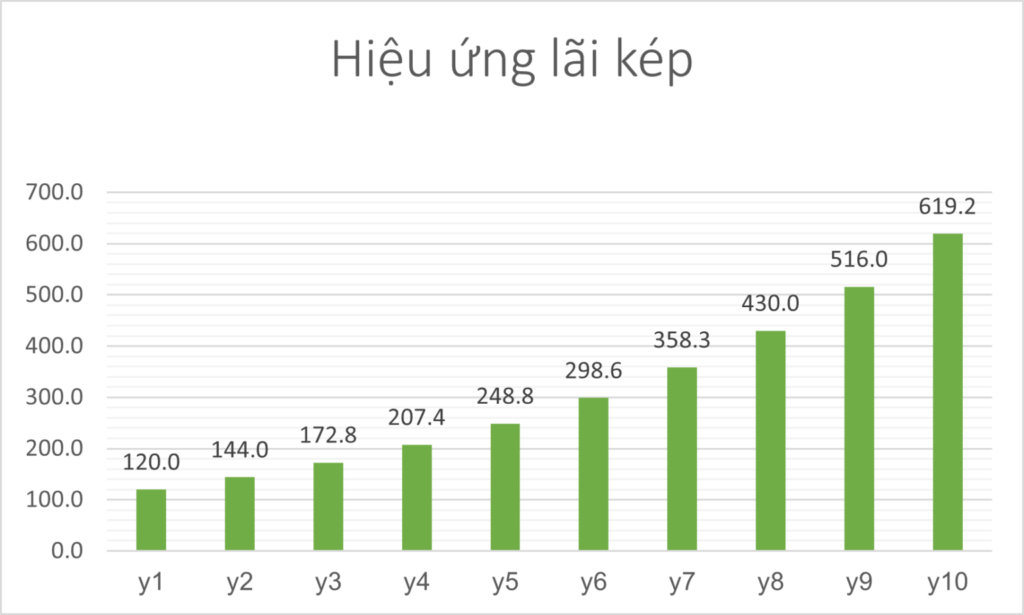
The chart above shows how an initial VND 100 million invested at 20% grows over 10 years. If you look closely, it takes almost 6 years for the money to grow from VND 100 million to VND 300 million. However, the next VND 200 million is generated in just 3 years, less than half the time, from year 6 to year 9 (rather like the concept of acceleration in physics).
The simple rule is this: the longer you invest at a moderate but steady rate of return, the more money you make over the long run. Expecting to double, triple or even 10x your capital in a short time is wishful thinking. A fundamental analyst needs to understand how important time and compounding are to their investments.
I’m already good at technical analysis. Do I still need to learn fundamental analysis?
Technical analysis (TA) can help you make quick short-term profits by timing your entries into and exits from the market better. However, relying on technical analysis alone is not an effective way to find good investment and trading opportunities. Consistent profits come only from intelligently sustaining investment performance over the long term, and for that, technical analysis and fundamental analysis must coexist and complement each other in your strategy.
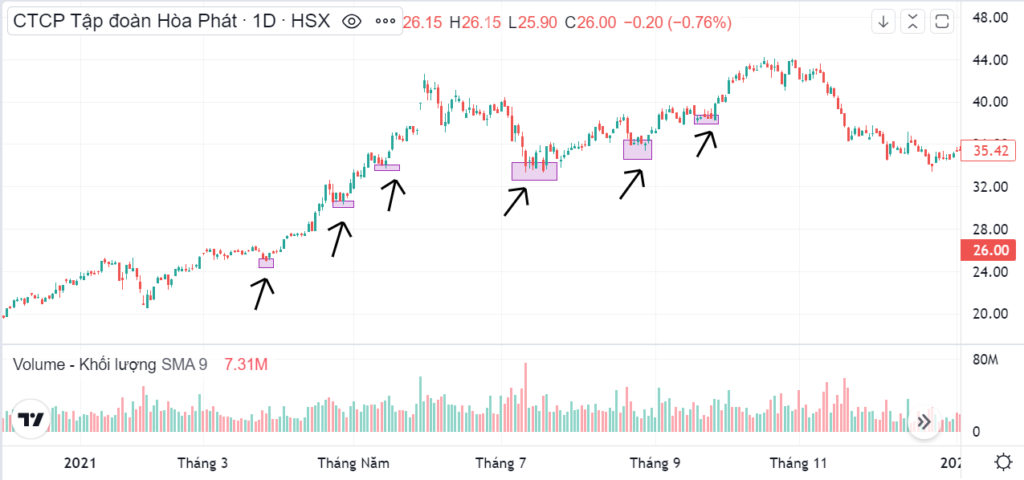
Take HPG’s rally in 2021 as an example, when the company benefited from rising steel demand and the expansion of its production capacity through the Dung Quat project. It would be ideal to spot a shift in the fundamentals and, at the same time, optimise your returns by adding to your long position on the stock’s pullbacks (in yellow), using technical analysis.
One final point: if you want to become a good fundamental analyst, be diligent and patient.
Happy trading!
The “Stock Trading For A Living” course
Green Chart designed this course to give students a solid foundation in fundamental analysis & stock valuation (Fundamental Analysis), and to show them how to integrate it effectively into their existing trading system, especially for traders who already use technical analysis (Technical Analysis). The program consists of 5 theory sessions and 6 months of hands-on guided trading in the live market with the lecturer.
See full details of the course here.